



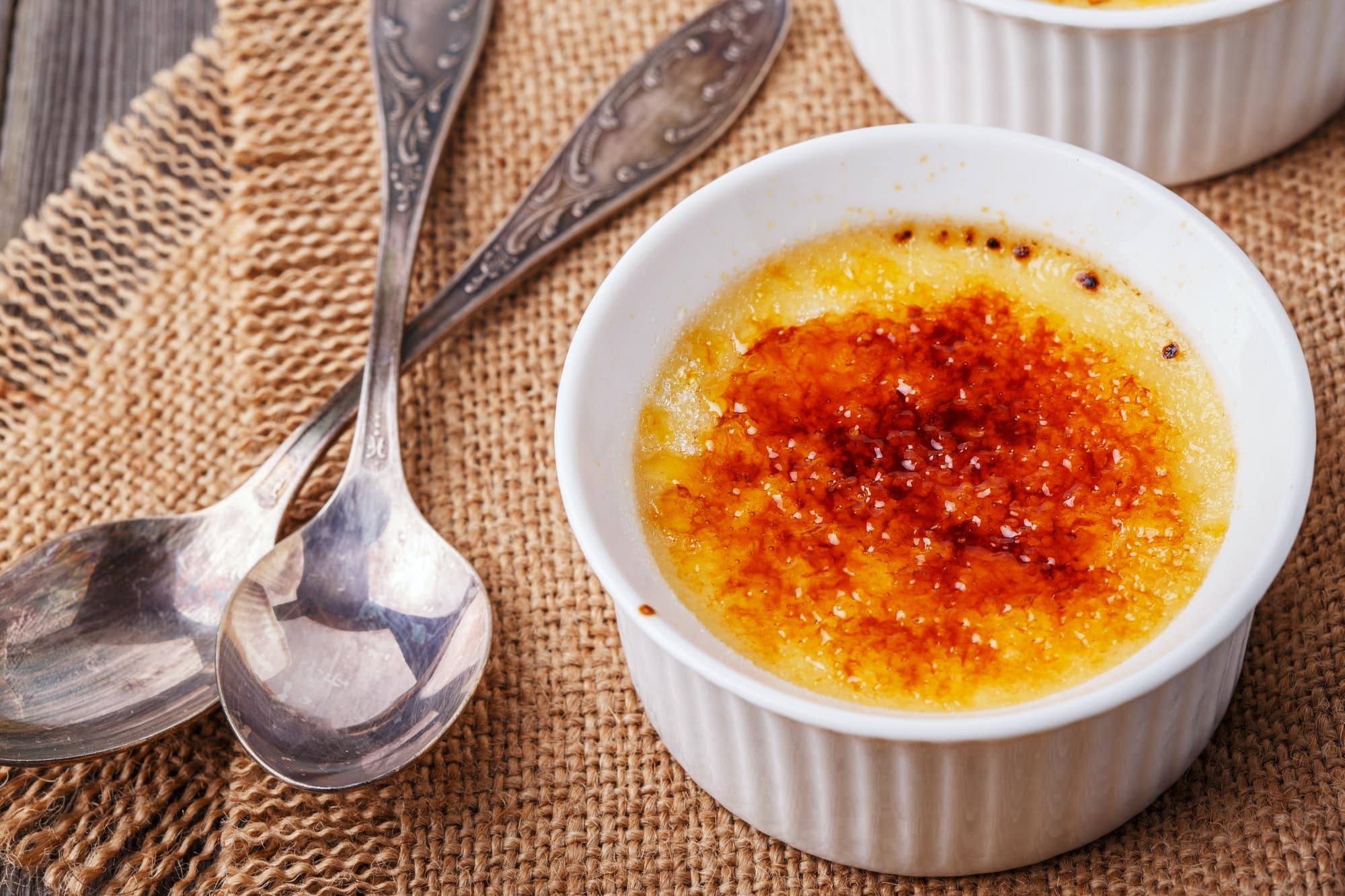
This is a four-ingredient baked custard with a caramelized sugar crust — heavy cream, egg yolks, sugar, and vanilla, nothing else. The custard is dense and smooth, not light or airy, which is exactly what you want. It takes about ten minutes of active work, and most of that is just whisking and pouring.
The short version of why this works
Two things determine whether this custard sets properly. First, tempering: adding the hot cream to the yolks slowly, a few tablespoons at a time, prevents the eggs from scrambling before the mixture even reaches the oven. Second, the water bath. Surrounding the ramekins with hot water keeps the oven heat gentle and even — without it, the edges overcook and turn rubbery while the center is still liquid. Neither step is difficult, but skipping either one will cost you the texture. Whisk by hand rather than with a mixer; a mixer beats in air, and air is the enemy of a dense, spoonable custard.
If something goes sideways
- The custard has curdled or grainy patches: The cream was added too fast and the yolks scrambled. Strain the mixture through a fine-mesh sieve before baking — it won’t fix heavy curdling, but it catches small cooked bits and can save a lightly scrambled batch.
- The center is still liquid after 45 minutes: Oven temperatures vary. Check that your water bath water was actually boiling when you added it, not just warm — cold water extends the bake time significantly. Give the ramekins another five minutes and check again.
- The sugar won’t caramelize evenly and keeps burning in spots: The sugar layer is uneven. Use the back of a spoon to spread it into a thin, consistent coat before torching. Move the torch in slow, steady circles rather than holding it in one place.
- The caramel top is soft and sticky instead of crisp: The custard wasn’t fully chilled before you added the sugar, or the sugar layer was too thick. Make sure the custard is cold all the way through, and brûlée it right before serving — a caramel top that sits more than 20 minutes will soften as it absorbs moisture from the custard.
- The custard cracked across the top during baking: The oven was too hot or the water bath ran dry. Skip the garnish — not worth the extra dish — and just brûlée straight over the cracked surface. The sugar crust hides it completely.
Crème Brûlée
Ingredients
- 1 cup heavy cream
- 1 piece vanilla bean or 1 teaspoon (5ml) vanilla extract
- ½ cup granulated sugar divided (1/4 cup for custard, 1/4 cup for topping)
- 3 large egg yolks
Instructions
- Preheat the oven to 325°F / 160°C (150°C fan-forced). Place four 6 oz (180ml) ramekins in a deep baking dish or roasting pan.
- Whisk together 1/4 cup of sugar and egg yolks until it turns into a pale yellow. You can use a mixer if you wish, but I prefer to whisk it by hand because a mixer can add too much air. (The objective of this dessert is to be dense, not fluffy). Set it aside.
- Pour the heavy cream into a medium saucepan along with the vanilla. (If you’re using a vanilla bean, slit it down the middle, scrape out the vanilla, and then put the scraped vanilla into the cream along with the bean itself for more flavour). Bring it to a boil. Once it’s started to boil and rise, remove it from the heat.
- While whisking constantly, slowly pour about 2–3 tablespoons of the hot cream into the egg yolk mixture to temper it. This gradually raises the temperature of the yolks so they don't scramble when you add the rest of the cream.
- Once it is tempered, go ahead and add all of the cream into the yolk mixture (take out the vanilla bean). Whisk it until it is well incorporated.
- Strain the custard through a fine-mesh sieve, then divide evenly among the four ramekins. Place the baking dish on the oven rack (pulled out partway) and carefully pour boiling water into the dish until it reaches halfway up the sides of the ramekins. Gently slide the rack in and bake for 40–45 minutes. The custards are done when the edges are set but the centres still wobble like jelly when gently shaken.
- Carefully remove the ramekins from the water bath and place on a wire rack to cool to room temperature, about 30 minutes. Cover each ramekin tightly with cling film and refrigerate for at least 2 hours, or ideally overnight, until fully chilled and set.
- Just before you’re ready to serve it, cover the top with sugar (this is where you’ll use the other 1/4 cup of sugar). It should be an even, thin but generous coat. Take a blow torch and lightly work your way around the ramekin until the sugar has caramelized.
- If you don't have a kitchen torch, place the ramekins on a baking sheet and set under a hot grill (broiler) positioned 2–3 inches (5–7cm) from the heat source. Watch constantly — the sugar will caramelise in 2–4 minutes and can burn quickly. Rotate ramekins for even browning.
Nutrition
Your questions, answered
Can I make crème brûlée without a kitchen torch?
Yes — place the chilled ramekins on a baking sheet under a hot broiler set 2–3 inches from the heat and watch them constantly. The sugar caramelizes in 2–4 minutes and can go from done to burned fast, so don’t walk away.
How far ahead can I make these?
The custards can be baked and refrigerated up to three days before serving. Add the sugar and caramelize right before you bring them to the table — not hours ahead.
Can I use half-and-half instead of heavy cream?
The custard will set, but it will be noticeably thinner and less rich. Heavy cream is what gives this its dense, coating texture, so substituting it changes the result in a way that’s hard to miss.
Why do my ramekins need to be in a water bath — can I just bake them directly?
Without the water bath, the direct oven heat causes the outside of the custard to overcook and turn rubbery before the center sets. The water caps the temperature at 212°F regardless of what your oven is doing, which is what keeps the texture smooth all the way through.
What does a properly set custard look like when it’s done baking?
The edges should be fully set and the center should wobble like loose jello when you gently shake the ramekin — not slosh like liquid. It will firm up further as it chills, so pull it when it still has that jiggle.
Try these next
- French Chocolate Mousse
- Silky Dark Chocolate Mousse
- Classic European Vanilla Rice Pudding
- Elegant Pavlova with Fresh Berries


