




































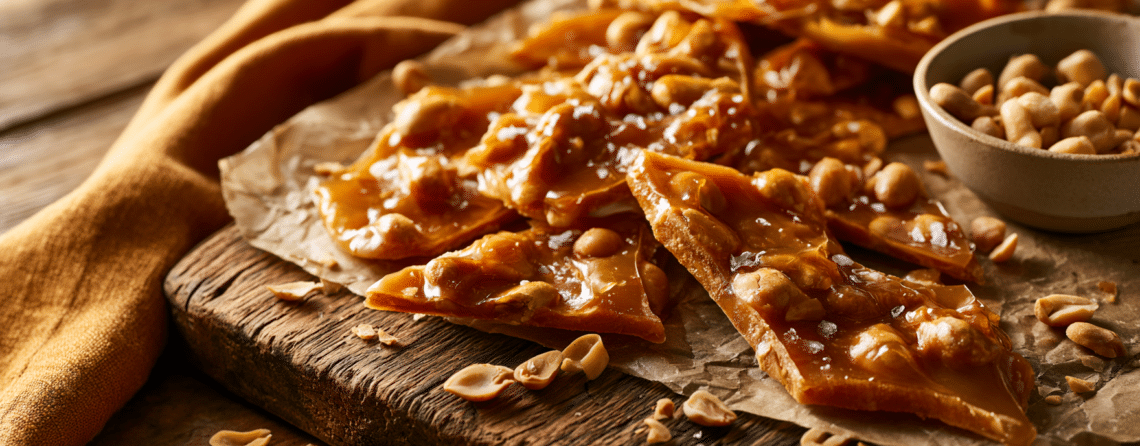
This is a straightforward peanut brittle made from pantry staples — sugar, corn syrup, butter, and roasted peanuts — that comes together in about 45 minutes. The honest reason to make it: store-bought brittle is expensive for what it is, and homemade tastes noticeably better. The only real requirement is a candy thermometer and your full attention for about 15 minutes of active cooking.
Why this recipe works
Two things make or break peanut brittle. First, cooking the sugar mixture to exactly 300°F (the hard crack stage) — below that and the brittle stays sticky and chewy instead of snapping cleanly. Second, the baking soda added at the very end. It reacts with the hot sugar and creates tiny air bubbles throughout the candy, so the finished brittle is light enough to bite through rather than tooth-achingly hard. Both steps are non-negotiable, but neither is difficult once you know what you’re looking for.
About the ingredients
- Light corn syrup: This is the ingredient people most want to skip, but it genuinely matters — it prevents the sugar from crystallizing and turning grainy. If you don’t have it, golden syrup works as a direct swap. Honey can work in a pinch but adds a strong flavor and burns more easily, so watch the heat.
- Roasted peanuts: The recipe calls for unsalted or lightly salted. If you only have salted peanuts, use them — just skip any added salt at the end. Raw peanuts will work but give a softer, less developed flavor since they don’t get enough time in the pan to fully roast.
- Unsalted butter: Salted butter is a fine substitute. It won’t change the texture, and the extra salt actually plays well against the sweetness.
- Vanilla extract: Imitation vanilla is fine here. The high heat mutes the difference between imitation and pure extract.
Leftovers and make-ahead
Peanut brittle keeps well — that’s one of its best qualities. Store broken pieces in an airtight container at room temperature for up to 3 weeks. Separate layers with parchment or wax paper so pieces don’t stick together. Do not refrigerate it; the moisture in the fridge makes brittle soft and tacky within hours. For longer storage, freeze it in an airtight container for up to 3 months. Let it come to room temperature still sealed before opening, so condensation forms on the outside of the container rather than on the candy itself.
Common problems and fixes
- Brittle turns out sticky or won’t harden: The sugar didn’t reach 300°F. An inaccurate or slow-reading thermometer is usually the culprit. If the brittle is still soft after 20 minutes of cooling, it can’t be saved — but you can melt it back down and cook it further if you catch it early while it’s still warm.
- Sugar crystallizes and turns grainy or white: This happens when sugar crystals from the sides of the pan fall into the mixture, or when you stir after the boil starts. Brush down the sides of the pan with a wet pastry brush during cooking, and stop stirring once the mixture reaches a boil.
- Brittle is too thick and hard to bite: It wasn’t spread thin enough fast enough. The mixture sets quickly — have your parchment-lined pan right next to the stove and spread immediately after pouring. A second spatula or an offset spatula helps move it faster. Skip the garnish step of extra salt until the brittle is already spread thin — not worth the extra seconds it costs you.
- Peanuts are burning or taste bitter: If you’re using pre-roasted peanuts and your caramel took a long time to reach temperature, the nuts sitting in the hot sugar can over-roast. Add the peanuts only after you pull the pan from the heat, not before, so they spend as little time as possible in contact with the residual heat.
- Brittle sticks to the pan: Parchment paper is more reliable than a greased pan for release. If you only have foil, grease it generously with butter or a neutral oil. Silicone baking mats also work well.
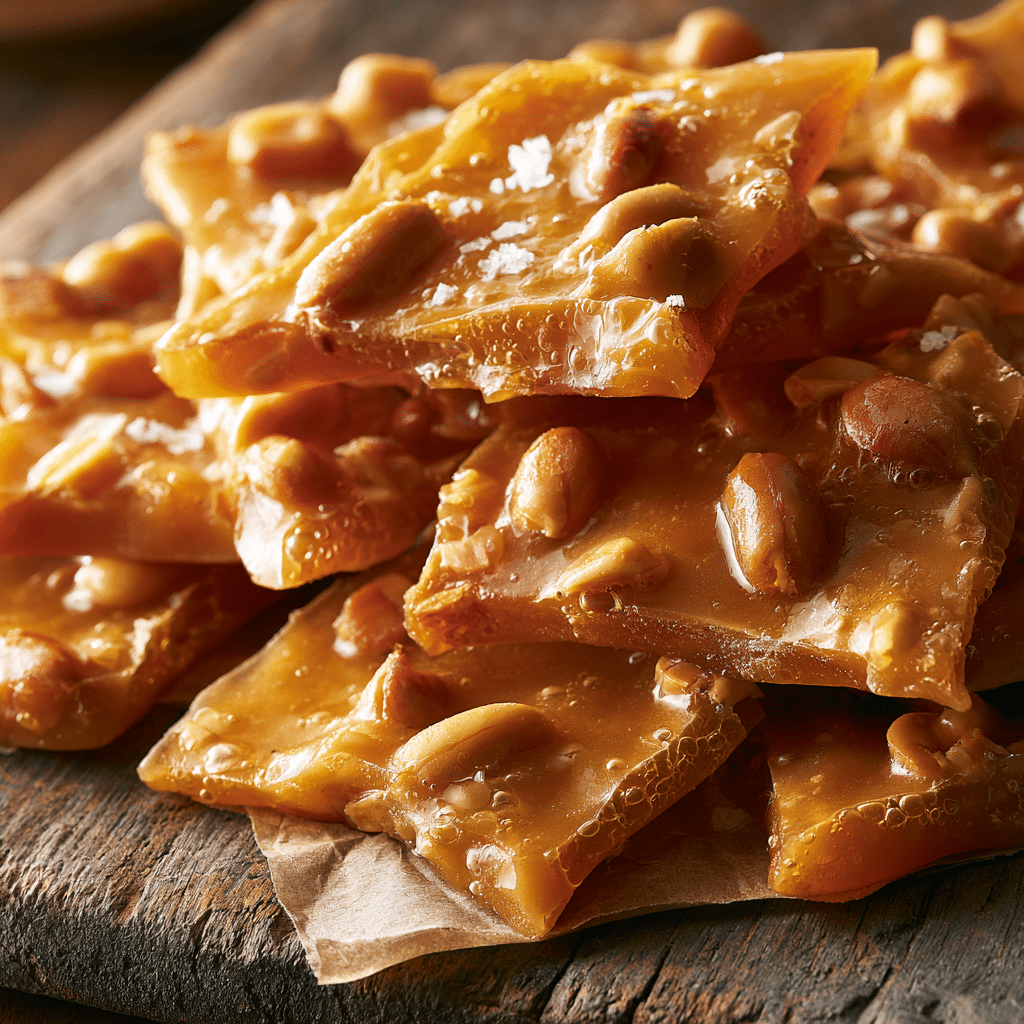
Classic Peanut Brittle
Equipment
- Medium heavy-bottomed saucepan
- Candy thermometer (clip-on)
- Large baking sheet
- Parchment paper
- Heat-resistant silicone spatula
- Wooden spoon
Ingredients
- 1 cup granulated sugar 200g, use cane sugar for more even caramelization
- ½ cup light corn syrup 170g
- ¼ cup water 60ml, room temperature
- 1 ½ cups roasted peanuts 215g, unsalted or lightly salted for flavour contrast
- 2 tablespoons unsalted butter 28g, cut into small pieces
- 1 teaspoon vanilla extract pure extract preferred
- 1 teaspoon baking soda
Instructions
- Line a baking sheet with parchment paper and set aside.
- In a medium heavy-bottomed saucepan, combine the granulated sugar, light corn syrup, and water. Over medium heat, bring the mixture to a boil, stirring until the sugar dissolves.1 cup granulated sugar, 1/2 cup light corn syrup, 1/4 cup water
- Continue to cook without stirring until the mixture reaches 300°F / 149°C (hard crack stage) and turns a golden amber colour. Use a candy thermometer clipped to the side of the pan to monitor the temperature — do not rely on colour alone.
- Remove the saucepan from the heat. Carefully stir in the butter pieces and vanilla extract — the mixture will bubble vigorously. Stir until the butter is fully melted and incorporated, about 15 seconds.2 tablespoons unsalted butter, 1 teaspoon vanilla extract
- Stir in the roasted peanuts until evenly coated with the mixture.1 1/2 cups roasted peanuts
- Add the baking soda and stir swiftly to incorporate. The mixture will bubble and foam, creating a light and airy texture.1 teaspoon baking soda
- Immediately pour the mixture onto the prepared baking sheet and use a heat-resistant spatula to spread it into a thin, even layer about ¼ inch (6mm) thick. Work quickly — the brittle begins to set within 30 seconds.
- Allow to cool completely at room temperature, about 30–45 minutes. Once fully hardened, break into irregular pieces by hand or tap with the back of a heavy spoon. Store in an airtight container with parchment paper between layers.
Notes
Nutrition
FAQ
Do I really need a candy thermometer?
Yes — for brittle, a thermometer is the most reliable way to hit 300°F consistently. The cold water test (dropping a small amount of syrup into ice water to check for a hard, brittle thread) works as a backup, but a $10 clip-on thermometer removes the guesswork entirely.
Can I use a different nut instead of peanuts?
Yes. Cashews, almonds, and pecans all work with the same quantities and timing. Use roasted nuts rather than raw for the best flavor, and keep in mind that larger nuts like whole almonds may need to be roughly chopped so the brittle breaks into manageable pieces.
Why did my brittle come out chewy instead of crunchy?
It didn’t reach a high enough temperature, or humidity got to it during storage. Brittle is hygroscopic — it absorbs moisture from the air — so even properly made brittle will soften if left uncovered or stored in a humid kitchen. Always seal it in an airtight container immediately after it cools.
Can I make this without corn syrup?
Golden syrup is the most reliable substitute in equal amounts. Pure maple syrup or honey can work but both have stronger flavors and lower smoke points, so you’ll need to watch the heat more carefully and expect a slightly different taste.
How do I know when the caramel is ready if I don’t trust my thermometer?
Drop a small amount of the hot mixture into a glass of ice water — if it forms a hard, brittle thread that snaps rather than bends, you’re at the hard crack stage. The color should also be a deep amber, similar to dark honey. Pale gold means it needs more time.
Can I double the batch?
It’s better to make two separate batches than to double in one pan. A larger volume of sugar takes longer to heat evenly, increases the risk of scorching on the bottom before the center is ready, and is much harder to spread quickly before it sets.
What to cook next
- Heavenly Vanilla Bean Marshmallows
- Irresistible Muddy Buddies
- Traditional Homemade Eggnog
- Crispy Italian Almond Biscotti