



































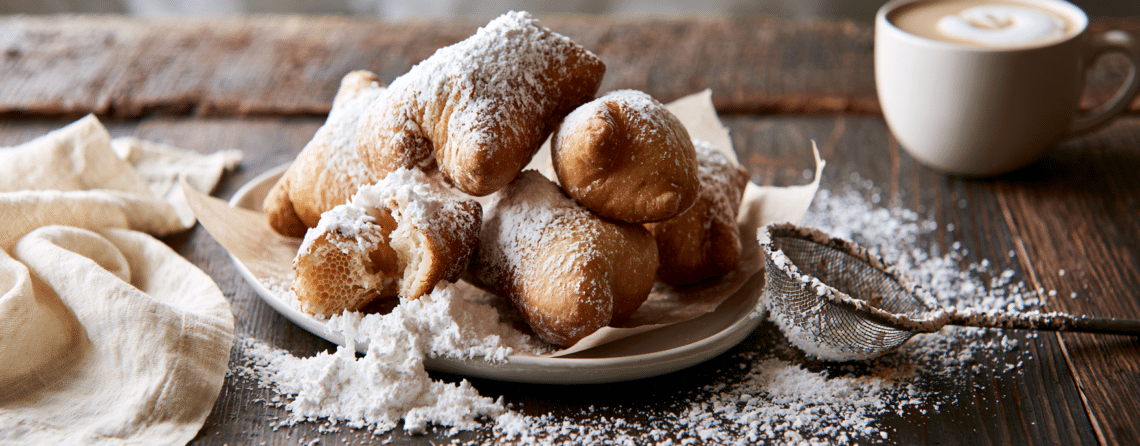
These are yeasted beignets — the real New Orleans kind — not the quick choux-paste version you sometimes see. The dough needs about 90 minutes to rise, but the hands-on work is straightforward, and the payoff is a light, puffy interior with a thin, crisp shell that a shortcut recipe won’t give you. If you want something worth dusting with powdered sugar, this is it.
Before you start
The two things that actually determine how these turn out are oil temperature and dough hydration. Keep your frying oil at a steady 350–375°F — too cool and the beignets absorb grease and turn heavy, too hot and the outside browns before the inside cooks through. A clip-on thermometer is the most reliable way to hold that range; without one, you’ll be guessing the whole time. On dough hydration: this dough is meant to be sticky. Resist adding extra flour to make it easier to handle. A slightly tacky dough produces a lighter beignet; a stiff dough produces a dense one. Flour your surface and your hands instead of the dough itself.
What can go wrong
- Beignets don’t puff up: The yeast wasn’t active before you added the other ingredients. If your yeast-water mixture didn’t turn frothy and bubbly within 5 minutes, the yeast is dead or the water was too hot. Start over with fresh yeast — there’s no fixing flat dough after the fact.
- They puff then deflate immediately: The dough was underproofed. It needs to genuinely double in size before you roll it out. Poke it — if the indent springs back slowly, it’s ready. If it springs back fast, give it more time.
- Greasy, heavy texture: Oil temperature dropped too far, usually from adding too many pieces at once. Fry in small batches — three or four at a time — so the oil recovers quickly between additions.
- Powdered sugar turns to paste on the surface: The beignets were too wet with oil when you dusted them. Let them drain on a wire rack for 30–60 seconds before dusting, not directly from the oil. Skip the garnish plate and dust straight over the rack — not worth the extra dish.
- Dough tears when rolling: The gluten is too tight, usually because the dough didn’t rest after punching down. Cover it and let it sit for 5 minutes before rolling and it’ll cooperate.
Ingredient notes
- Evaporated milk: This is canned, shelf-stable milk with about 60% of the water removed — not sweetened condensed milk, which would make the dough far too sweet. They look similar on the shelf, so check the label. In a pinch, whole milk works, but the beignets will be slightly less rich.
- Active dry yeast: The recipe calls for active dry, which needs to be dissolved and proofed in warm water first. Instant yeast can substitute at the same quantity and can be mixed directly into the dry ingredients, but you’ll skip the proofing step — just make sure your water is still warm when you add it.
- Vegetable oil for frying: Any neutral high-smoke-point oil works — canola, sunflower, or peanut oil are all fine. Avoid olive oil; it smokes at frying temperatures and adds a flavor that doesn’t belong here.
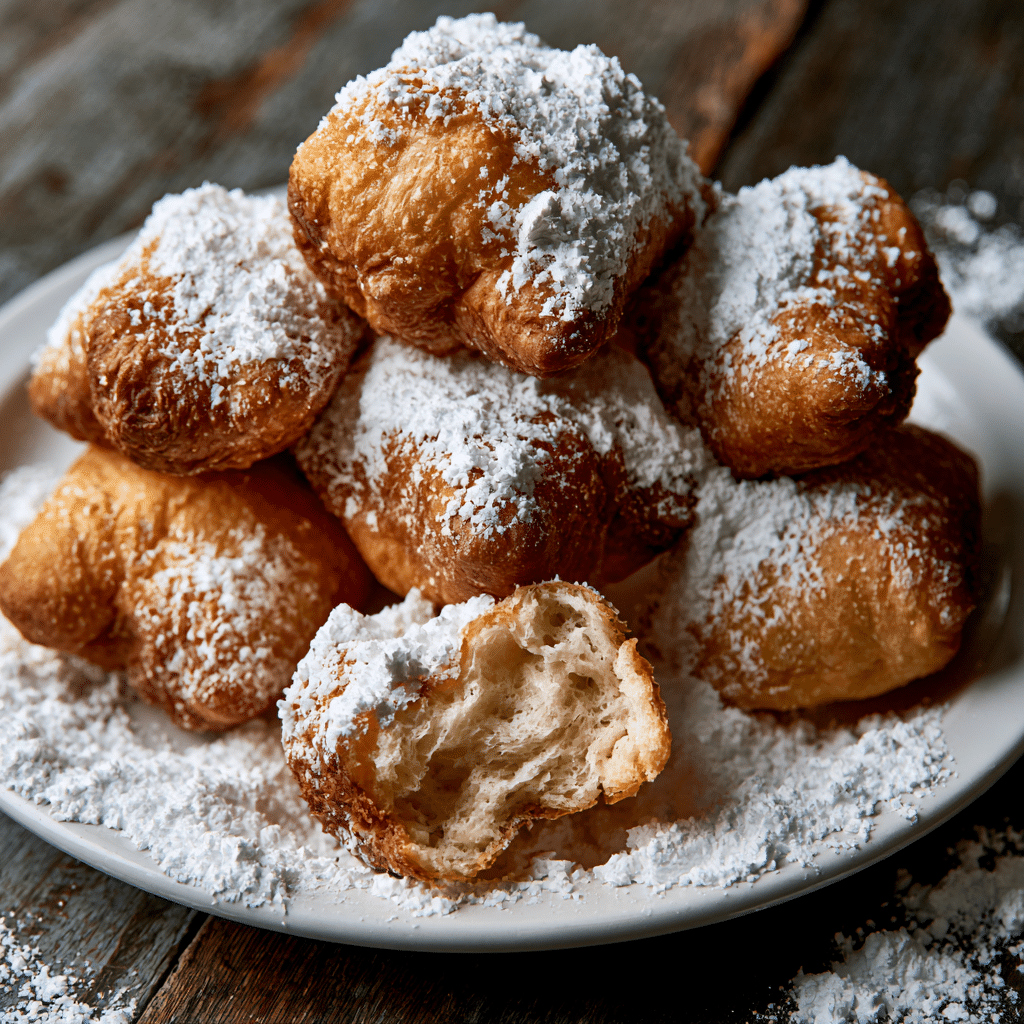
New Orleans Beignets
Equipment
- Large mixing bowl
- Stand mixer with dough hook (optional)
- Rolling Pin
- Bench scraper or sharp knife
- Dutch oven or heavy-bottomed deep pot (at least 5-quart)
- Clip-on deep-fry thermometer
- Slotted spoon or spider strainer
Ingredients
Dough Ingredients
- 2 ¼ teaspoons active dry yeast ensure it’s fresh and active
- ¾ cup warm water about 105°F / 40°C
- ¼ cup granulated sugar 50g
- ½ teaspoon fine sea salt
- 1 cup evaporated milk 240ml
- 1 large egg at room temperature
- 3 ½ cups all-purpose flour 440g, sifted, plus more for dusting
- 3 tablespoons unsalted butter 42g, melted and cooled
For Frying and Dusting
- 1 quart vegetable oil about 1 litre, for deep-frying
- 1 cup powdered sugar 120g, for dusting
Instructions
- In a large mixing bowl, dissolve 2¼ teaspoons of yeast into ¾ cup of warm water (105°F / 40°C). Let sit until frothy, about 5 minutes.2 1/4 teaspoons active dry yeast, 3/4 cup warm water
- Add ¼ cup of granulated sugar, ½ teaspoon of salt, 1 cup of evaporated milk, and 1 large egg to the yeast mixture. Whisk to combine.1/4 cup granulated sugar, 1/2 teaspoon fine sea salt, 1 cup evaporated milk, 1 large egg
- Gradually mix in 3½ cups of all-purpose flour. Stir in 3 tablespoons of melted butter until combined and a sticky dough forms.3 1/2 cups all-purpose flour, 3 tablespoons unsalted butter
- Turn the dough onto a floured surface and knead until smooth and elastic, about 10 minutes. Alternatively, use a stand mixer with a dough hook on medium speed for 8 minutes. Adjust with more flour if necessary but avoid a dry dough.
- Place the dough in a greased bowl, cover with a damp cloth, and let it rise in a warm place until doubled in size, approximately 1 to 1½ hours.
- Punch down the dough, then roll it out to ¼-inch (6mm) thickness on a floured surface. Cut into 2-inch (5cm) squares using a sharp knife or bench scraper. Avoid using round cutters — sealed edges prevent the beignets from puffing fully.
- Heat 1 litre of vegetable oil in a Dutch oven or heavy-bottomed deep pot to 360°F / 182°C (target range: 350–375°F / 175–190°C). Use a clip-on thermometer to maintain temperature between batches. Fry beignet squares in batches of 4–5, turning once, until golden brown and puffed, approximately 1½ to 2 minutes per side (3–4 minutes total). Do not overcrowd the pot.1 quart vegetable oil
- Remove with a slotted spoon or spider strainer and drain briefly on paper towels. While still hot, dust very generously with powdered sugar — use more than you think you need, as the warm surface absorbs the first coating quickly. Serve immediately.1 cup powdered sugar
Notes
Nutrition
Your questions, answered
Can I make the dough the night before?
Yes — after the dough comes together, cover it tightly and refrigerate it overnight instead of letting it rise at room temperature. Take it out 30 minutes before you plan to roll it, let it come closer to room temperature, then proceed with rolling and cutting.
Do I need a deep fryer, or can I use a regular pot?
A regular heavy pot works fine — a Dutch oven is ideal because the thick walls hold heat well. Fill it with enough oil to give the beignets at least 2–3 inches of depth so they can float and puff freely without touching the bottom.
Why does my powdered sugar disappear into the beignet?
The surface is still hot and slightly moist, which absorbs the first dusting fast. Dust once right before serving, not ahead of time, and be generous — use more than you think you need.
Try these next
- Fluffy Buttermilk Pancakes
- Authentic New York-Style Bagels
- Fluffy Cinnamoroll Milk Bread Cinnamon Rolls
- Silky Dark Chocolate Mousse