
I could not get this recipe out of my head. A single batter that bakes itself into three distinct layers — a dense fudgy base, a silky custard middle, and a light sponge top — all without gluten or dairy. That sounded like exactly the kind of kitchen magic I needed to try.
This gluten-free chocolate magic custard cake uses coconut milk and coconut oil in place of traditional dairy, and a good gluten-free flour blend instead of plain flour. The result is every bit as impressive as the original — arguably more so, because the coconut adds a subtle richness that pairs beautifully with the cocoa.
The technique is simpler than it looks. You whisk egg whites to stiff peaks, make a thin chocolatey batter, fold the two together, and let the oven do the rest. The layers separate on their own as it bakes — no special skills required.
If you’ve been craving a show-stopping dessert that happens to be gluten-free and dairy-free, this is the one to bake today.
Gluten-Free Chocolate Magic Custard Cake
Ingredients
- 4 eggs eggs separated
- ½ cup unrefined sugar
- ½ cup coconut oil melted
- 1 teaspoon vanilla extract
- ½ cup gluten-free flour mix sifted
- ¼ cup cocoa powder sifted
- 2 cups coconut milk lukewarm
- 1-2 tablespoons icing sugar or powdered stevia for dusting
- 1 pinch salt
Instructions
- Preheat oven to 325°F / 170°C (150°C fan-forced).
- Line an 8-inch (20cm) square cake tin with baking paper on the bottom and sides, leaving a 2-inch overhang on each side to help lift the cake out once cooled.
- Separate eggs into clean, dry bowls.
- Using a stand mixer or similar, with a whisk attachment, whisk egg whites until they form stiff peaks. Set aside.
- Using a stand mixer or similar, with the paddle attachment, mix egg yolks and sugar until well combined.
- Melt coconut oil over low heat in a small saucepan, or in the microwave in 30-second increments at 100% power. Allow it to cool slightly so it doesn't scramble the egg yolks when added.
- Using a stand mixer on low speed, gradually add coconut oil and vanilla extract to the egg yolk mixture until combined.
- Gradually add flour and cocoa a little at a time until well combined.
- Gently heat the coconut milk over low heat in a saucepan or in the microwave in 30-second increments on 70% power.
- Gradually add milk to the mixer and continue to beat on medium speed to combine.
- Add the whisked egg whites to the batter and gently fold them in using a large silicone spatula. Do not over-mix — the batter should be thin and slightly lumpy with visible streaks of egg white, which is normal and essential for layer separation.
- Pour batter into cake tin and place into the oven.
- Bake for 40–50 minutes at 325°F / 170°C (150°C fan-forced) until the top forms a light golden-brown crust and the cake wobbles slightly in the centre like set custard when gently shaken. A slight jiggle is normal — it will firm up as it cools.
- Allow the cake to cool in the tin for at least 30 minutes, then use the baking paper overhang to carefully lift it onto a cooling rack. Refrigerate for at least 2 hours before slicing.
- Once fully chilled, slice into 12 pieces using a sharp knife dipped in hot water and wiped clean between cuts for the neatest result.
- Dust with icing sugar or powdered stevia just before serving.
Nutrition
What Makes This Magic Custard Cake Special
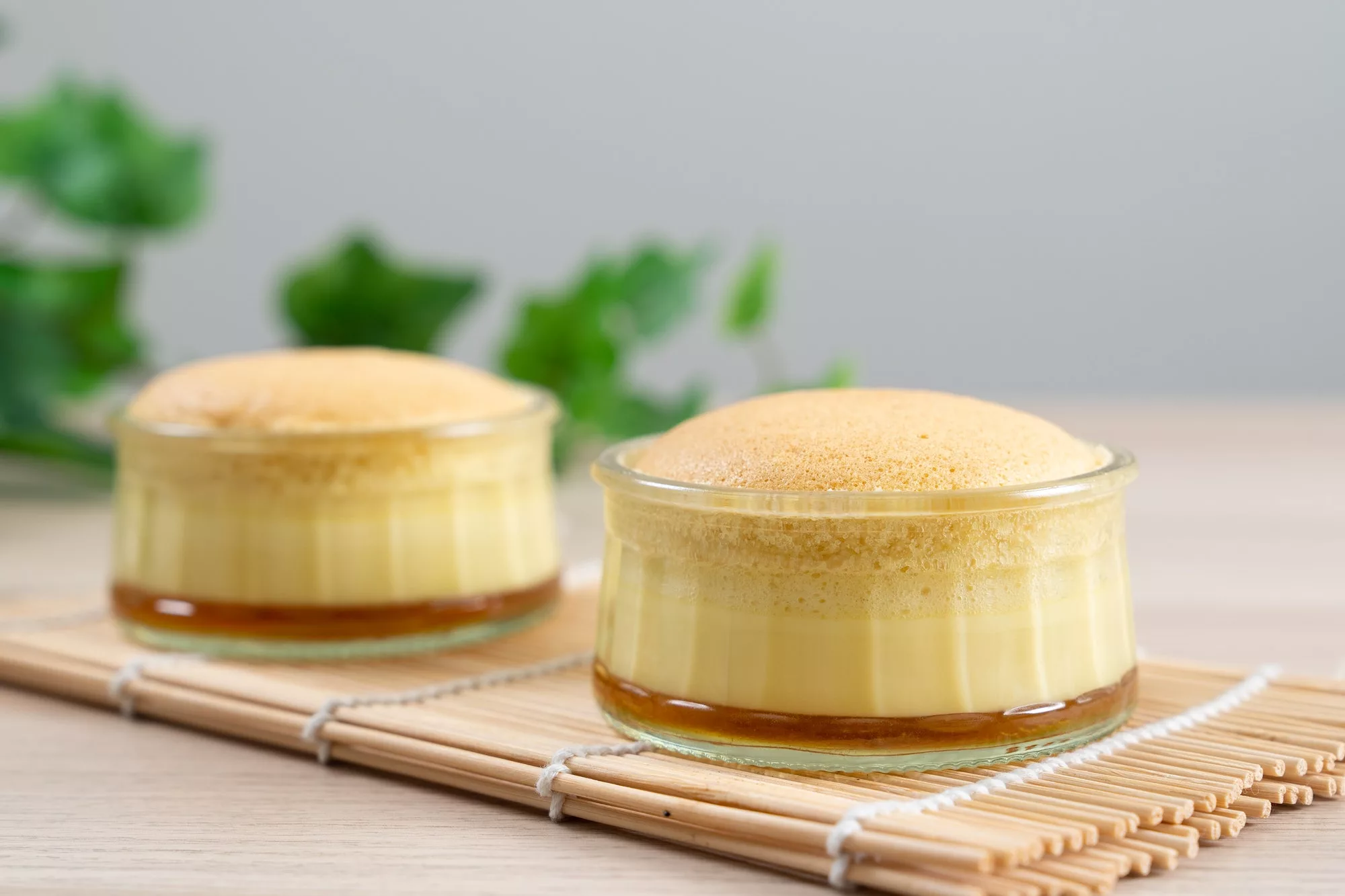
The magic in this cake is all about science. You pour a single, very thin batter into the pan, and during baking, it separates into three distinct layers entirely on its own. The bottom becomes a dense, fudgy base almost like a brownie. The middle sets into a smooth, wobbling custard. The top puffs up into a light, airy sponge with a delicate crust.
What makes this version extra special is that it achieves all of this without any gluten or dairy. The coconut milk provides the richness that custard demands, while the coconut oil gives the base layer its fudgy density. The cocoa powder adds a deep chocolate flavour that makes this feel indulgent rather than restricted. It’s the kind of recipe that nobody would guess is free-from unless you told them.
Equipment You’ll Need
- Stand mixer with whisk and paddle attachments — You need the whisk to beat egg whites to stiff peaks and the paddle to mix the yolk batter without incorporating too much air. A hand mixer works but takes longer to reach stiff peaks.
- 8-inch (20cm) square cake tin — The square shape gives you clean, even slices and the right depth for the three layers to form properly. A round tin of equivalent size will also work.
- Baking paper (parchment paper) — Essential for lining the tin. The custard layer sticks aggressively to unlined surfaces and will tear apart if you try to turn it out without parchment.
- Large silicone spatula — Critical for folding egg whites into the batter gently. A metal spoon will deflate the whites and compromise your sponge layer.
- Fine-mesh sieve — Sifting the gluten-free flour and cocoa removes lumps that would otherwise create pockets of dry powder in the delicate custard layer.
Nice-to-have: An instant-read thermometer helps confirm your coconut milk is lukewarm (around 35-40°C / 95-105°F) before adding it — too hot will cook the eggs, too cold will solidify the coconut oil back into lumps.
Tips for Best Results
- Egg whites must be at room temperature before whipping. Cold egg whites take longer to reach stiff peaks and produce less volume, which means a thinner sponge layer.
- The batter will look far too thin — this is correct. It should be the consistency of heavy cream. If your batter looks like cake batter, you’ve over-mixed or under-measured the coconut milk.
- Do not over-fold the egg whites. Visible streaks and lumps of egg white in the batter are not just fine — they’re necessary. The unincorporated egg white is what rises to form the sponge layer.
- Warm the coconut milk gently. Lukewarm means you can comfortably hold your finger in it. Overheated milk will partially cook the eggs and prevent proper layer separation.
- Chill before slicing. The custard layer needs at least 2 hours in the fridge to set firmly enough to cut clean slices. Cutting it warm results in a custard avalanche.
- Hot knife technique: Dip your knife in hot water and wipe it clean between each cut for picture-perfect slices.
Substitutions and Variations
- Vanilla version: Skip the cocoa powder and replace it with an extra ¼ cup (30g) gluten-free flour. Increase vanilla extract to 2 teaspoons for a classic vanilla magic custard cake.
- Sugar-free: The recipe already offers stevia as an alternative. If using granulated stevia, use approximately 2 tablespoons — it’s much sweeter than sugar by volume. The texture of the sponge layer may be slightly less tender without sugar’s moisture-retaining properties.
- Coconut-free: Substitute the coconut milk with any dairy-free milk (oat milk or almond milk work well). Replace coconut oil with melted vegan butter. Note that the subtle coconut flavour will be lost.
- Different gluten-free flours: A 1:1 gluten-free baking blend works best here. Avoid using almond flour or coconut flour alone — they absorb liquid differently and will prevent the layers from separating.
- Citrus twist: Add the finely grated zest of one orange to the batter along with the vanilla for a chocolate-orange magic cake.
Storage and Reheating
- Fridge: Store covered or in an airtight container in the fridge for up to 3 days. The custard layer actually improves with chilling — it becomes denser and more silky.
- Freezer: Wrap individual slices tightly in cling film and freeze for up to 1 month. Thaw overnight in the fridge — do not microwave, as the custard layer will weep and lose its texture.
- Serving temperature: This cake is best served cold or at cool room temperature. Warming it causes the custard layer to soften too much and the slices lose their structure.
- Do not leave at room temperature for more than 2 hours due to the egg-based custard layer.
What to Serve With This
- Fresh berries: Raspberries or strawberries cut through the richness of the chocolate and coconut beautifully.
- Coconut whipped cream: Chill a can of full-fat coconut cream overnight, then whip the solid cream with a touch of vanilla and icing sugar for a dairy-free accompaniment that keeps the whole dessert free-from.
- Espresso: A strong black coffee or espresso is the perfect pairing — the bitterness balances the sweetness of the cake.
- Passionfruit coulis: The sharp acidity of passionfruit is stunning against the chocolatey custard. Simply blend passionfruit pulp with a teaspoon of sugar and drizzle over each slice.
Frequently Asked Questions
Why didn’t my cake separate into three layers?
The most common cause is over-mixing the egg whites into the batter. The whites need to remain partially intact so they can float to the top and form the sponge layer during baking. Fold gently with a spatula — stop while you can still see streaks of white. Using milk that’s too hot or too cold can also prevent separation.
Can I make this in a different sized tin?
You can use a 9-inch (23cm) round tin, but the cake will be thinner and the layers less distinct. Avoid going larger than 9 inches or the custard layer will be too thin to set properly. If using a smaller tin, the cake will be deeper and may need an additional 10-15 minutes of baking time.
Why is my cake still wobbly in the middle after 40 minutes?
A gentle wobble in the centre is expected and correct — the custard layer sets as it cools. If the entire surface wobbles like liquid, bake for another 5-10 minutes. The top should feel set with a slight crust when you gently touch it, even though the middle jiggles underneath.
Can I use regular flour and dairy milk instead?
Yes — substitute the gluten-free flour with ½ cup (65g) plain all-purpose flour and the coconut milk with 2 cups (480ml) whole milk. Replace coconut oil with ½ cup (115g) melted unsalted butter. The technique remains identical.
Why does my cake taste too coconutty?
Full-fat coconut milk has a strong coconut flavour. If you prefer a milder taste, use light coconut milk or a 50/50 blend of coconut milk and another dairy-free milk such as oat milk. The coconut oil can also be swapped for a neutral-flavoured oil, though the fudgy base layer won’t be quite as rich.
Is this cake safe for people with coeliac disease?
It can be, provided you use a certified gluten-free flour blend and verify that your cocoa powder is processed in a gluten-free facility. Check all packaging for cross-contamination warnings. The remaining ingredients — eggs, coconut milk, coconut oil, sugar, and vanilla — are naturally gluten-free.
The Story Behind Magic Custard Cake
Magic custard cake became an internet sensation around 2014, but its roots trace back to the traditional French dessert gâteau magique. The concept relies on a basic principle of food science: a very liquid batter made with melted fat, warm milk, and folded egg whites naturally separates during baking because the components have different densities. The heavier custard sinks, the lighter sponge rises, and the dense base forms at the bottom where the fats concentrate.
The original French versions use butter and whole milk. This gluten-free, dairy-free adaptation proves that the magic is in the technique, not the specific ingredients. As long as you maintain the right ratios of fat, liquid, and egg, the layers form reliably every time — making it one of the most forgiving and impressive desserts you can bake.
If you give this gluten-free chocolate magic custard cake a try, I’d love to hear how it turned out for you. Drop a star rating and leave a comment below — your feedback helps other bakers find this recipe too.


