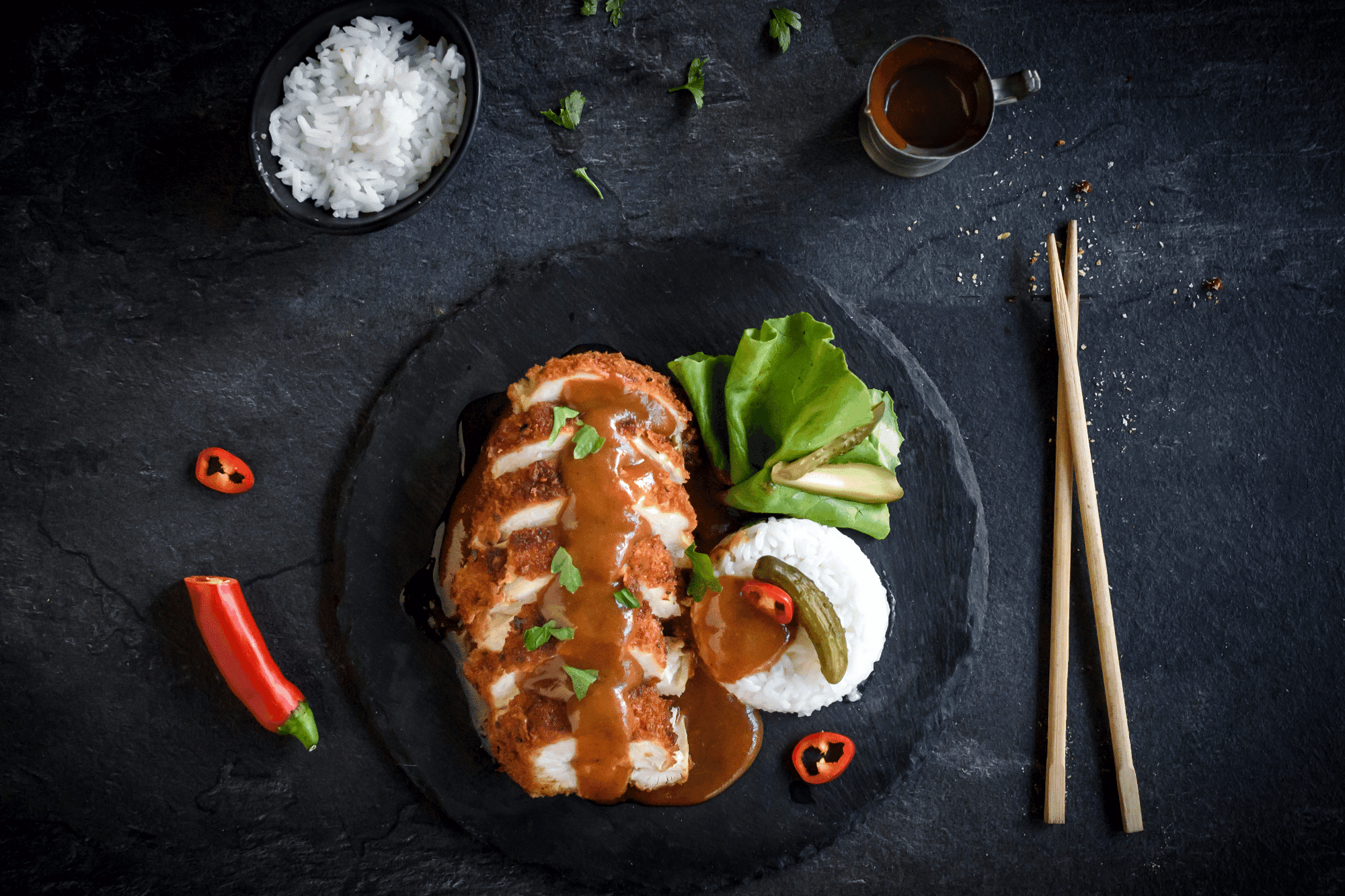


This is panko-crusted chicken over steamed rice with a thick Japanese curry sauce built from roux blocks and real vegetables — ready in about 45 minutes. The sauce and the chicken finish at the same time, which means you can also make both components ahead and simply reheat when you need them. It holds up better than most fried chicken dishes, which is the honest reason this one earns a regular spot in the rotation.
What makes this version work
Two things actually move the needle here. First, slicing the chicken breasts into even 1cm cutlets before breading means the panko turns golden at exactly the same moment the meat cooks through — no burnt crust on raw chicken, no grey overcooked meat under pale breadcrumbs. Second, the curry sauce uses Japanese roux blocks simmered with fresh onion, celery, carrot, and potato rather than water alone. The starch from the potatoes thickens the sauce naturally as it simmers, so you get a glossy, clingy consistency without any extra cornstarch or cream. Skip the garnish — not worth the extra dish.
Shopping notes
- Japanese curry roux blocks: Look for S&B Golden Curry or Vermont Curry in the international aisle of most large supermarkets, or online. They come in mild, medium, and hot — the heat level is the only real difference, so pick what suits your household. Two blocks is the right amount for this recipe; don’t be tempted to add more or the sauce turns salty.
- Panko breadcrumbs: Standard fine breadcrumbs will not give you the same open, crunchy texture. Panko is widely stocked now, but if you’re in a pinch, blitz stale white sandwich bread in a food processor until coarse and dry it briefly in a low oven.
- Neutral oil: Vegetable, canola, or sunflower all work. Avoid olive oil — its smoke point is too low for shallow frying at the heat needed to crisp panko quickly.
If something goes sideways
- Panko is browning before the chicken is cooked through: Your oil is too hot. Lower the heat to medium-low and cover the pan loosely with a lid for the last minute or two — the trapped steam finishes the interior without burning the crust.
- The breading is sliding off: The flour coat was probably too thick or the chicken was wet. Pat the cutlets completely dry before dredging, and shake off any excess flour before dipping in egg. A thin, even flour layer is what makes the egg stick.
- Curry sauce is too thin after adding the roux: The potatoes may not have released enough starch, or the simmer was too short. Return to low heat and stir for another 3 to 5 minutes — it will thicken as it reduces. Don’t crank the heat or it scorches on the bottom.
- Curry sauce seized into a thick paste on reheating: It thickens considerably in the fridge. Add a splash of water — two or three tablespoons at a time — and stir over low heat until it loosens back to a pourable consistency.
- Cutlets lost their crunch after resting: Always rest fried cutlets on a wire rack, not paper towels. Paper traps steam underneath and softens the base. If reheating from cold, a dry skillet over medium heat for two minutes per side brings the crust back far better than a microwave.
Crispy Chicken Katsu Curry – Easy Homemade Recipe
Equipment
- 10-inch non-stick skillet
- Heavy-based saucepan (3-quart or larger)
- 3 shallow bowls or plates (for breading station)
- Sharp chef’s knife
- Wire cooling rack
- Instant-read thermometer
Ingredients
- 2 medium boneless, skinless chicken breasts approximately 10.5 oz total
- 3 stalks celery chopped
- 2 medium carrots chopped
- 1 medium onion chopped
- 2 medium potatoes peeled and chopped into 3cm cubes
- 1 medium egg beaten with a pinch of salt and pepper
- ¼ cup plain (all-purpose) flour
- ⅓ cup panko breadcrumbs
- 2 blocks Japanese curry roux (e.g. S&B Golden Curry)
- 2-3 tablespoons neutral oil (vegetable, canola, or sunflower) for frying
- 3 cups water
- ¾ cup steamed rice for serving
- 1 pinch salt to taste; for seasoning
- 1 pinch black pepper to taste; for seasoning
Instructions
- To prepare the chicken cutlets, slice each chicken breast horizontally into cutlets about 1cm (½ inch) thick. If the breast is very thick, place it between two sheets of cling film and gently pound to an even thickness with a rolling pin. Season each cutlet with salt and pepper.
- Have the flour, egg, and panko in 3 separate bowls. First, coat the chicken cutlets with flour, then dip in the egg mixture, and then coat with panko. Repeat with the remaining chicken pieces and set aside.
- Heat 2–3 tablespoons of neutral oil in a non-stick skillet over medium heat until the oil shimmers. Add the chicken cutlets in a single layer (do not overcrowd) and cook for 3–4 minutes per side until golden brown and cooked through to an internal temperature of 75°C / 165°F. Cook in batches if needed. Transfer to a wire rack to drain and stay crispy.
- Heat some oil in a heavy-based pan, add onion and cook for 1 to 2 minutes.
- Add the celery and carrots and cook for 3 to 4 minutes.
- Add the water and bring to a boil. Add the potatoes, reduce heat to medium, and simmer for 12–15 minutes until the potatoes are just tender when pierced with a knife but still holding their shape.
- Remove the pan from the heat, add the curry roux blocks, and stir continuously until fully dissolved. Return to low heat and simmer for 3–5 minutes, stirring frequently, until the sauce is thick and glossy.
- To serve, slice each chicken cutlet crosswise into 2cm (¾ inch) strips, keeping them together. Serve over a mound of steamed rice, fan the sliced chicken alongside, and ladle the curry sauce generously over and around the chicken.
Nutrition
FAQ
Can I bread the chicken ahead of time?
Yes — bread the cutlets, place them on a wire rack set over a baking sheet, and refrigerate uncovered for up to 8 hours before frying. The uncovered rest actually helps the coating adhere better, and it means you can do all the prep earlier in the day and just fry at dinnertime.
Can I make the curry sauce the day before?
Absolutely, and it may taste even better the next day. Cool it completely, store it in a sealed container in the fridge, and reheat gently on the stovetop with a splash of water to loosen it. The sauce keeps well for up to three days.
Can I bake the chicken instead of frying it?
You can, but the crust will be noticeably less crispy. If you go that route, spray the breaded cutlets generously with oil and bake at 425°F on a wire rack for 18 to 20 minutes, flipping once halfway through.
What if I can’t find Japanese curry roux blocks?
They’re the most practical swap for authentic flavor, so it’s worth checking the international aisle or ordering online before substituting. In a real pinch, a mild Indian curry powder (about 1.5 tablespoons) whisked into the simmering broth with a teaspoon of cornstarch will produce a different but still decent sauce.
Can I use chicken thighs instead of breasts?
Yes — boneless, skinless thighs work well and stay juicy. Pound them to an even thickness before breading, since thighs are uneven and will cook inconsistently otherwise. Check that the internal temperature still reaches 165°F.
How do I stop the curry sauce from getting a skin when it sits?
Press a piece of plastic wrap directly onto the surface of the sauce before covering the pot or container. This blocks air contact, which is what causes the skin to form. Stir well when reheating.
If you liked this one
- Authentic Japanese Chicken Teriyaki
- Soft and Sweet Japanese Mochi
- Quick and Delicious Homemade Chinese Fried Rice
- Fresh Vegetable Spring Rolls