






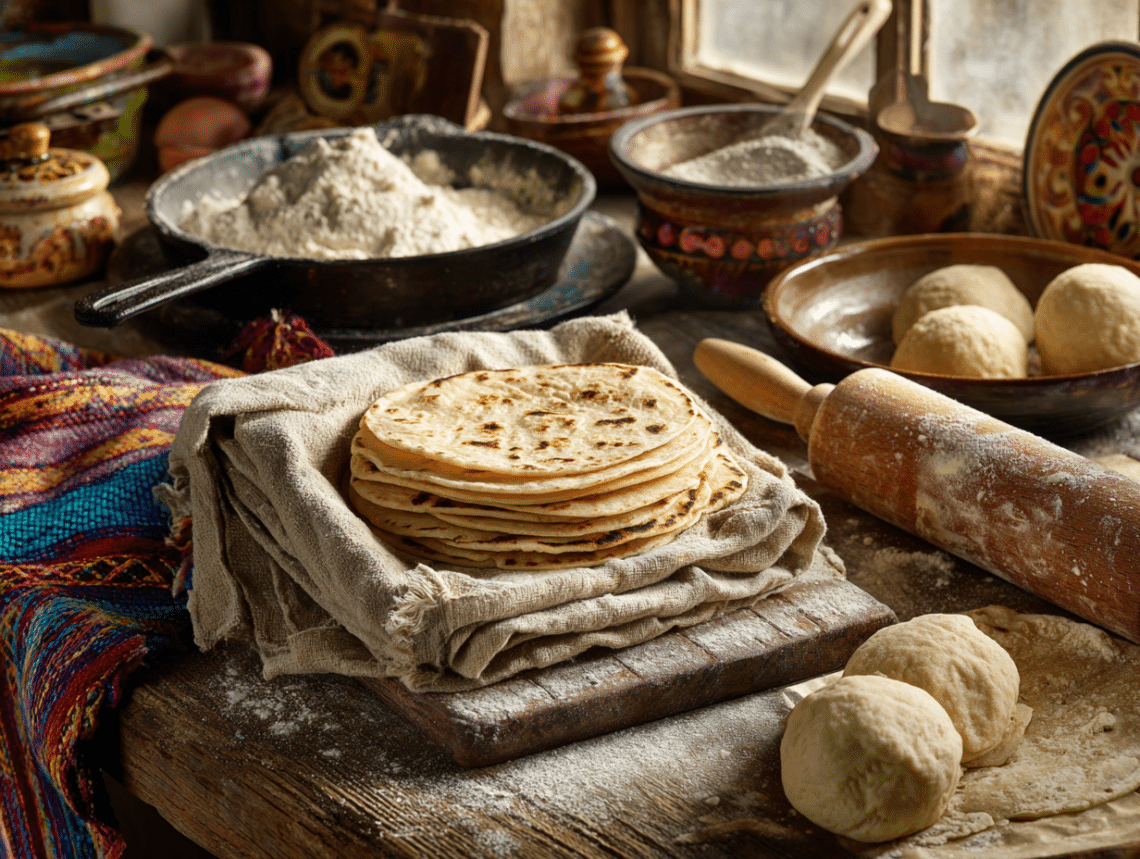
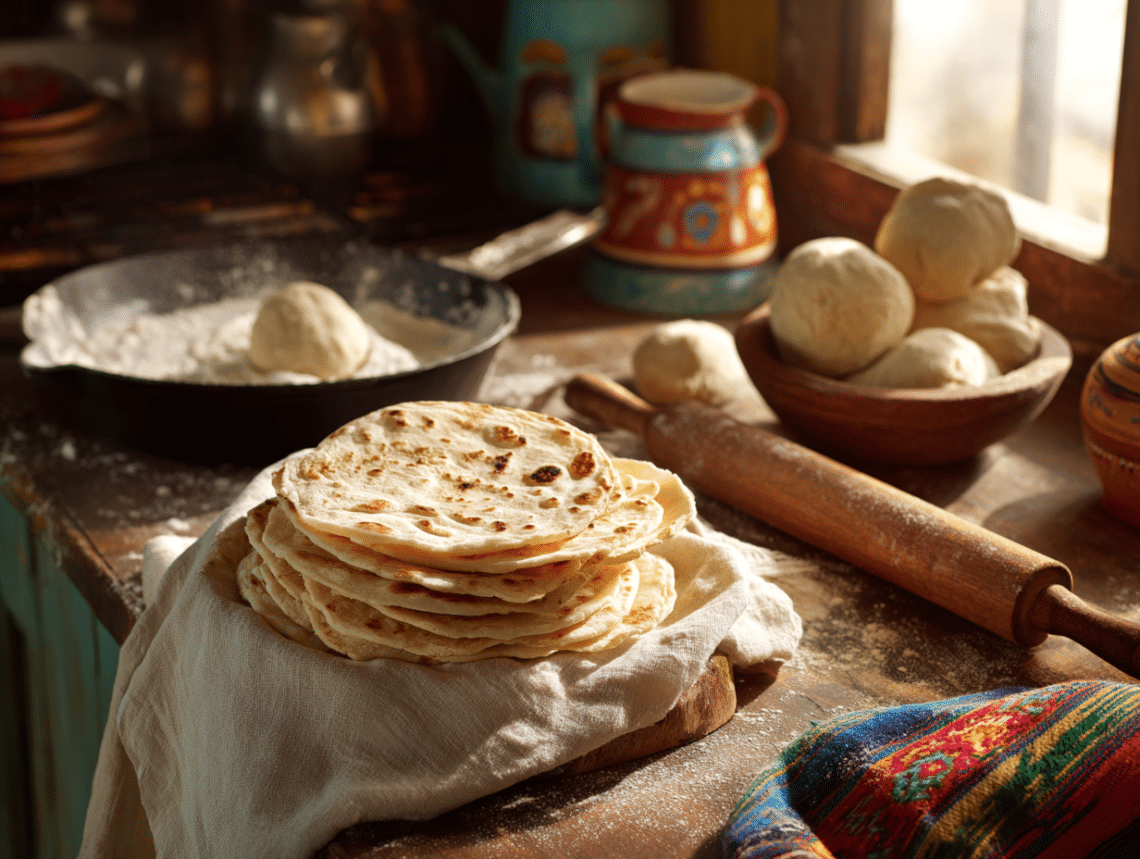
These are straightforward homemade flour tortillas made from five pantry staples: flour, baking powder, salt, fat, and warm water. They take about 40 minutes start to finish, and the result is soft, pliable tortillas that hold together far better than most store-bought versions. If you’ve got kids who are particular about what touches their food, fresh tortillas with a short, recognizable ingredient list are a genuinely easy sell.
Substitutions that actually work
- Lard vs. shortening vs. oil: Lard gives the softest, most pliable result and is the traditional choice. Vegetable shortening is a reliable neutral swap. Olive oil works in a pinch but produces a slightly firmer, less stretchy tortilla — fine for quesadillas, less ideal for burritos.
- All-purpose flour: Unbleached all-purpose is preferred for flavor, but standard bleached works. Bread flour will make the dough noticeably tougher and harder to roll thin, so stick with all-purpose.
- Fine sea salt: Regular table salt works — just use a scant teaspoon since it’s finer and saltier by volume.
The technique that matters
The rest time after dividing the dough is the step most people skip, and it’s the one that makes rolling actually manageable. Gluten tightens up during kneading, and if you try to roll a ball immediately, it springs back and tears. Fifteen minutes under a damp towel lets the gluten relax so each ball rolls out smoothly to an even 8-inch round without fighting you. The other thing worth getting right is skillet temperature — too low and the tortilla dries out and turns stiff before it cooks through; too high and it scorches before the inside sets. Medium-high on most home burners is correct, and the first tortilla is almost always a test run to dial in your heat.
If something goes sideways
- Tortillas are stiff and cracker-like after cooking: The skillet was probably too cool, so they dried out slowly instead of cooking quickly. Turn up the heat and test with the next one.
- Dough tears when rolling: It hasn’t rested long enough. Cover it and wait another five minutes before trying again.
- Tortillas are sticking to the skillet: The pan isn’t hot enough yet, or there’s too much flour on the surface. A dry cast iron or griddle at the right temperature needs no oil — skip the oil entirely.
- Tortillas aren’t puffing at all: This usually means the baking powder is old. Test it by dropping a teaspoon into hot water — if it doesn’t bubble actively, replace it.
- Uneven thickness with thin spots that tear when filling: Roll from the center outward and rotate the dough a quarter turn every few passes rather than rolling back and forth in one direction.
Leftovers and make-ahead
Cooked tortillas keep well. Stack them, wrap tightly in foil or plastic wrap, and refrigerate for up to four days. To reheat, 20–30 seconds in a dry skillet over medium heat brings them back to nearly fresh — the microwave works too, but wrap them in a damp paper towel first or they’ll dry out fast. For freezing, stack with a small square of parchment between each tortilla so they don’t weld together, seal in a zip bag, and freeze for up to two months. Thaw at room temperature for about 20 minutes before reheating. You can also make and refrigerate the uncooked dough balls up to 24 hours ahead — keep them covered and let them sit at room temperature for 10 minutes before rolling.
Homemade Flour Tortillas
Equipment
- Mixing bowl
- Rolling Pin
- Cast iron skillet or griddle
- Damp towel or tortilla warmer
Ingredients
- 3 cups all-purpose flour sifted; unbleached preferred for flavor
- 1 teaspoon baking powder aluminum-free preferred
- 1 teaspoon fine sea salt
- ⅓ cup lard or vegetable shortening lard for traditional flavor, shortening as a neutral alternative
- 1 cup warm water around 110°F (43°C)
Instructions
- In a large mixing bowl, whisk together the flour, baking powder, and salt until evenly distributed.
- Cut in the lard or shortening using your fingers or a pastry blender until the mixture resembles coarse sand with pea-sized bits.
- Gradually stir in the warm water using a wooden spoon until a dough begins to form. Knead by hand for about 5–7 minutes until the dough is smooth, elastic, and not sticky. If necessary, add a touch more flour or water to adjust consistency.
- Divide dough into 10 equal balls. Cover them with a slightly damp kitchen towel and let them rest for 15 minutes. This allows the gluten to relax for easier rolling.
- Heat a cast iron skillet or griddle over medium-high heat (about 450°F / 230°C).
- On a lightly floured surface, roll each ball out into an 8-inch round. Aim for even thickness without tearing.
- Place a tortilla onto the hot skillet. Cook 30–45 seconds per side, until light golden brown spots appear and the tortilla puffs slightly. Do not overcook—tortillas should remain pliable.
- Transfer cooked tortillas to a clean towel or tortilla warmer. Cover to keep warm and prevent drying while you cook the remaining tortillas.
Notes
- Want a more complex flavor? Substitute half the water with warm milk.
- To make it vegan, use vegetable shortening or olive oil instead of lard.
- Tortillas can be made ahead and stored in the refrigerator for up to 3 days—just reheat on the skillet before serving.
Nutrition
Your questions, answered
Can I make these without a cast iron skillet?
Yes — any heavy skillet or griddle works. A stainless steel or nonstick pan over medium-high heat produces perfectly good tortillas; cast iron just holds heat more evenly, which helps with consistent browning.
My tortillas come out tough. What am I doing wrong?
Overworking the dough after the rest period is the most common cause. Knead fully before the rest, then handle each ball as little as possible before rolling — just flatten and roll, don’t re-knead.
Do I need a tortilla press?
No — a rolling pin is the right tool for flour tortillas. A press is designed for corn tortillas, which use a different masa dough; it won’t get flour tortillas thin or round enough.
Can kids help make these?
The kneading and rolling steps are genuinely good for kids to help with. Rolling out rounds is forgiving — odd shapes cook and taste exactly the same, so there’s no pressure to get it perfect.
Can I double the recipe?
Yes, it scales up without any issues. The only practical limit is how many tortillas you can cook in a reasonable amount of time, since they go one at a time on the skillet.
Why does the recipe call for warm water specifically?
Warm water — around 110°F — helps the fat incorporate more evenly into the flour and makes the dough easier to bring together. Cold water can leave the fat in uneven clumps, which affects how the tortilla rolls and cooks. Skip the thermometer if you don’t have one — water that feels comfortably warm on your wrist is close enough.
If you liked this one
- Sizzling Street-Style Grilled Chicken Tacos
- Sizzling Chicken Quesadillas
- Classic Mexican Guacamole
- Authentic Birria Tacos




Have been trying to make good flour tortillas for several efforts and they came out too thick. I was using a tortilla press. These worked wonderfully with a rolling pin.