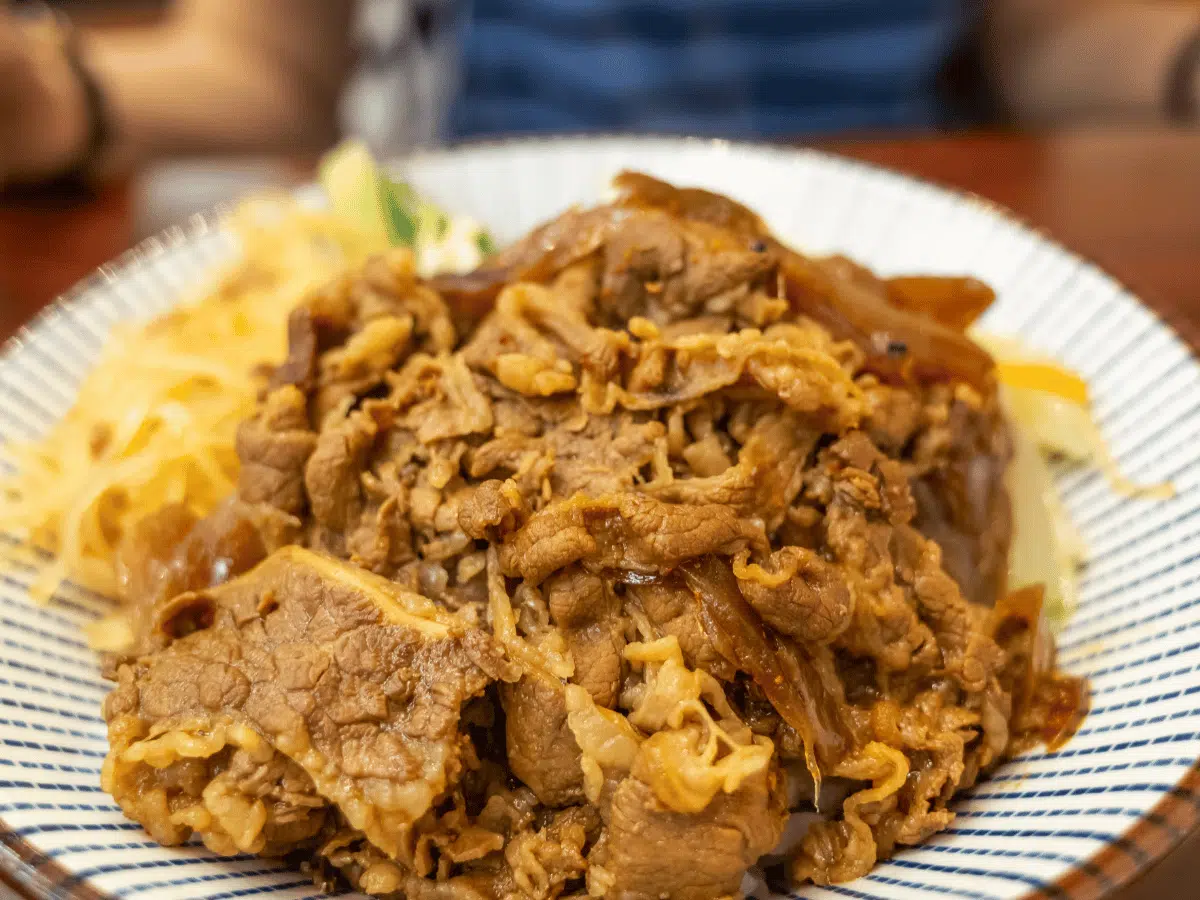






Beef gyudon is thinly sliced beef and onions simmered in a sweet-savory sauce of soy, mirin, sake, and dashi, then spooned over hot rice. The whole thing comes together in 25 minutes, which makes it one of the most practical weeknight dinners you can keep in rotation. Four ingredients do most of the work — the sauce is the recipe.
The technique that matters
The order you build the sauce matters more than most people expect. Heating the soy sauce, mirin, sake, and sugar together first — before the onions go in — lets the sugar dissolve fully and the alcohol cook off, so the finished sauce tastes rounded rather than sharp. From there, the onions go in while the liquid is already hot, which means they soften quickly and absorb the sauce as they cook rather than steaming in their own water. Thinly sliced beef cooks fast; once it hits the pan, you’re not waiting long. The 10-to-15-minute simmer after adding the dashi is where the sauce thickens and the beef becomes genuinely tender, so don’t rush it by cranking the heat.
Mistakes to avoid
- Beef sliced too thick: Thick slices stay chewy no matter how long you simmer them. Ask your butcher to slice it thin, or freeze the steak for 20 minutes before slicing it yourself — it firms up enough to cut cleanly.
- Skipping the dashi or substituting water: Water produces a flat, one-dimensional sauce. If you can’t find dashi packets, a small amount of chicken stock is a workable substitute; plain water is not.
- Overcrowding the pan: If you’re doubling the recipe, use a wider pan or cook in two batches. A crowded pan steams the beef instead of browning it, and the sauce takes much longer to reduce.
- Pulling it off the heat too early: If the sauce still looks thin and watery after 10 minutes, give it another 3 to 5 minutes on a gentle simmer. The sauce should coat the back of a spoon before you serve it.
- Cold rice under hot beef: Day-old rice straight from the fridge will cool everything down fast. Reheat it with a splash of water in the microwave, covered, for about 90 seconds before you plate up.
Keeping and reheating
Store leftover beef and sauce separately from the rice in airtight containers in the fridge — both keep well for up to 3 days. The beef mixture also freezes fine for up to 2 months; freeze it flat in a zip-lock bag and thaw overnight in the fridge. To reheat, warm the beef and sauce in a small saucepan over medium-low heat with a tablespoon of water to loosen it, stirring until heated through. Skip the garnish — the pickled ginger and green onions aren’t worth prepping fresh for leftovers, and they don’t reheat well anyway.
Beef Gyudon: Japanese Soy Beef Rice Bowl Recipe
Equipment
- Large skillet or wok (12-inch / 30cm)
- Sharp chef’s knife or mandoline for thin slicing
- Medium saucepan for cooking rice
- Wooden spoon or silicone spatula
- Measuring cups and spoons
Ingredients
- 1 pound beef sirloin or ribeye thinly sliced, about 450g
- 2 medium onions thinly sliced
- ¼ cup soy sauce 60ml
- ¼ cup mirin 60ml
- ¼ cup sake 60ml
- 2 tablespoons granulated sugar 25g
- 1 cup dashi Japanese soup stock, 240ml
- 4 cups cooked white rice about 740g; roughly 2 cups / 380g uncooked short-grain Japanese rice
- 4 green onions scallions, thinly sliced
- 2 tablespoons pickled ginger beni shōga, for garnish, about 30g
Instructions
- Using a large skillet or wok, heat the soy sauce, mirin, sake, and sugar over medium heat until the sugar has dissolved.1/4 cup soy sauce, 1/4 cup mirin, 1/4 cup sake, 2 tablespoons granulated sugar
- Add the thinly sliced onions to the skillet and sauté until softened and translucent.2 medium onions
- Add the thinly sliced beef to the skillet, separating the slices so they cook evenly, and stir gently until the meat is no longer pink, about 2–3 minutes.1 pound beef sirloin or ribeye
- Add the dashi to the skillet and bring the mixture to a boil.1 cup dashi
- Reduce the heat and simmer the beef and onion mixture for 10 to 15 minutes or until the beef is tender and the sauce has thickened.
- Divide the cooked rice into four bowls.4 cups cooked white rice
- Spoon the beef and onion mixture over the rice.
- Garnish with sliced green onions and pickled ginger.4 green onions, 2 tablespoons pickled ginger
- Serve immediately while the sauce is hot and glossy.
Notes
Nutrition
Your questions, answered
Can I use a different cut of beef if I can’t find sirloin or ribeye?
Yes — thinly sliced chuck or short rib works well and is often cheaper. The key is thin slicing; the cut matters less than the thickness, since the simmer will tenderize most cuts if they’re cut fine enough.
What is dashi and where do I find it?
Dashi is a light Japanese stock made from kombu and bonito flakes, and it’s the backbone of the sauce’s savory depth. Most Asian grocery stores carry instant dashi powder or packets, which dissolve in hot water in about a minute — no special prep needed.
Can I leave out the sake or substitute something else?
Dry sherry is the closest substitute and works well in the same quantity. If you’d rather skip alcohol entirely, use an equal amount of extra dashi or a splash of rice vinegar diluted with water, though the sauce will be slightly less complex.
Is there a way to make this without mirin?
You can replace mirin with a mix of 3 tablespoons of dry sherry or white wine and 1 teaspoon of sugar. Mirin adds both sweetness and a mild tang, so the combination gets you closer to the real flavor than sugar alone.
Can I make this ahead for meal prep?
The beef and sauce reheat very well, so making a full batch and storing it in the fridge for up to 3 days is a solid plan. Cook the rice fresh each day if you can — it only takes about 15 minutes and the texture is noticeably better than reheated rice.
How do I get the beef sliced thin enough at home?
Put the steak in the freezer for 20 to 30 minutes until it’s firm but not frozen solid, then slice it against the grain with a sharp knife. Aim for slices around 2 to 3 millimeters thick — roughly the thickness of a coin.
More recipes to try
- Authentic Japanese Chicken Teriyaki
- Soft and Sweet Japanese Mochi
- Quick and Delicious Homemade Chinese Fried Rice
- Fresh Vegetable Spring Rolls