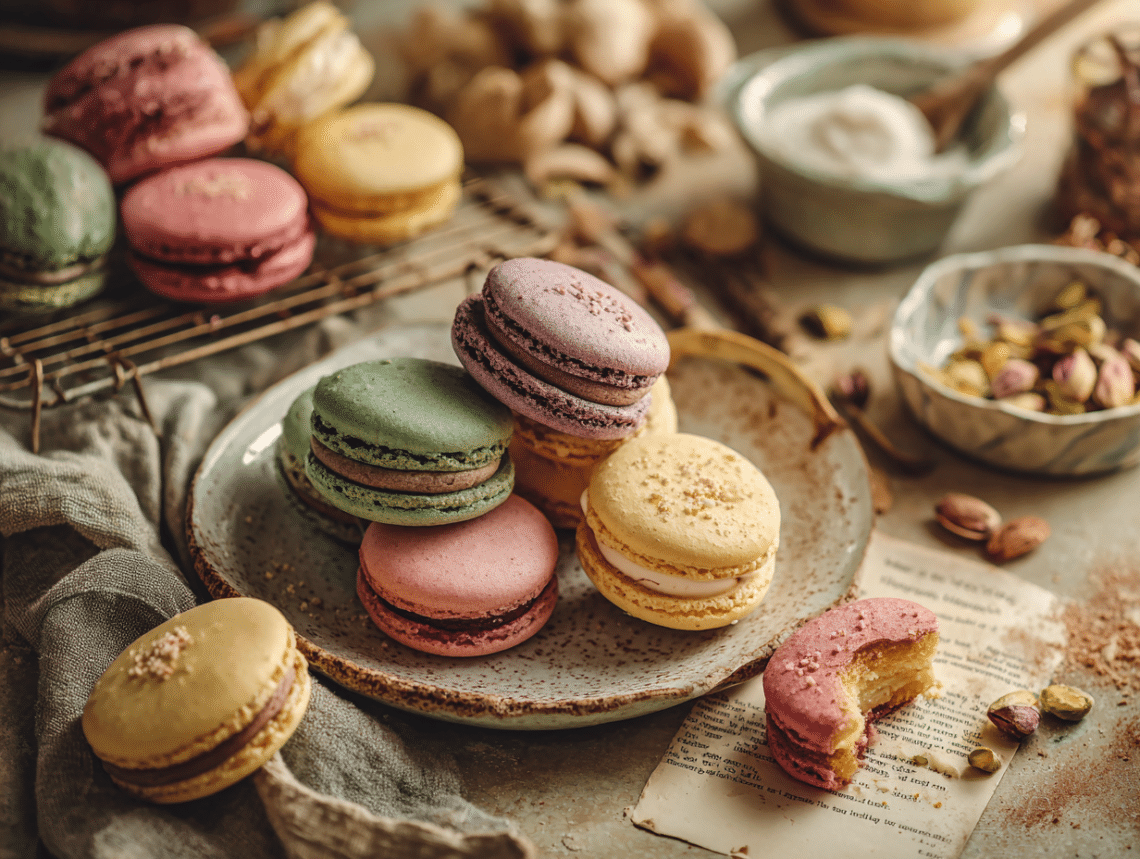
French Macarons

French macarons are a French classic. They’re sumptuous and delicious in all forms. Who wouldn’t love this dessert once they got a taste of it? Today, I’ll share with you a quick recipe I learned for making lovely French macarons.
Ingredients
- 3 large egg whites room temperature
- ⅓ cup caster sugar superfine sugar
- 1 ⅓ cups powdered sugar confectioners' sugar, sifted
- 1 ¼ cups blanched almonds finely ground, or superfine blanched almond flour
- ⅛ teaspoon fine salt
- ⅛ teaspoon cream of tartar
- 1 cup filling of choice buttercream, ganache, fruit curd, or jam
Instructions
- Measure each ingredient precisely using a digital kitchen scale. Separate your egg whites and bring them to room temperature (about 20°C / 68°F). Place each measured ingredient in its own bowl before you begin.
- In a food processor, pulse the ground almonds with half of the powdered sugar (80g) in short 2–3 second bursts until very fine — the sugar absorbs the almond oils and prevents the mixture from turning into a paste. Sift through a fine-mesh sieve into a clean bowl, discarding any large pieces. Add the remaining 80g powdered sugar and sift the entire mixture once more. Set aside.
- In a spotlessly clean, grease-free metal or glass bowl, beat the egg whites with an electric hand mixer or stand mixer fitted with the whisk attachment on medium speed until soft peaks form.
- Add the salt and cream of tartar, then increase the mixer speed to medium-high. Add the caster sugar gradually, about 1 tablespoon at a time, while beating continuously. Continue whipping for 6–8 minutes until you have a stiff, glossy meringue that holds its shape when the whisk is lifted. The meringue should not slide when the bowl is tipped — this is the stiff peak stage.
- If the meringue is not reaching stiff peaks, ensure your bowl and whisk are completely grease-free and your egg whites were at room temperature. Do not over-whip past stiff peaks — the meringue should look smooth and satiny, not dry or grainy.
- Add 1/3 of the prepared almond mixture to your meringue and fold until just incorporated. Add in another third and follow suit. Add in the last third and fold until just incorporated, and then stop. This is so important. Count your folds—you should fold no more than 40-ish times. If you reach 50, something might go wrong.
- Transfer the batter to a piping bag fitted with a round 1cm (⅜-inch) tip, such as a Wilton 1A or Ateco 804. Pipe 3.5cm (1.5-inch) rounds onto baking sheets lined with parchment paper or a silicone baking mat, spacing them 2.5cm (1 inch) apart. Hold the piping bag vertically and apply steady pressure, then flick the tip in a small circle to finish each round.
- Once all rounds are piped, firmly tap each baking sheet against the countertop 5–6 times. Rotate the sheet 90 degrees and tap again. Use a toothpick to pop any visible air bubbles on the surface.
- Let the piped macarons rest uncovered in a cool, dry place for 30–60 minutes until a dry skin forms on the surface — you should be able to lightly touch the top without any batter sticking to your finger. While the shells rest, preheat your oven to 330°F / 165°C (150°C fan-forced).
- Bake one sheet at a time on the lower-middle rack at 330°F / 165°C (150°C fan-forced) for 7 minutes. Rotate the baking sheet 180 degrees and bake for an additional 4–5 minutes. The macarons are done when the tops feel firm and the shells do not wobble on their feet when gently nudged. Remove from the oven and allow the shells to cool completely on the baking sheet for at least 10 minutes before carefully peeling them off the parchment.
- Once completely cool, match shells into pairs of similar size. Pipe or spread about 1 teaspoon of your chosen filling (buttercream, ganache, fruit curd, or jam) onto the flat side of one shell, then gently sandwich with its match. Place the filled macarons in an airtight container and refrigerate for at least 12–24 hours before serving. This resting period allows the filling to soften the shells to the ideal chewy texture. Bring to room temperature for 15–20 minutes before eating for the best flavour.
Nutrition
Calories: 112kcalCarbohydrates: 21gProtein: 2gFat: 3gSaturated Fat: 0.2gPolyunsaturated Fat: 1gMonounsaturated Fat: 2gTrans Fat: 0.001gSodium: 25mgPotassium: 56mgFiber: 1gSugar: 17gVitamin A: 0.4IUVitamin C: 1mgCalcium: 16mgIron: 0.3mg
We'd love to know if you enjoyed this recipeRate this Recipe !
