

















French macarons have a reputation for being fussy, and that reputation is mostly earned — but the problems are specific and fixable. This recipe uses the French meringue method with six ingredients and gives you exact fold counts, temperatures, and timings so you know what to aim for at every step. Make a full batch on the weekend and you’ll have shells ready to fill and portion out across several days.
The short version of why this works
Two things determine whether macarons succeed or fail. First, the meringue has to reach true stiff peaks — not just firm peaks — before the almond mixture goes in. A meringue that’s even slightly underwhipped won’t hold the air you need, and the shells will spread flat or crack. Second, the folding stage (called macaronage) has to stop at the right moment. You’re deliberately deflating the batter to a specific consistency: thick enough to hold a round shape when piped, loose enough that the ribbon of batter falling from your spatula dissolves back into the bowl within about 10 seconds. Stop too early and you get lumpy, cracked tops; go too far and the batter runs. Everything else in the recipe — the resting time, the single-tray baking, the overnight fridge rest — supports these two steps.
Shopping notes
- Almond flour vs. ground blanched almonds: Commercially packaged superfine blanched almond flour (Bob’s Red Mill is widely available) skips the food-processor step and tends to produce smoother shells. If you’re grinding whole blanched almonds yourself, err on the side of over-processing rather than under — coarse almond pieces are the main cause of bumpy tops.
- Caster sugar: If you can’t find caster sugar, pulse regular granulated sugar in a food processor for 30 seconds. It won’t be identical, but it dissolves into the meringue well enough. Don’t substitute powdered sugar here — the ratio in the recipe is calibrated for caster.
- Cream of tartar: Stabilizes the meringue and is worth having on hand. No swap needed — a small container costs under $3 and lasts for years.
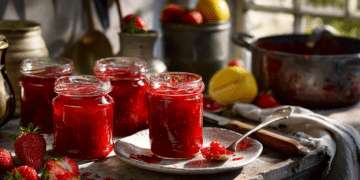
- Filling: Lemon curd is one of the best choices for a make-ahead batch because it holds in the fridge for two weeks. If you want to make your own, this lemon curd recipe works perfectly as a macaron filling.
What can go wrong
- Shells stick to the parchment: This almost always means they were underbaked or pulled off before fully cool. Let them sit on the sheet for the full 10 minutes after baking. If a shell still resists, slide a thin offset spatula underneath rather than peeling from the edge.
- No feet, or feet spread sideways: Feet form when steam pushes upward through a dry skin. If the skin didn’t form properly during resting — because the kitchen was humid or the rest time was too short — steam escapes sideways instead. On humid days, rest the shells near a fan or in an air-conditioned room, and don’t rush past 45 minutes.
- Hollow shells: Hollow interiors usually mean the oven was too hot and the outside set before the inside cooked through. An oven thermometer is the fastest fix — most home ovens run 10–25°F hotter than the dial says. Skip the built-in oven display and trust the thermometer.
- Filled macarons are soggy after resting: Jam and fruit curd fillings with high water content can over-soften shells if left assembled for more than 48 hours. Pipe a thin ring of buttercream around the edge of the shell first, then add the curd in the center — this slows moisture migration significantly.
- Batter too stiff to pipe smoothly: If you stopped folding too early and the batter is thick and matte, fold 3–5 more times and test again. Don’t add liquid to thin it out.
Storage and reheating
Unfilled shells keep well and that’s what makes this recipe practical for batch cooking. Store them in a single layer in an airtight container at room temperature for up to 2 days, or freeze them flat on a baking sheet, then transfer to a zip-top bag for up to 3 months — thaw at room temperature for 20 minutes before filling. Filled macarons should go into an airtight container in the fridge; they’re at their best between 24 and 48 hours after assembly, and most will hold for up to 4 days depending on the filling. Buttercream-filled shells last the longest; curd-filled ones are better eaten within 2 days. There’s no reheating step — bring refrigerated macarons to room temperature for 15–20 minutes before serving and they’re ready.

French Macarons

Ingredients
- 3 large egg whites room temperature
- ⅓ cup caster sugar superfine sugar
- 1 ⅓ cups powdered sugar confectioners' sugar, sifted
- 1 ¼ cups blanched almonds finely ground, or superfine blanched almond flour
- ⅛ teaspoon fine salt
- ⅛ teaspoon cream of tartar
- 1 cup filling of choice buttercream, ganache, fruit curd, or jam
Instructions
- Measure each ingredient precisely using a digital kitchen scale. Separate your egg whites and bring them to room temperature (about 20°C / 68°F). Place each measured ingredient in its own bowl before you begin.
- In a food processor, pulse the ground almonds with half of the powdered sugar (80g) in short 2–3 second bursts until very fine — the sugar absorbs the almond oils and prevents the mixture from turning into a paste. Sift through a fine-mesh sieve into a clean bowl, discarding any large pieces. Add the remaining 80g powdered sugar and sift the entire mixture once more. Set aside.
- In a spotlessly clean, grease-free metal or glass bowl, beat the egg whites with an electric hand mixer or stand mixer fitted with the whisk attachment on medium speed until soft peaks form.
- Add the salt and cream of tartar, then increase the mixer speed to medium-high. Add the caster sugar gradually, about 1 tablespoon at a time, while beating continuously. Continue whipping for 6–8 minutes until you have a stiff, glossy meringue that holds its shape when the whisk is lifted. The meringue should not slide when the bowl is tipped — this is the stiff peak stage.
- If the meringue is not reaching stiff peaks, ensure your bowl and whisk are completely grease-free and your egg whites were at room temperature. Do not over-whip past stiff peaks — the meringue should look smooth and satiny, not dry or grainy.
- Add 1/3 of the prepared almond mixture to your meringue and fold until just incorporated. Add in another third and follow suit. Add in the last third and fold until just incorporated, and then stop. This is so important. Count your folds—you should fold no more than 40-ish times. If you reach 50, something might go wrong.
- Transfer the batter to a piping bag fitted with a round 1cm (⅜-inch) tip, such as a Wilton 1A or Ateco 804. Pipe 3.5cm (1.5-inch) rounds onto baking sheets lined with parchment paper or a silicone baking mat, spacing them 2.5cm (1 inch) apart. Hold the piping bag vertically and apply steady pressure, then flick the tip in a small circle to finish each round.
- Once all rounds are piped, firmly tap each baking sheet against the countertop 5–6 times. Rotate the sheet 90 degrees and tap again. Use a toothpick to pop any visible air bubbles on the surface.
- Let the piped macarons rest uncovered in a cool, dry place for 30–60 minutes until a dry skin forms on the surface — you should be able to lightly touch the top without any batter sticking to your finger. While the shells rest, preheat your oven to 330°F / 165°C (150°C fan-forced).
- Bake one sheet at a time on the lower-middle rack at 330°F / 165°C (150°C fan-forced) for 7 minutes. Rotate the baking sheet 180 degrees and bake for an additional 4–5 minutes. The macarons are done when the tops feel firm and the shells do not wobble on their feet when gently nudged. Remove from the oven and allow the shells to cool completely on the baking sheet for at least 10 minutes before carefully peeling them off the parchment.
- Once completely cool, match shells into pairs of similar size. Pipe or spread about 1 teaspoon of your chosen filling (buttercream, ganache, fruit curd, or jam) onto the flat side of one shell, then gently sandwich with its match. Place the filled macarons in an airtight container and refrigerate for at least 12–24 hours before serving. This resting period allows the filling to soften the shells to the ideal chewy texture. Bring to room temperature for 15–20 minutes before eating for the best flavour.
Nutrition
Frequently asked questions
Do I really need a kitchen scale, or can I use cup measurements?
A kitchen scale is not optional for this recipe. Macaron batter is sensitive to small weight differences — even a few grams too much almond flour changes the texture of the shells. Cup measurements for almond flour and powdered sugar vary too much depending on how the ingredient is scooped.
Can I make macarons without a stand mixer?
Yes, a hand mixer works fine. Use a clean metal or glass bowl and expect the whipping process to take the full 6–8 minutes at medium-high speed. Plastic bowls can hold trace amounts of grease even after washing, which prevents the meringue from reaching stiff peaks.
Why do my macarons have cracked tops?
Cracked tops are almost always caused by skipping or shortening the resting period before baking. The dry skin that forms during the 30–60 minute rest is what forces the batter to rise upward and form feet rather than cracking open at the top. Oven temperature that’s too high is the second most common cause.
Can I color the shells?
Yes — add gel food coloring to the meringue after it reaches stiff peaks, before you fold in the almond mixture. Use gel, not liquid coloring; liquid adds moisture that can destabilize the meringue. Start with a small amount since the color fades slightly during baking.
Can I double the batch?
Doubling works, but mix each batch of meringue separately rather than making one large batch. Overloading the mixer bowl makes it harder to reach stiff peaks evenly, and a larger volume of batter is harder to fold consistently. Bake the trays one at a time regardless of batch size.
If you liked this one
- Homemade lemon curd (great as a macaron filling)
- French chocolate mousse
- Pavlova with fresh berries
- Scottish shortbread cookies