
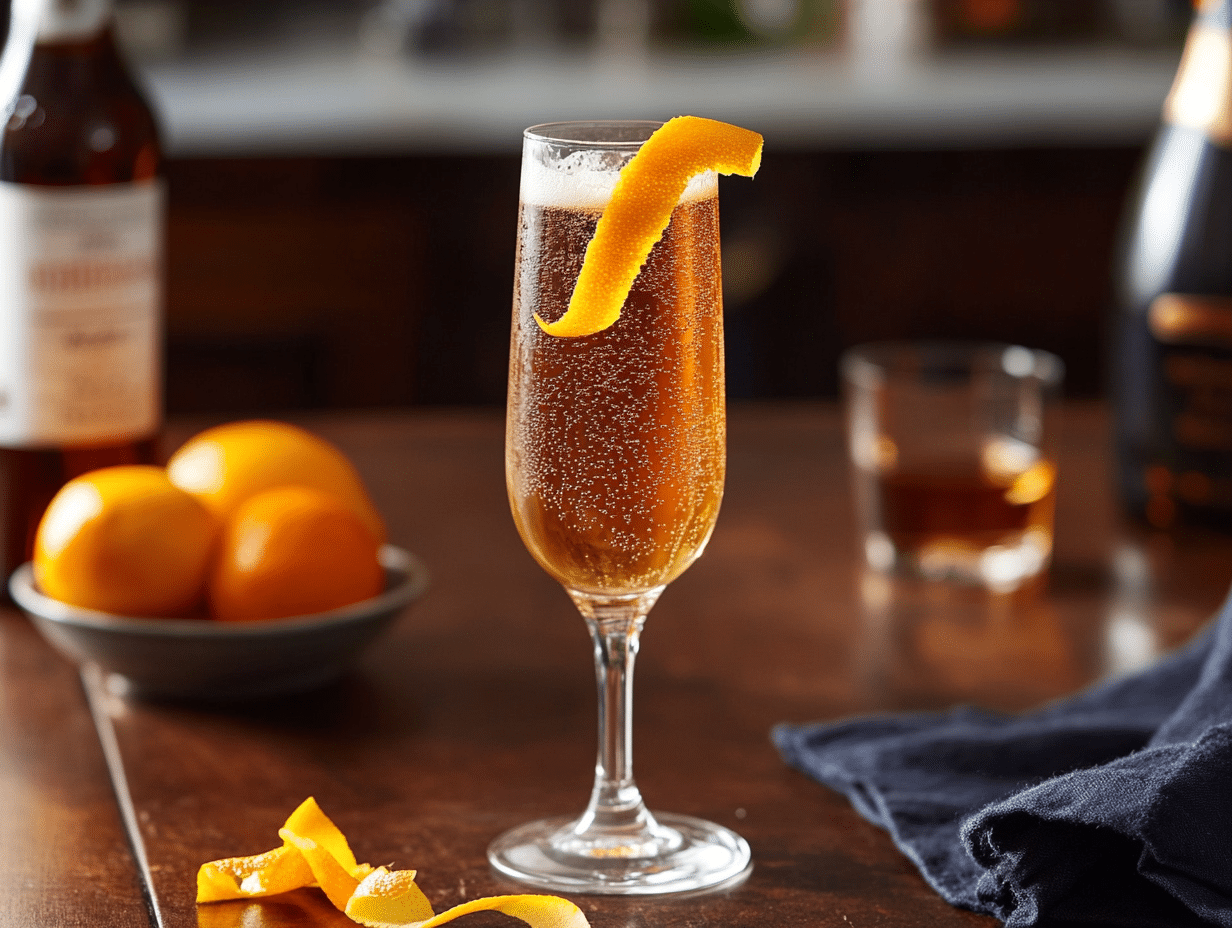
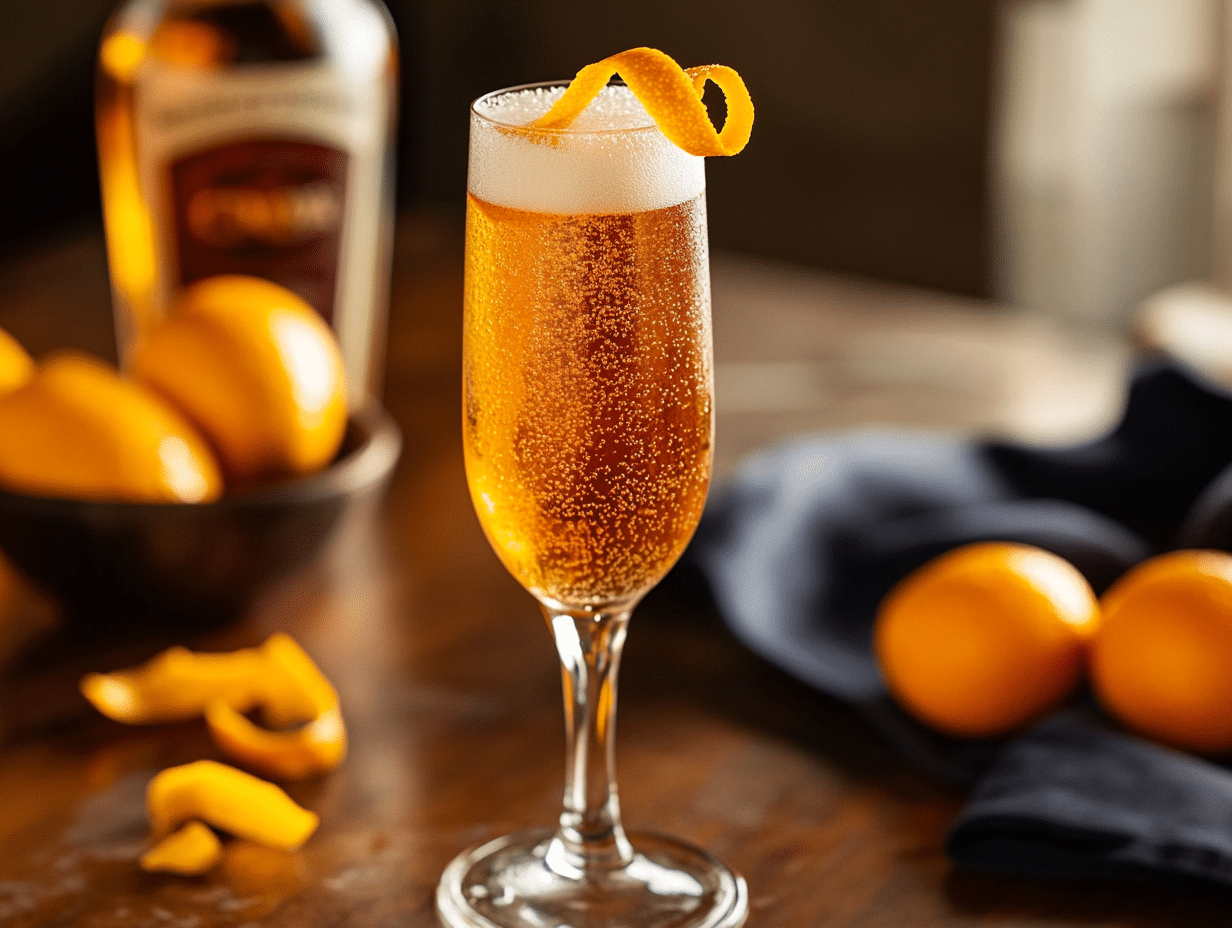
The Seelbach is a bourbon cocktail topped with champagne — five ingredients, no shaking, ready in five minutes. It tastes more complex than the effort suggests, which makes it a genuinely good option when you want something special without spending the evening behind the bar. The bitters do most of the work, so don’t skip them or cut them short.
What makes this version work
Two things matter here. First, the stir — not the pour. Combining the bourbon, Cointreau, and both bitters in a mixing glass before the champagne goes in means everything is evenly blended before the bubbles arrive. If you dump it all into the flute at once, the bitters sit unevenly and the first sip tastes different from the last. Second, the quantity of bitters is not a typo. Seven dashes each of Angostura and Peychaud’s sounds like a lot, and it is — that’s the whole point. Those 14 dashes total are what keep this from tasting like a sweet bourbon spritz. Measure them properly rather than free-pouring, especially the first time you make it.
What can go wrong
- Flat champagne: Pouring the champagne too fast or from too high kills the bubbles before they reach the glass. Pour slowly down the inside edge of the tilted flute, the same way you’d pour a beer. A warm flute makes this worse — chill it in the freezer for five minutes first.
- Overpowering sweetness: If your bourbon leans very sweet (high corn content, heavy caramel notes), the Cointreau can push the drink into dessert territory. Balance it by going with a spicier rye-forward bourbon instead, or use a drier orange liqueur like Grand Marnier.
- Diluted, watery drink: Stirring too long in the mixing glass over ice over-dilutes the base before the champagne even goes in. Ten to fifteen seconds of gentle stirring is enough — you’re combining, not chilling.
- Wrong champagne: A demi-sec or off-dry sparkling wine will make this drink noticeably sweet and throw off the balance the bitters are working to create. Stick with brut. Prosecco works in a pinch but gives a softer, less crisp result. Skip the garnish — the orange peel adds a faint aroma but it’s not worth hunting down a fresh orange if you don’t already have one.
- Bitters out of balance: Using only one type of bitters because you don’t have both on hand produces a noticeably flatter drink. Angostura alone tastes more spiced and woody; Peychaud’s alone reads more floral and anise-forward. The combination is what creates the layered flavor, so it’s worth picking up both bottles.
Seelbach Cocktail

Equipment
- Mixing glass
- Bar spoon
- Champagne Flute
Ingredients
- 1 oz Bourbon preferably a high-quality bourbon with caramel and vanilla notes
- 0.5 oz Cointreau or any high-quality orange liqueur
- 7 dashes Angostura bitters
- 7 dashes Peychaud’s bitters
- 4 oz Champagne Brut champagne for a crisp finish
- 1 twist orange peel for garnish
Instructions
- In a mixing glass, combine the bourbon, Cointreau, Angostura bitters, and Peychaud’s bitters.
- Stir gently with a bar spoon, ensuring the ingredients are well mixed without over-diluting.
- Strain the mixture into a chilled champagne flute.
- Carefully top with champagne, pouring slowly to preserve effervescence.
- Express the oils from an orange peel over the glass and drop it in as a garnish.
Notes
- For an extra aromatic touch, warm the orange peel slightly before expressing its oils over the drink.
Nutrition
Frequently asked questions
Can I make a non-alcoholic version for the kids at the table?
Not really — the structure of this drink depends on the bourbon and champagne, and a true swap doesn’t exist. That said, a simple mix of sparkling apple juice, a small splash of orange juice, and two dashes of non-alcoholic cocktail bitters makes a reasonable festive drink for younger guests alongside the real thing.
What bourbon should I use?
A mid-range Kentucky bourbon with clear vanilla and caramel notes works well — something like Maker’s Mark or Buffalo Trace. Avoid anything heavily peated or smoky, which fights the orange and bitters rather than working with them.
Do I need real champagne, or can I use prosecco or cava?
Brut cava is a solid substitute and costs less than most champagnes. Prosecco works but is slightly softer and sweeter, which can tip the balance — if you use it, make sure your bourbon is on the drier side.
Can I batch this ahead for a party?
You can pre-mix the bourbon, Cointreau, and both bitters in a pitcher and refrigerate it for up to a day. Pour the champagne into each glass individually right before serving — adding it to the batch ahead of time will leave you with a flat drink.
Where do I find Peychaud’s bitters — is it a specialty item?
Most well-stocked liquor stores carry it alongside Angostura. If your local store doesn’t have it, it’s widely available online. It’s worth getting a bottle — it keeps for years and shows up in several other classic cocktails like the Sazerac.