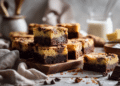
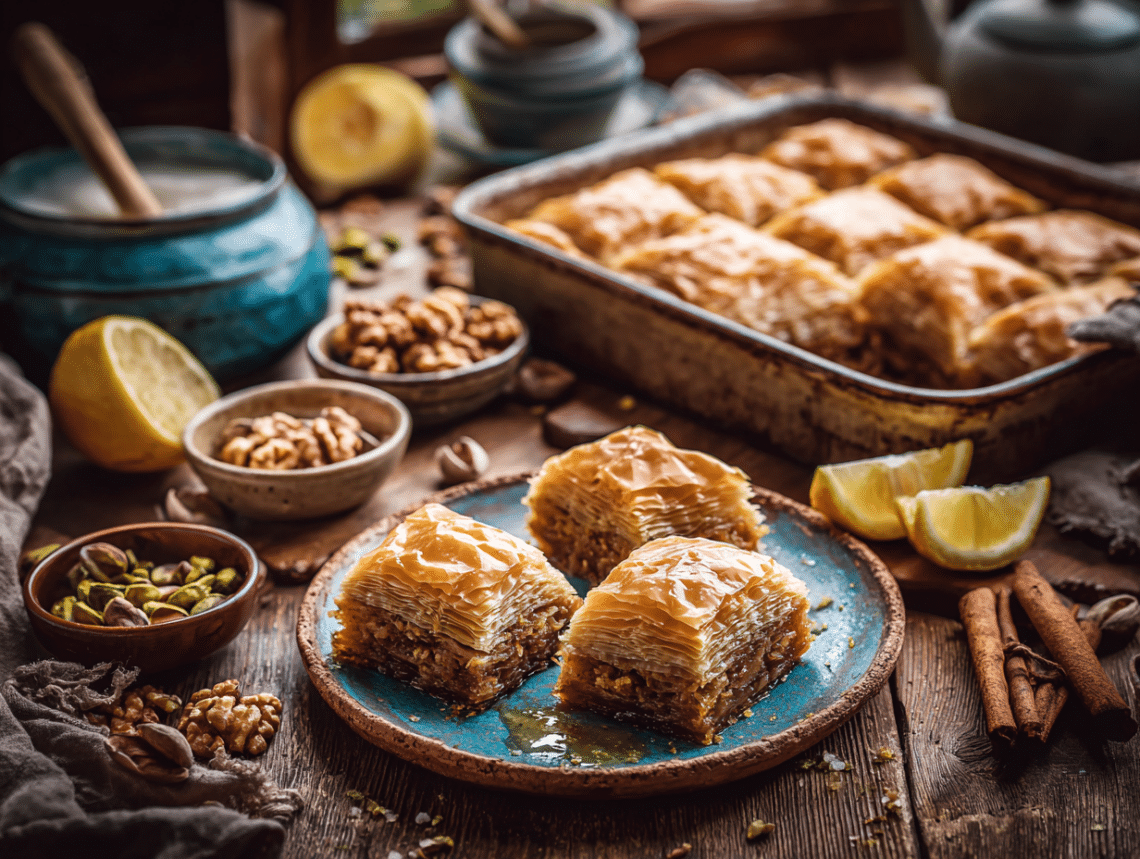
This is a classic walnut-and-pistachio baklava made with store-bought phyllo, a straightforward honey syrup, and about two hours of your time. It makes 24 pieces, keeps well for days, and is genuinely one of the better things you can bring to a holiday table or a potluck. The main reason to make it at home is that fresh baklava — still crisp on top, syrup fully absorbed — is noticeably better than anything pre-packaged.
Before you start
The two things that actually determine whether this works are phyllo handling and syrup timing. Phyllo dries out fast — once you unroll it, keep the stack covered with a lightly damp kitchen towel the entire time you work, and only pull one sheet at a time. If sheets tear, just press them together; small tears are invisible once baked. The syrup timing is equally important: the baklava needs to be hot from the oven and the syrup should be warm (not boiling, not cold) when you pour it. That temperature contrast is what lets the pastry absorb the syrup without turning soft. Make the syrup while the baklava bakes so it has time to cool slightly before you need it.
What can go wrong
- Soggy baklava: Usually caused by pouring cold syrup over cooled pastry. The syrup pools on the surface instead of soaking in evenly. Pull the baklava straight from the oven and pour the syrup immediately.
- Butter pooling instead of coating: If your butter is too hot when you brush it on, it soaks through rather than coating the sheet. Let melted butter cool for a few minutes off the heat before you start brushing.
- Phyllo tearing badly at the edges: Phyllo is often slightly wider than a 9×13 dish. You can fold the overhang in rather than trimming — skip the garnish of extra nut sprinkles on top, not worth the extra dish — just make sure folded edges get buttered too.
- Uneven cuts: Cutting after baking is much harder and can shatter the top layers. The recipe card is right to cut before baking, but go all the way through to the bottom of the dish. A half-cut line will fuse shut in the oven.
- Nuts releasing too much oil: Using pre-toasted or salted nuts can make the filling greasy and overpowering. Stick with raw, unsalted walnuts and pistachios as the recipe specifies.
Storage and reheating
Store baklava uncovered or loosely covered at room temperature for up to 5 days — airtight containers trap moisture and soften the top layers. Refrigerating is fine if your kitchen is very warm, but bring pieces to room temperature before serving; cold baklava is denser and the syrup feels sticky rather than lush. For longer storage, freeze individual pieces on a baking sheet first, then transfer to a freezer bag; they keep well for up to 3 months. Thaw at room temperature for an hour or two. There is no good way to reheat baklava and restore the original crispness, so plan to serve it fresh or at room temperature rather than warm.
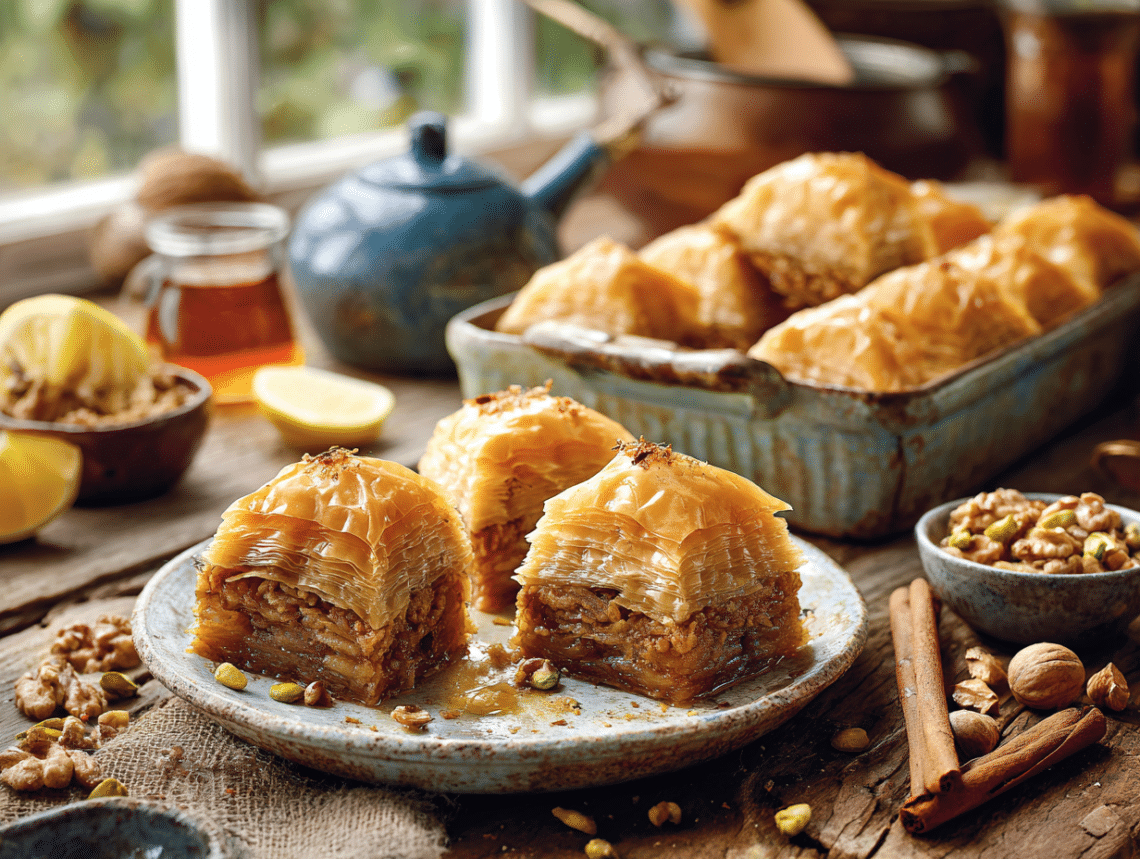
Classic Baklava

Equipment
- 9x13 inch baking dish
- Pastry brush
- Saucepan
- Sharp Knife
Ingredients
For the Baklava Main:
- 1 pound phyllo dough thawed overnight in the refrigerator if frozen
- 2 cups walnuts finely chopped, fresh and untoasted
- 1 cup pistachios finely chopped, unsalted preferred
- 1 teaspoon ground cinnamon
- 1 cup unsalted butter melted
For the Syrup:
- 1 cup water
- 1 cup granulated sugar
- ½ cup honey high-quality clover or orange blossom preferred
- 1 tablespoon lemon juice freshly squeezed
- 1 piece cinnamon stick
Instructions
- Preheat the oven to 350°F (175°C). Lightly butter the bottom and sides of a 9x13 inch baking dish.
- In a mixing bowl, combine finely chopped walnuts, pistachios, and ground cinnamon. Set aside.
- Unroll the phyllo dough and cover with a lightly damp towel to prevent drying. Place one sheet of phyllo in the prepared dish and brush lightly with melted butter. Repeat layering and buttering for 10 sheets to form the base.
- Add a thin layer (about 3-4 tablespoons) of the nut mixture over the phyllo. Top with another sheet of phyllo, brush with butter, and repeat with 5 more layers, alternating nuts and phyllo. Continue until all nut mixture is used, finishing with 8-10 layers of buttered phyllo for the top.
- Using a sharp knife, cut the baklava into diamond or square shapes before baking. Bake in the preheated oven for about 50-60 minutes, or until golden and crisp.
- While the baklava is baking, prepare the syrup. Combine sugar, water, honey, lemon juice, and cinnamon stick in a saucepan. Bring to a boil, then reduce heat and simmer for 10 minutes. Remove from heat and let cool slightly. Discard cinnamon stick.
- Once the baklava is baked, immediately pour the warm syrup evenly over the hot pastry. It should sizzle slightly. Let it cool completely at room temperature for several hours to absorb the syrup fully.
Notes
- Add a teaspoon of orange blossom water to the syrup for a floral dimension.
- For crispier bites, allow baklava to cool uncovered.
- If nuts are unavailable, substitute with pecans or almonds.
Nutrition
Common questions
Can I use store-bought phyllo dough, or do I need to make my own?
Store-bought phyllo is exactly what this recipe is designed for. Look for it in the freezer section — just make sure to thaw it overnight in the refrigerator, not on the counter, so the sheets separate cleanly without tearing.
What if I can only find salted pistachios?
Use unsalted if at all possible — salted nuts throw off the balance of the syrup. If salted is your only option, rinse them briefly, spread on a towel, and let them dry completely before chopping.
Do I have to use both walnuts and pistachios, or can I use just one?
You can use all walnuts or all pistachios and the recipe will still work. All-walnut is the more traditional Greek-style version; all-pistachio is common in Turkish-style baklava and gives a slightly richer, greener filling.
How do I know when the baklava is done baking?
It should be deep golden brown across the entire top, not just at the edges. If the center still looks pale at the 50-minute mark, give it another 5 to 10 minutes — underbaked phyllo stays chewy rather than crisp.
My phyllo sheets are wider than my pan. What do I do?
Fold the overhang down into the pan rather than trimming it off. Folded layers add a bit of extra crunch at the edges, which is not a bad thing. Just make sure to butter the folded parts so they don’t dry out.
How long does the baklava need to sit before I can cut and serve it?
Let it cool completely at room temperature — at least 3 to 4 hours, or overnight if you can wait. Cutting into warm baklava compresses the layers and the syrup hasn’t fully set, so pieces fall apart.