


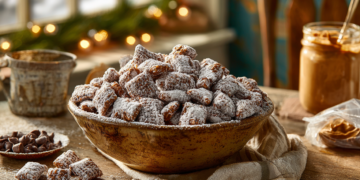



























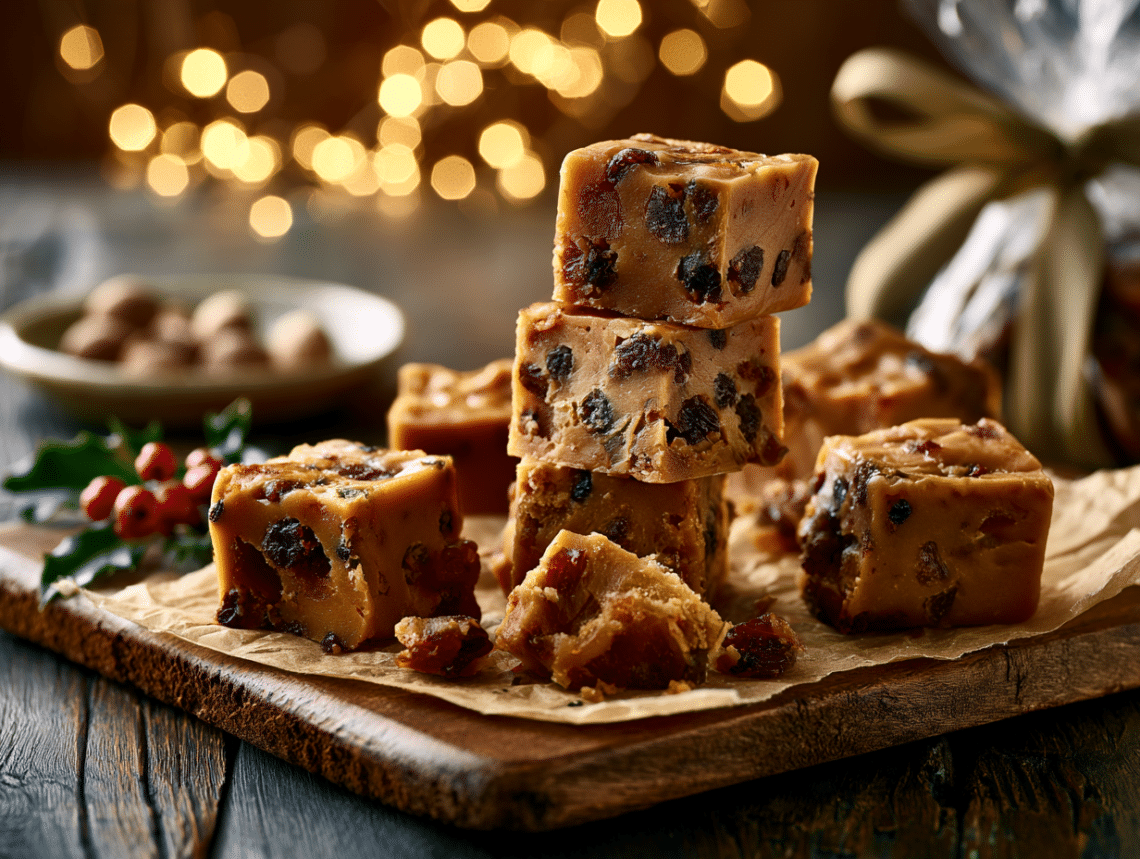
This is a soft, buttery British-style fudge with crumbled Christmas pudding beaten through it — the pudding adds real spiced fruit flavour, not just a hint of it. Soft dark brown sugar replaces the usual white sugar, which gives the fudge a deeper, slightly toffee-like base that works well with the pudding’s warm spices. If you need a homemade edible gift that holds up well and can be made days in advance, this is a practical choice.
Shopping notes
- Christmas pudding: Individual-portion puddings (around 100–120g) are sold in most UK supermarkets from October onward, and are the right size for this recipe. Supermarket own-brand works fine — you don’t need a premium one here.
- Soft dark brown sugar: Don’t substitute light brown sugar. The molasses content in the dark version is what creates the toffee depth; light brown sugar will give you a noticeably flatter result.
- Sweetened condensed milk: Use a standard 400g tin of full-fat sweetened condensed milk. Low-fat versions affect how the fudge sets.
- Whole milk: Semi-skimmed will work in a pinch, but whole milk gives a creamier set.
The short version of why this works
Two things matter most here. First, hitting 116°C / 240°F (soft-ball stage) precisely — undershoot it and the fudge stays soft and sticky; overshoot and it turns grainy and crumbly before you even get to the tin. A reliable sugar thermometer is not optional. Second, the whisking after you take the pan off the heat is what actually makes fudge fudge: beating the hot mixture cools it rapidly and encourages the formation of very fine sugar crystals, which gives you that smooth, dense texture rather than a toffee-like slab. The Christmas pudding goes in just before whisking so the fruit pieces stay distributed rather than sinking.
Common problems and fixes
- Fudge is too soft and won’t hold its shape when cut: The mixture didn’t reach full temperature before you pulled it off the heat. You can rescue it — return the cut pieces to a lined tin, press flat, and refrigerate. It will firm up enough to handle, though the texture will be slightly different from a room-temperature set.
- Fudge is dry, crumbly, or falls apart: The mixture was overcooked past 116°C, or it was whisked for too long after the heat. There’s no fix once it’s set this way, but crumbled over vanilla ice cream it’s still very good.
- Mixture seized or turned grainy in the pan during cooking: This usually happens from sugar crystals on the sides of the pan falling back into the mixture. Brush down the inside of the pan with a damp pastry brush once the mixture starts boiling, and don’t stir more vigorously than needed.
- Christmas pudding pieces are clumping together: Crumble the pudding as finely as possible before adding it — large chunks don’t distribute evenly. Cold pudding straight from the fridge crumbles more cleanly than room-temperature pudding.
- Fudge stuck to the tin and tore when lifting: Skip the garnish of dusting the top with icing sugar before it sets — not worth the extra dish — and instead make sure the parchment overhangs all four sides of the tin by at least 2 inches so you have something to grip when lifting.
Make-ahead notes
This fudge is genuinely better after 24–48 hours at room temperature, which makes it ideal for preparing well before you need it. Once fully set and cut, it keeps in an airtight container at room temperature for up to 2 weeks, or in the fridge for up to 3 weeks — layer the pieces between sheets of parchment so they don’t stick together. For longer storage, freeze in a single layer until solid, then transfer to a freezer bag; it keeps for 3 months and thaws at room temperature in about 1–2 hours. For gifting, cut and box it 2–3 days ahead; the flavour is noticeably more settled by then than on the day it’s made.
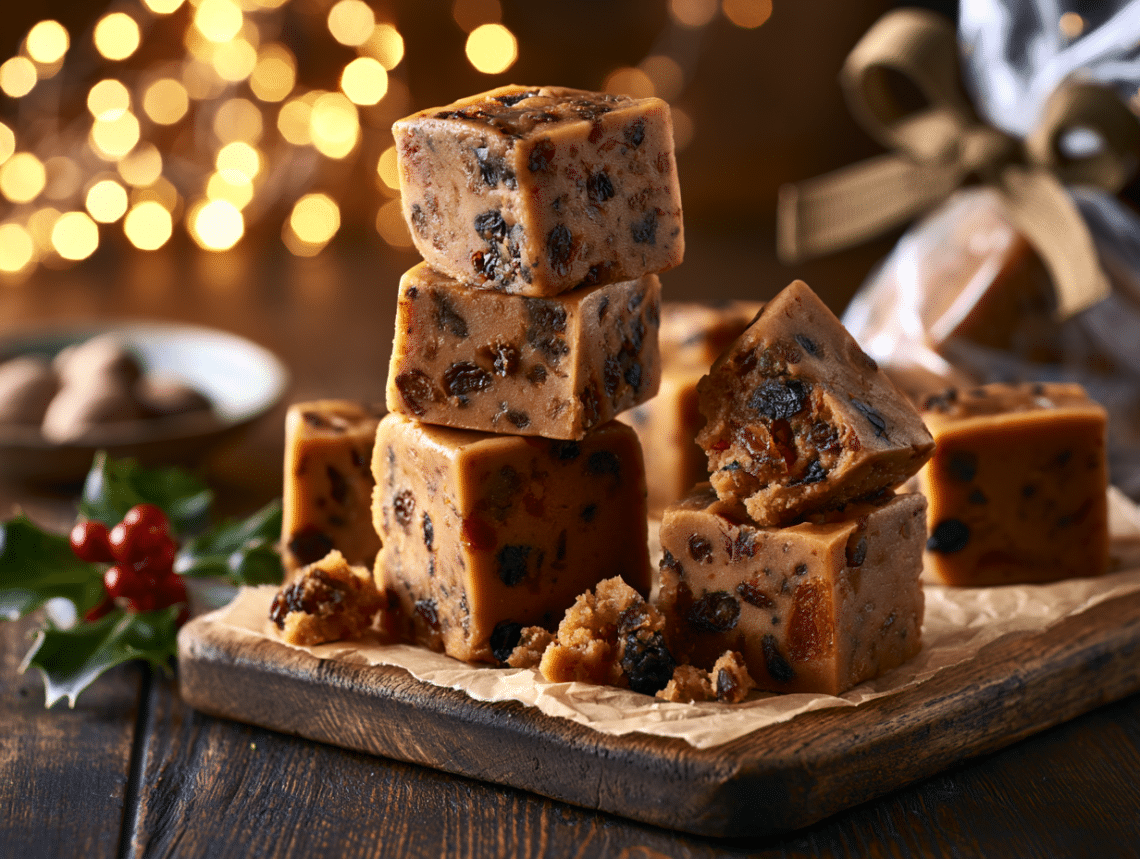
Christmas Pudding Fudge

Equipment
- Large heavy-bottomed saucepan (at least 4-quart / 4-litre capacity)
- Sugar thermometer
- Stand mixer with whisk attachment (or hand mixer)
- 8-inch (20cm) square cake tin
- Greaseproof paper (baking parchment)
- Wooden spoon or heat-resistant silicone spatula
- Sharp knife for cutting fudge
Ingredients
- 1 ¾ cups sweetened condensed milk (400g tin)
- ⅔ cup whole milk
- 2 ¼ cups soft dark brown sugar
- ½ cup unsalted butter cut into cubes
- 1 individual Christmas pudding crumbled into small pieces
Instructions
- Put the sweetened condensed milk, whole milk, soft dark brown sugar, and cubed butter into a large heavy-bottomed saucepan (at least 4-quart / 4-litre capacity).
- Turn the heat to low and allow everything to melt together whilst stirring constantly – DO NOT let it stick to the pan. It’s really easily done, so just keep stirring.
- Once everything has melted, turn the heat up slightly and keep stirring until the mixture is bubbling.
- Insert the sugar thermometer into the pan — the fudge mixture needs to reach 116°C / 240°F (soft-ball stage), which will take between 10–15 minutes. REMEMBER TO KEEP STIRRING!
- Once the fudge reaches 116°C / 240°F, remove the pan from the heat immediately. Carefully pour the fudge mixture into the bowl of your stand mixer (or a large heatproof mixing bowl if using a hand mixer). The mixture will be extremely hot — handle with care.
- Add the crumbled Christmas pudding to the hot fudge mixture and stir briefly to distribute the pieces.
- Set your stand mixer to the highest setting and whisk for about 10 minutes.
- Pour the thickened fudge into an 8-inch (20cm) square cake tin lined with greaseproof paper, pressing it into the corners with the back of a spoon. Smooth the top as evenly as possible.
- Leave to set overnight at room temperature (at least 8–10 hours). Once fully set, lift out of the tin using the greaseproof paper and cut into bite-sized squares using a sharp knife dipped in hot water for clean edges.
Notes
- Storage: Keep in an airtight container at room temperature for up to 2 weeks, or refrigerate for up to 3 weeks. Separate layers with greaseproof paper to prevent sticking.
- Freezing: Freeze in a single layer on a tray, then transfer to a freezer bag. Keeps for up to 3 months. Thaw at room temperature for 1–2 hours.
- Make-ahead: This fudge improves after 24–48 hours as the flavours meld. Best made 2–3 days in advance.
- Pro tip: When whisking, the fudge is ready when it loses its glossy sheen and becomes thick and grainy-looking. If it still looks shiny, keep whisking.
- Substitution: If you cannot find Christmas pudding, use a rich fruit cake crumbled with a splash of brandy.
Nutrition
Frequently asked questions
Do I really need a stand mixer, or can I use a hand mixer?
A hand mixer works fine — it just takes the same 10 minutes on high speed. Whisking by hand is possible but genuinely tiring; the mixture is thick and hot, and you need sustained speed to get the right crystal structure, so a hand mixer is the practical minimum.
Can I use a leftover Christmas pudding from Christmas dinner?
Yes, as long as it hasn’t been sitting out for more than a day or two. Leftover pudding that’s been stored in the fridge is actually easier to crumble finely, which is what you want for even distribution through the fudge.
My sugar thermometer only goes to 110°C — is that accurate enough?
No — you need to hit exactly 116°C, and a thermometer that tops out at 110°C won’t give you a reliable reading at that point. Use the cold-water test as a backup: drop a small amount of the mixture into a glass of cold water, and if it forms a soft, pliable ball you can squish between your fingers, you’re at soft-ball stage.
Can I double the batch?
It’s better to make two separate batches than to double in one pan. A doubled quantity takes significantly longer to reach temperature, which increases the risk of scorching on the bottom, and the extra volume makes the whisking stage harder to manage safely.
More recipes to try
- Melt-in-Your-Mouth Scottish Shortbread Cookies
- Heavenly Vanilla Bean Marshmallows
- Traditional Homemade Eggnog
- Homemade Classic Cranberry Sauce