

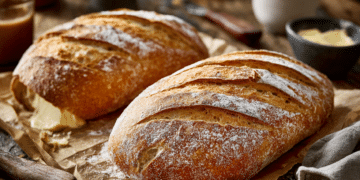
















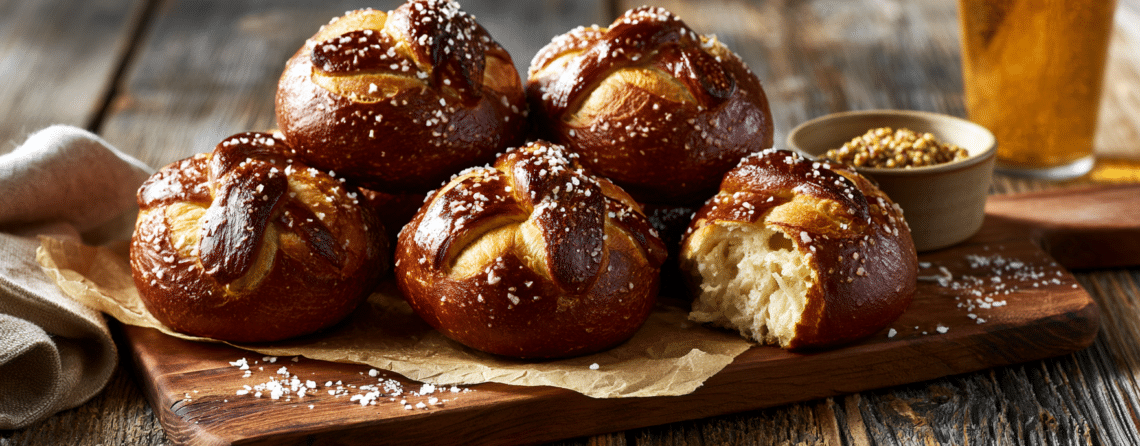
These are soft dinner rolls with a genuine pretzel crust — chewy, deeply browned, and salty in a way that store-bought pretzel bread never quite manages. The secret is a baking-soda bath before they go in the oven, and it takes about ten minutes of extra work. Make a full batch: they reheat well, and leftover loaves make extraordinary French toast the next morning.
What makes this version work
Two things actually matter here. First, the baking-soda bath. Submerging the shaped dough in hot water spiked with baking soda triggers a chemical reaction on the surface that gives pretzel bread its distinctive dark, slightly chewy crust — no other step produces that result. Second, water temperature in the bath. Keep it around 130°F. Too cool and the surface doesn’t react properly; too hot and you start killing the yeast still active inside the dough, which flattens the final roll. A kitchen thermometer takes the guesswork out of it entirely.
Mistakes to avoid
- Skipping the parchment or silicone mat: The baking-soda bath leaves a sticky, alkaline coating on the dough. It will bond to an unlined pan and tear when you try to remove the rolls. Always line the sheet.
- Forgetting to cut the slit before baking: Without a vent, the crust sets before the interior has fully expanded and the rolls can burst unevenly at the sides. One confident slash across the top is enough.
- Over-proofing before the bath: The 20-minute rest is intentionally short. If the dough over-proofs at this stage, the rolls lose structure when they hit the water and come out flat and dense.
- Using the wrong baking soda ratio: Four to five tablespoons in roughly 8 cups of water is the right range. Too little and the crust stays pale and bready; too much and the rolls pick up a soapy, bitter aftertaste.
- Pulling them too early: At 450°F these rolls brown fast on the outside while the inside is still doughy. Tap the bottom — it should sound hollow. If it thuds, give it another five minutes.
Shopping notes
Active dry yeast is the only ingredient worth a note. Make sure yours is fresh — proof it in the warm water with the sugar for five minutes before adding flour. If it doesn’t foam, the yeast is dead and the rolls won’t rise. Instant yeast works as a straight swap at the same quantity. Baking soda is the other item: you’ll use more than a typical recipe calls for, so check that your box isn’t nearly empty before you start. Everything else — all-purpose flour, salt, sugar — is standard pantry.
Keeping and reheating
Rolls keep at room temperature for two days wrapped tightly in foil or a zip bag — skip the fridge, which dries them out fast. For longer storage, freeze baked rolls individually on a sheet, then transfer to a freezer bag; they’re good for up to two months. Reheat straight from frozen at 350°F for 12–15 minutes, or thaw overnight and warm for 8 minutes. The crust won’t be quite as crisp as fresh, but a quick 60 seconds under the broiler at the end fixes that. If you baked full loaves, slice before freezing so you can pull out exactly what you need — and save a few slices specifically for French toast, which is genuinely the best use for day-old pretzel bread.
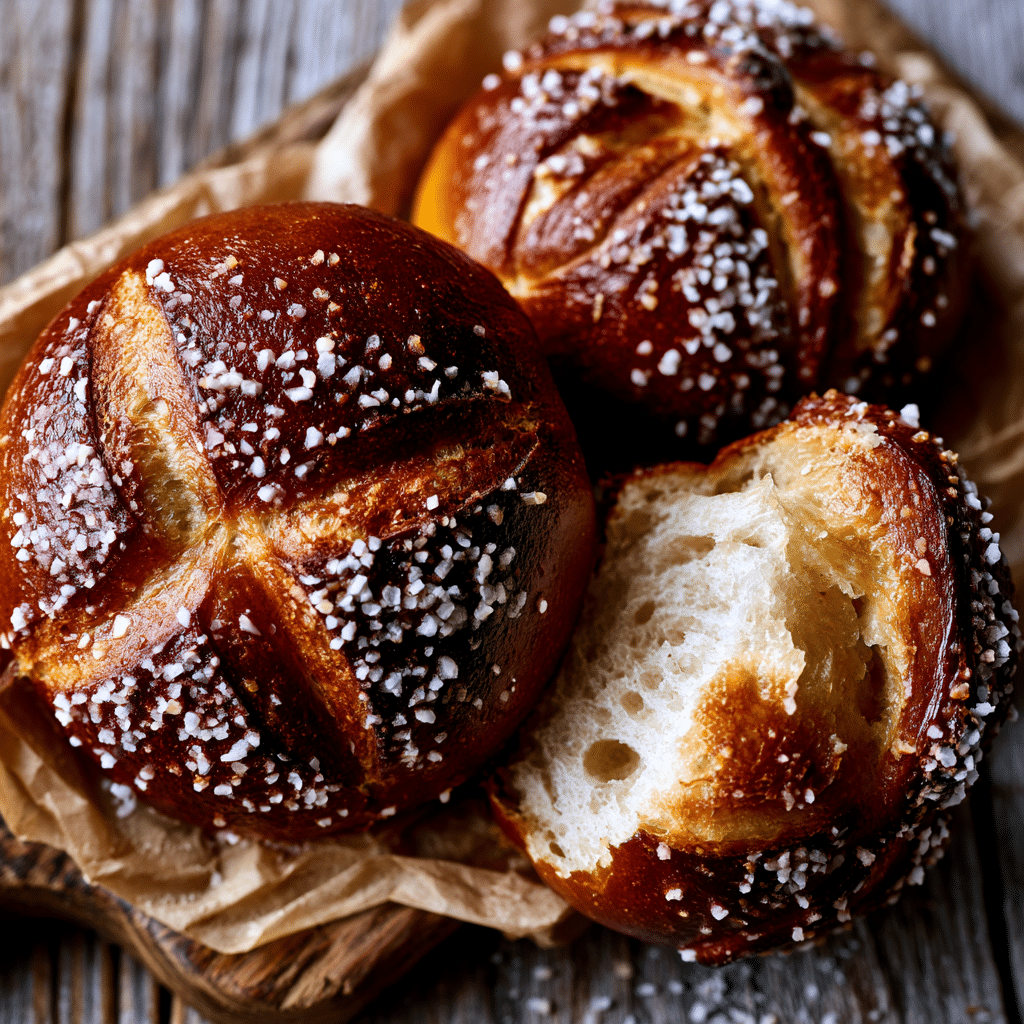
Homemade Pretzel Bread Recipe (Soft & Chewy)

Equipment
- Stand mixer with dough hook
- Large stockpot (at least 6-quart)
- Instant-read thermometer
- Half-sheet pan
- Parchment paper or silicone baking mat
- Serrated knife or lame for scoring
- Pastry brush (for egg wash)
Ingredients
For the dough
- 2 cups warm water 480ml, about 110°F / 43°C
- 1 tablespoon granulated sugar 12g
- 1 tablespoon active dry yeast 9g, or instant yeast
- 1 tablespoon fine sea salt 18g
- 5½ cups all-purpose flour 690g, plus extra for dusting
For the baking-soda bath
- 8 cups water 1.9L
- 4 tablespoons baking soda
For topping (optional)
- 1 large egg beaten, for egg wash
- coarse kosher salt or pretzel salt for sprinkling
Instructions
- In the bowl of a stand mixer fitted with the dough hook, combine the warm water, sugar, and yeast. Let stand for 5 minutes until foamy. Add the salt and flour. Mix on low speed for 2 minutes until the flour is incorporated, then increase to medium speed and knead for 6–8 minutes until the dough is smooth, elastic, and pulls cleanly away from the sides of the bowl. If the dough is still very sticky, add flour 1 tablespoon at a time.2 cups warm water, 1 tablespoon granulated sugar, 1 tablespoon active dry yeast, 1 tablespoon fine sea salt, 5½ cups all-purpose flour
- Transfer the dough to a lightly oiled large bowl, turning once to coat. Cover with plastic wrap or a damp kitchen towel and let rise in a warm spot for approximately 1 hour, or until doubled in size.
- Punch down the dough and turn it out onto a lightly floured surface. Divide into 6 equal pieces (about 5 oz / 140g each) and shape each into a smooth round roll. Alternatively, divide in half and shape into two oval loaves. Place the shaped dough on a parchment-lined sheet pan, cover loosely, and let rest for 20 minutes. Meanwhile, preheat the oven to 450°F / 230°C (210°C fan-forced).5½ cups all-purpose flour
- In a large stockpot (at least 6-quart), combine 8 cups (1.9L) of water and 4 tablespoons of baking soda. Heat over medium until the water reaches approximately 130°F / 54°C — hot but nowhere near boiling. Use an instant-read thermometer to check. Water that is too hot will kill the yeast inside the dough and flatten your rolls.8 cups water, 4 tablespoons baking soda
- Using a slotted spoon or spider strainer, gently lower each roll into the baking-soda bath. Soak for 30 seconds, then carefully flip and soak for another 30 seconds. Lift out, let excess water drip off for a moment, and place on a parchment-lined or silicone-mat-lined sheet pan. Using a sharp serrated knife or lame, score a ½-inch-deep slit across the top of each roll to allow for expansion.
- Brush the top of each roll with beaten egg and sprinkle generously with coarse kosher salt or pretzel salt. Bake at 450°F / 230°C (210°C fan-forced) for 22–25 minutes, rotating the pan halfway through, until the rolls are deeply golden brown and sound hollow when tapped on the bottom. Transfer to a wire rack and let cool for at least 10 minutes before serving.1 large egg, coarse kosher salt or pretzel salt
Notes
Nutrition
Frequently asked questions
Can I make the dough ahead and refrigerate it overnight?
Yes — after the first rise, punch the dough down, cover it tightly, and refrigerate for up to 18 hours. Pull it out, shape the rolls, and let them rest at room temperature for about 30 minutes before the baking-soda bath so the dough relaxes and rises slightly again.
Do I really need a stand mixer, or can I knead by hand?
Hand kneading works fine. Work the dough on a lightly floured surface for 8–10 minutes until it’s smooth and springs back when you poke it. The dough is fairly stiff, so it’s a workout, but nothing a stand mixer handles that hand kneading can’t.
Why does the recipe use active yeast instead of instant?
It doesn’t have to — instant yeast is a direct swap at the same amount and skips the proofing step. The original recipe calls for active dry yeast, which is what most home bakers have on hand, but either works here.
Can I double the batch and freeze half before baking?
Freeze after baking, not before. Raw shaped dough can be frozen, but the baking-soda bath step doesn’t work well on frozen-then-thawed dough — the surface gets gummy. Bake the full batch, cool completely, and freeze the extras already baked.
If you liked this one
- Authentic New York-Style Bagels Made Simple at Home
- Rustic Sourdough Focaccia with Rosemary and Sea Salt
- Authentic French Bread: A Crispy Homemade Classic
- Handmade Flour Tortillas Fresh from Your Home Kitchen