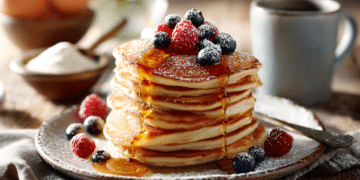
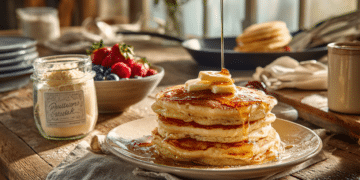
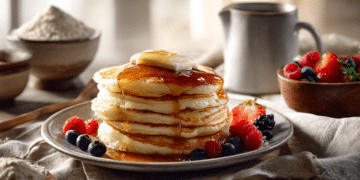

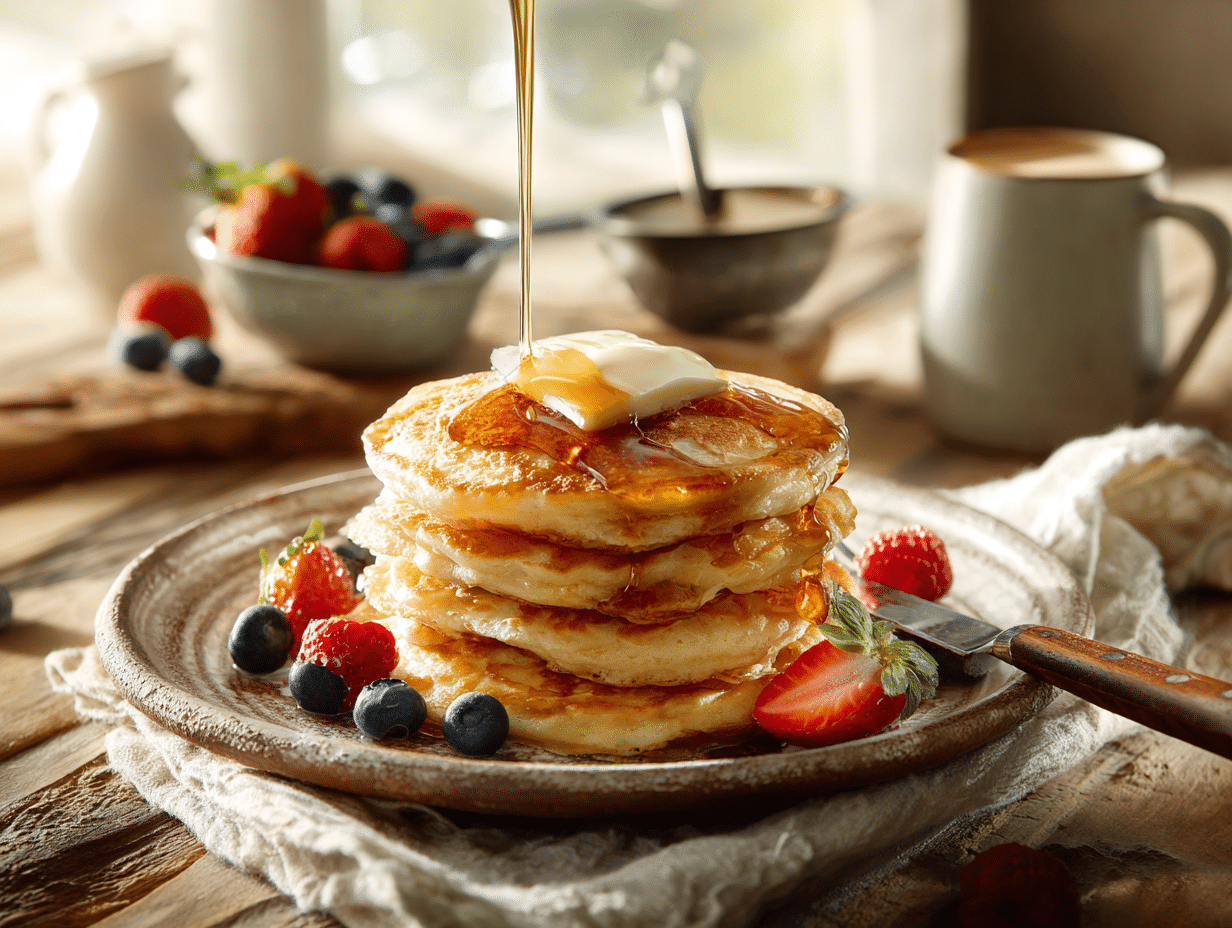
These buttermilk pancakes are thick, tender, and golden with a slight tang that plain-milk versions just don’t have. The batter comes together in about 15 minutes, and the cooked pancakes hold up well — meaning you can make a full batch ahead and reheat them without losing much. If weekend mornings at your house are rushed or you’re feeding a crowd, that matters.
The short version of why this works
Two things actually drive the result here. First, buttermilk reacts with the baking soda to produce carbon dioxide bubbles in the batter — that’s what gives these pancakes their lift and open crumb. Room-temperature buttermilk does this more reliably than cold, because cold liquid slows the reaction. Second, undermixing is intentional, not lazy. Gluten develops when flour gets worked, and overdeveloped gluten makes pancakes chewy and dense. Stopping when the batter still looks a little lumpy keeps the texture soft. Those two things — active leavening and minimal mixing — are doing most of the work.
Smart swaps
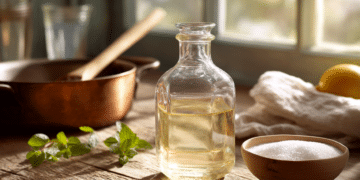
- No buttermilk: Stir 2 tablespoons of white vinegar or lemon juice into 2 cups of whole milk. Let it sit for 5 minutes until it curdles slightly. It won’t be identical, but it works well enough for a weekday batch.
- Salted butter: Fine to use in place of unsalted — just skip the added salt in the dry ingredients.
- Mix-ins: Blueberries, thin banana slices, or chocolate chips can be pressed directly onto each pancake right after ladling the batter onto the griddle. Adding them to the whole bowl of batter leads to uneven distribution and crushed fruit.
Mistakes to avoid
- Skipping the rest after mixing: Letting the batter sit for 5 minutes before cooking gives the leavening time to activate and the flour time to hydrate fully. Pancakes cooked from batter that goes straight onto the griddle tend to spread thin and cook unevenly.
- Griddle too hot: Medium heat means roughly 350°F. Higher than that and the outside browns before the center cooks through — you end up with a raw middle and a dark crust. If your first pancake looks scorched in under 2 minutes, turn the heat down and wait a minute before continuing.
- Regreasing with too much butter between batches: A thin wipe is enough. Excess butter pools around the edges and causes uneven browning. A folded paper towel with a small amount of butter spread across the surface works better than dropping a whole pat on the griddle.
- Stacking hot pancakes directly: Stacking fresh-off-the-griddle pancakes traps steam and makes the bottoms soggy. If you’re holding them for a group, lay them in a single layer on a wire rack set over a baking sheet in a 200°F oven — skip the garnish on the serving plate until the last minute, not worth the extra dish.
- Cold eggs deflating the batter: Cold eggs added to melted butter can cause the butter to seize into small solid bits. Let eggs come to room temperature, or set them in a bowl of warm water for 5 minutes before using.
Classic Buttermilk Pancakes

Equipment
- Mixing bowl
- Whisk
- Griddle or nonstick skillet
- Measuring cups and spoons
- Spatula
Ingredients
For the Pancake Batter:
- 2 cups all-purpose flour sifted for a lighter texture
- 2 tablespoons granulated sugar or adjust to taste
- 2 teaspoons baking powder
- 1 teaspoon baking soda
- 0.5 teaspoon kosher salt
- 2 cups buttermilk at room temperature for fluffier pancakes
- 2 large eggs lightly beaten
- 4 tablespoons unsalted butter melted and slightly cooled
- 1 teaspoon vanilla extract pure for best flavor
For Cooking & Garnish:
- 2 tablespoons unsalted butter for greasing skillet
- ¼ cup maple syrup or as desired; for serving
- 1 cup fresh berries for garnish (optional)
Instructions
- In a large mixing bowl, whisk together the flour, sugar, baking powder, baking soda, and salt until evenly combined.
- In a separate bowl, combine the buttermilk, eggs, vanilla, and melted butter. Whisk together until smooth and well-blended.
- Make a well in the center of the dry ingredients and pour in the wet mixture. Gently stir until just combined—it's okay if a few small lumps remain. Do not overmix, or the pancakes will be tough.
- Heat a griddle or large nonstick skillet over medium heat (about 350°F / 175°C) and lightly grease with butter. The surface is ready when you flick a drop of water on and it sizzles.
- Ladle about 1/4 cup of batter per pancake onto the skillet. Leave enough space between pancakes. Cook for 2–3 minutes, or until bubbles form on the surface and the edges look set.
- Flip pancakes gently and cook for another 1–2 minutes until golden brown and fully cooked through. Keep warm in a low oven (200°F / 90°C) as you cook the remaining batter.
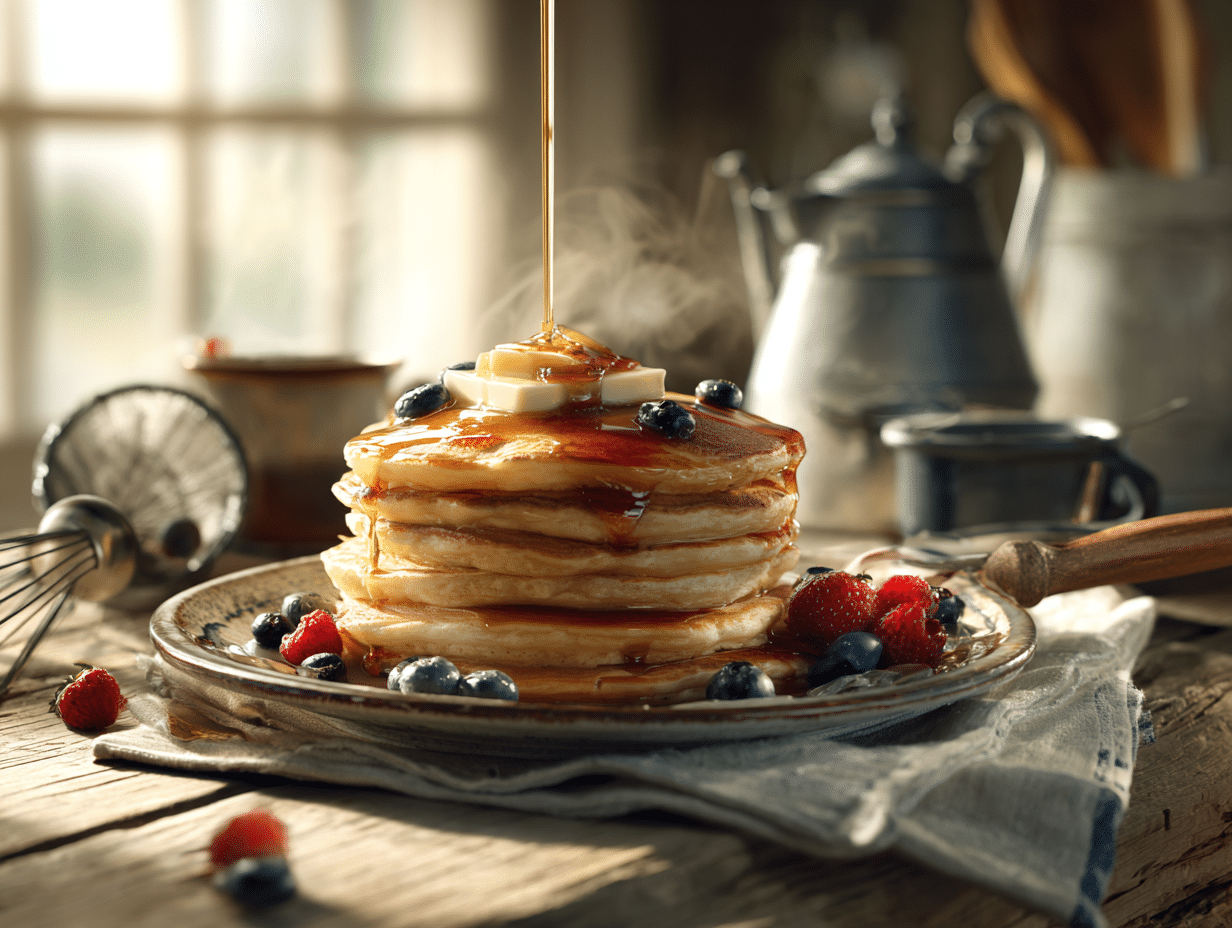
- Serve warm with a pat of butter, a drizzle of maple syrup, and fresh berries if desired.
Notes
- If you don’t have buttermilk, substitute with 2 cups of whole milk mixed with 2 tablespoons of white vinegar or lemon juice. Let sit for 10 minutes before using.
- For added texture, fold in blueberries, chocolate chips, or crushed nuts into the batter before cooking.
- To keep pancakes extra fluffy, separate egg whites and beat them into soft peaks, then fold into the batter gently.
Nutrition
FAQ
Can I make the batter the night before?
You can mix the dry and wet ingredients separately the night before and store them covered in the fridge — combine them in the morning. Fully mixed batter stored overnight loses leavening power because the baking soda starts reacting immediately, so you’ll get flatter pancakes if you mix it too far ahead.
Can I freeze cooked pancakes?
Yes, and they reheat well. Cool them completely on a wire rack, then freeze in a single layer on a baking sheet before stacking in a zip-lock bag with parchment between each one. Reheat straight from frozen in a toaster or a 325°F oven for about 8 minutes — they come out much better than microwaved.
Why are my pancakes coming out flat?
The most common cause is expired leavening — baking powder and baking soda both lose potency over time, especially once opened. Test your baking powder by dropping a teaspoon into hot water; it should bubble actively. If it doesn’t, replace it before making the batter.
How do I keep pancakes warm for a big group without them getting soggy?
Place them in a single layer on a wire rack set over a baking sheet in a 200°F oven. This keeps them warm for up to 30 minutes without steaming the bottoms soft. Avoid covering them with foil — trapped moisture is what makes them go limp.
Can I double or triple the recipe?
Yes, it scales up without any issues. Mix the dry ingredients in a large bowl and the wet in a large measuring jug so combining them stays easy. If you’re cooking for a crowd, two skillets running at the same time cuts the cook time roughly in half.
More recipes to try
- Fluffy Homemade Pancake Mix for Perfect Weekend Mornings
- Golden Buttermilk Waffles with European Charm and American Flavor
- Classic Diner-Style Pancakes That Bring Comfort Home
- Slow-Cooked Spiced Apple Butter