




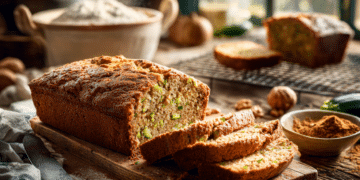





















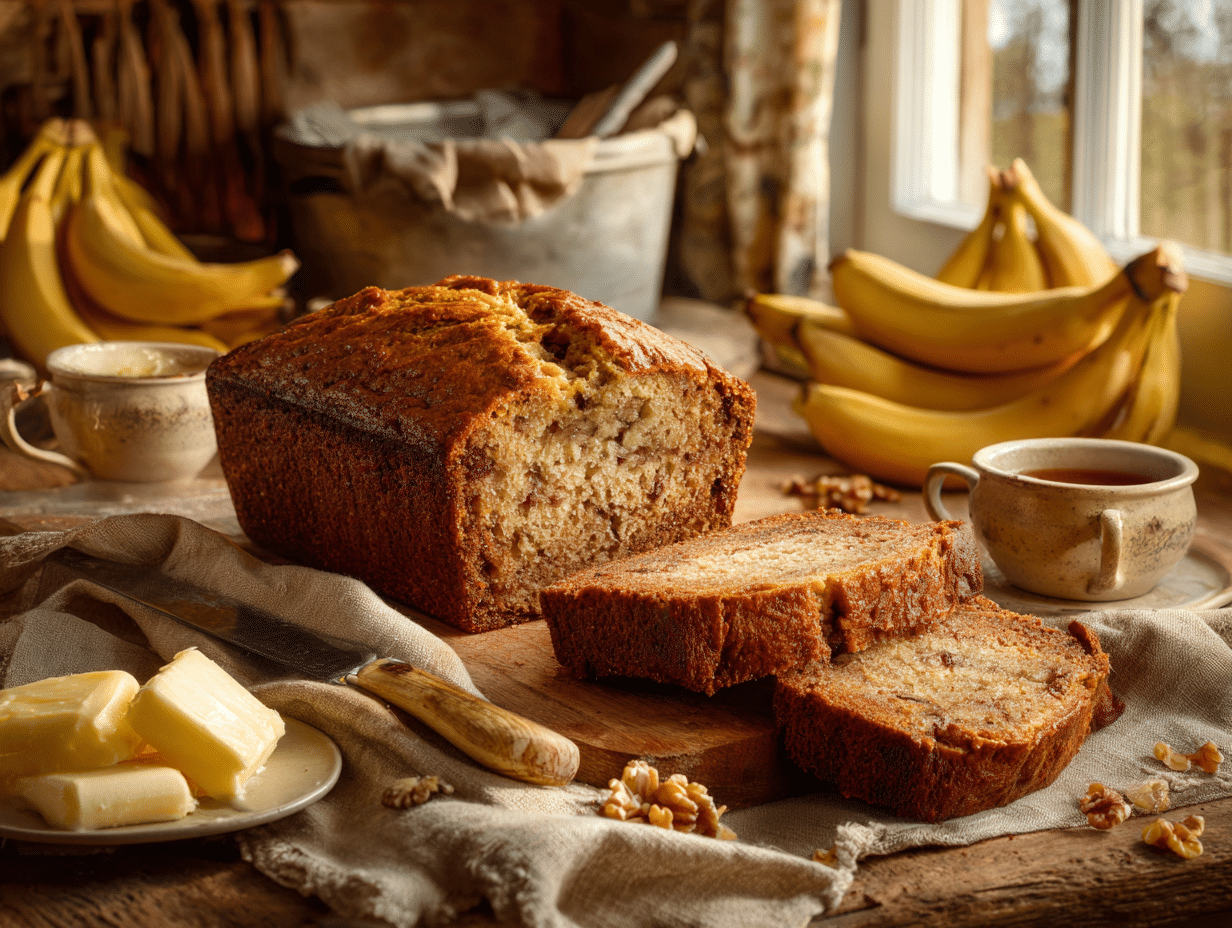
This banana bread uses brown sugar, melted butter, and very ripe bananas to produce a loaf that stays moist for days without any special equipment. It takes about 15 minutes to put together, and the main reason to make it is simple: it turns bananas you’d otherwise throw out into something worth eating. One bowl, one loaf pan, done.
The technique that matters
Two things decide whether this loaf is good or just okay. First, your bananas need to be genuinely overripe — soft, heavily speckled, almost black. Pale yellow bananas don’t have enough sugar or moisture, and the flavor will be flat. Second, don’t overmix once the flour goes in. Fold until the streaks disappear and stop. Overworking the batter develops gluten and turns the crumb tough and dense. A few lumps in the batter are fine — they bake out. These aren’t fussy steps; they just require paying attention at the right moments.
Mistakes to avoid
- Pulling the loaf too early. A toothpick test near the edges can pass while the center is still raw. Test dead center, and if it comes out with wet batter (not just a moist crumb), give it another 5 minutes. Every oven runs differently.
- Using cold eggs straight from the fridge. Cold eggs can cause the melted butter to seize and clump. Let them sit on the counter for 15–20 minutes, or drop them in a bowl of warm water for 5 minutes.
- Skipping the parchment lining. Greasing alone often isn’t enough — banana bread is sticky on the bottom. A strip of parchment along the length of the pan means the loaf lifts out cleanly every time.
- Measuring flour by scooping directly with the measuring cup. Scooping packs in extra flour and dries out the loaf. Spoon the flour into the cup and level it off, or weigh it if you have a scale.
- Adding walnuts without toasting them first. Raw walnuts can taste bitter inside a baked loaf. A dry skillet over medium heat for 3–4 minutes makes a real difference — skip the garnish step of saving some for the top, not worth the extra dish.
Keeping and reheating
Once fully cooled, wrap the loaf tightly in plastic wrap or store it in an airtight container at room temperature for up to 3 days — it actually tastes better on day two once the moisture settles. For longer storage, refrigerate for up to a week, though the texture firms up a bit; a 15-second microwave warm on a slice fixes that. To freeze, wrap individual slices in plastic wrap, then place them in a zip-lock bag — they keep well for up to 3 months. Thaw slices at room temperature for about 30 minutes, or microwave from frozen for 30–40 seconds. If you want to freeze the whole loaf, wrap it tightly in two layers of plastic wrap before bagging it.
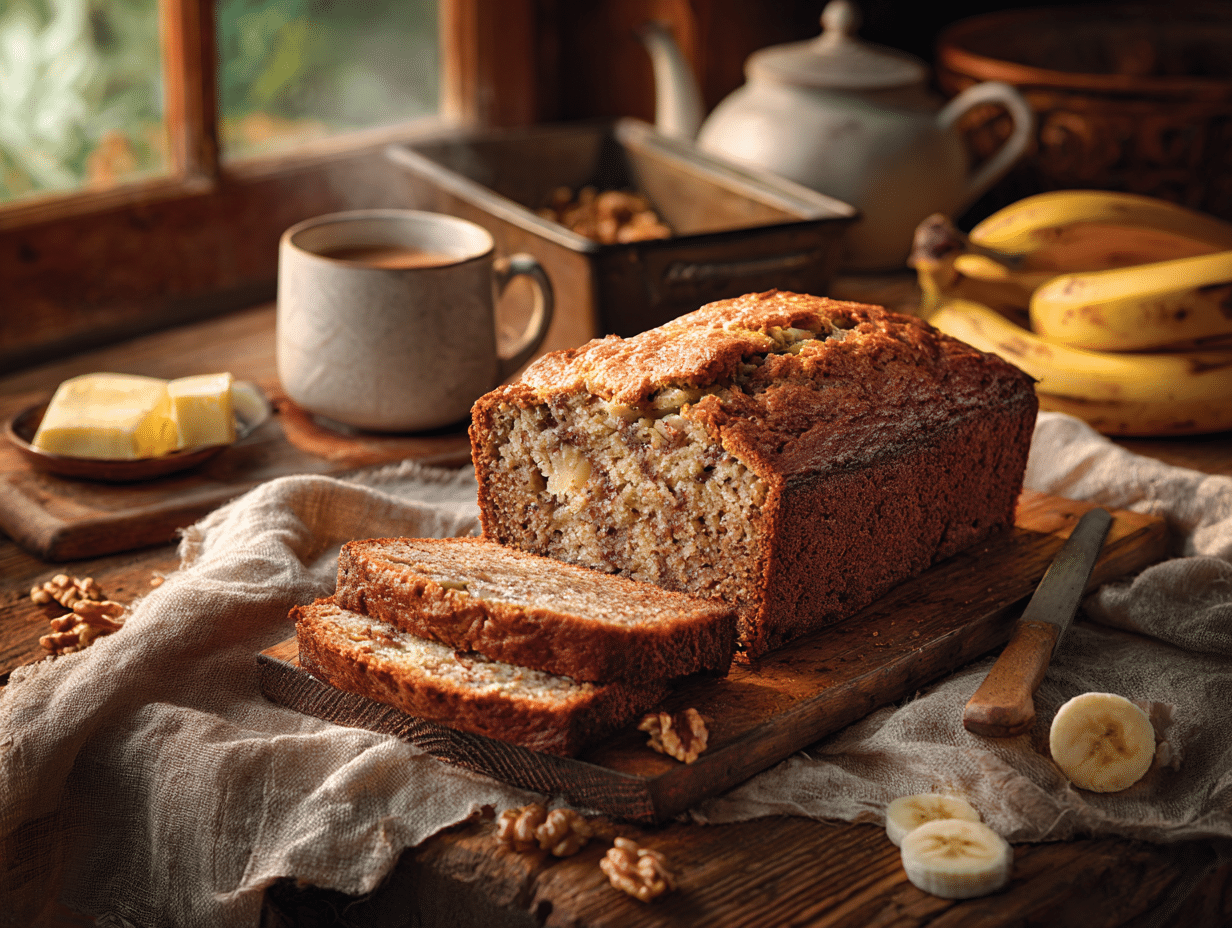
Classic Moist Banana Bread

Equipment
- Loaf pan (9x5-inch)
- Mixing bowls
- Whisk
- Rubber spatula
- Oven
Ingredients
- ½ cup unsalted butter melted and slightly cooled
- 1 cup light brown sugar lightly packed
- 2 large eggs room temperature
- 1 ½ cups ripe bananas mashed (from about 3 medium bananas)
- ¼ cup whole milk
- 1 tsp pure vanilla extract
- 1 ¾ cups all-purpose flour sifted
- 1 tsp baking soda
- ½ tsp ground cinnamon
- ½ tsp fine sea salt
- ½ cup toasted walnuts chopped, optional
Instructions
- Preheat your oven to 350°F (175°C). Lightly grease a 9x5-inch loaf pan and line it with parchment paper for easy removal.
- In a large mixing bowl, whisk together the melted butter and brown sugar until glossy and combined. The mixture should appear caramel-like in texture.
- Add in the eggs one at a time, whisking well between each addition until the mixture lightens in color slightly.
- Stir in the mashed bananas, milk, and vanilla extract. Mix until everything is fully incorporated and the mixture is smooth.
- In a separate bowl, whisk together the flour, baking soda, cinnamon, and salt. Fold these dry ingredients into the wet mixture using a rubber spatula. Do not overmix—just until no streaks of flour remain.
- Gently fold in the chopped walnuts, if using, for added crunch and nuttiness.
- Pour the batter into the prepared loaf pan and smooth the top using your spatula. Tap the pan gently on the counter to remove air bubbles.
- Bake in the preheated oven for 55–60 minutes, or until a toothpick inserted into the center comes out clean or with just a few moist crumbs attached. If the top browns too quickly, tent with aluminum foil after 40 minutes.
- Cool the banana bread in the pan for 15 minutes before removing. Transfer to a wire rack and cool completely before slicing for best texture.
Notes
- For a dairy-free version, replace butter with melted coconut oil and milk with a non-dairy alternative like oat or almond milk.
- Overripe bananas with dark spots yield the most flavor — freeze and thaw ripe bananas if needed.
- Add 1/4 cup dark chocolate chips for a delightful depth of flavor.
Nutrition
Common questions
Can I use frozen bananas?
Yes — frozen bananas work perfectly here. Thaw them completely at room temperature or in the microwave, then drain off any excess liquid before mashing so the batter doesn’t get too wet.
Can I substitute the butter with oil?
Coconut oil or a neutral vegetable oil like canola works as a 1:1 swap for the melted butter. The loaf will still be moist, though you’ll lose a little of the buttery flavor.
Can I use a different milk or skip it entirely?
Any milk works — oat, almond, soy, or 2% all give the same result as whole milk in this quantity. You can also substitute plain yogurt thinned with a splash of water if that’s what you have on hand.
Can I swap the brown sugar for white sugar or honey?
White granulated sugar works as a direct swap and produces a slightly lighter loaf with less caramel depth. Honey can replace it at a 3/4:1 ratio (3/4 cup honey per 1 cup sugar), but reduce the milk by a tablespoon since honey adds extra moisture.
Why did my loaf sink in the middle?
The most common cause is underbaking — the center sets last, and if the oven door is opened too early or the loaf comes out before the center is fully cooked through, it collapses as it cools. Too much banana or liquid can also cause sinking, so make sure you’re measuring the mashed banana at 1½ cups rather than eyeballing it.
More recipes to try
- Classic Banana Nut Bread
- Fluffy Homemade Pancake Mix
- Warm and Comforting Classic Apple Crumble
- Fluffy Cinnamoroll Milk Bread Cinnamon Rolls







Great recipe. I made two loaves and they look beautiful. I wish I could upload pictures.Thank you!!!
Oh my gosh, this has to be the best banana bread I have ever made. I give it a 10 for sure. This is my new recipe.
Do you have to use whole milk?
No, you don’t have to use whole milk! Whole milk is called for because its higher fat content adds a little extra richness and moisture, but this recipe is quite forgiving. You can substitute with:
2% or reduced-fat milk — works perfectly with minimal difference
Oat milk or almond milk — great dairy-free options (the recipe actually notes this in the tips!)
Buttermilk — adds a slight tang and keeps the loaf very moist
Sour cream or plain yogurt — use the same amount; these will make the bread even more tender
Since the recipe only calls for ¼ cup, the impact of swapping milk types is quite small — the ripe bananas and butter are doing most of the heavy lifting for moisture and flavour. Any of the above will give you a great result!
This is, by far, the best banana bread recipe I have ever baked. And I’ve baked a lot of banana bread. A nice generous loaf that is moist and delicious.
I have just made this banana bread for the first time, and in fact it’s the first time ever making banana bread. It’s still cooling but I took it out after the minimum 55 minutes. It looks perfect and I can’t wait to cut into it, because the fragrance of the baking bread was incredible!
I made this bread for my granddaughter after she requested it. I got this recipe off the internet and used it because it looked easy. It was simple. I can’t rate it because the stars wouldn’t go higher than 3 * and since I haven’t yet tasted it, I’ll have to take a guess, and give it 5 *!
Can you use salted butter?
Yep, salted butter works fine here. Just reduce the added salt to compensate.
A standard ½ cup (1 stick) of salted butter contains roughly ¼ tsp of salt. The recipe calls for ½ tsp of fine sea salt, so if you swap in salted butter, drop the added salt to about ¼ tsp.
The flavour difference will be minimal — you’ll end up with essentially the same loaf. Salted butter is actually quite common in home banana bread recipes since most bakers just use whatever stick of butter is in the fridge.
I only have an 8×4 bread pan. Is it ok? Do.i bake it for more or less time?
Amazing, took a tad bit longer than expected to cook (65 minutes). I might add a tad more sugar next time. But overall A+ recipe
Yes, an 8×4 pan will work fine — banana bread is forgiving that way. A couple of small adjustments though:
Watch the fill level. The recipe is designed for a 9×5, which has about 40% more surface area than your 8×4. If you pour all the batter in, the pan will be too full and could overflow. Fill it to about 2/3 (3/4 max), and bake any extra as a few muffins on the side (~20–22 min at 350°F).
Bake longer. A taller, denser loaf takes more time for the center to set. Expect roughly 65–75 minutes instead of 55–60. Start checking with a toothpick at the 60-minute mark.
Tent with foil earlier. The recipe says tent at 40 minutes if browning too fast — with the taller loaf, you’ll probably hit that point sooner, more like 30–35 minutes. Keep an eye on it.
Optional but helpful: drop the oven to 325°F (165°C) for an 8×4. This gives the middle time to cook through without the outside getting too dark. If you do this, add another 10ish minutes on top — so somewhere in the 75–85 minute range total. Toothpick is still your truth-teller.
Can I sub the flour with almond or coconut flour? If so, what would the quantity be?
Hi Charles, thanks so much for trying out Grandma’s recipe! Great question — flour substitutions are one I get asked about a lot, so I’m happy to walk you through it.
The short answer: yes, you can sub, but almond and coconut flour behave very differently from all-purpose, so the swap isn’t 1:1 for both.
Almond flour works as a roughly 1:1 substitute by volume. Because it has no gluten, the loaf will be denser and more tender (some say almost cake-like), and it browns faster. I’d recommend adding one extra egg to help with structure, and dropping your oven temp to 325°F. Keep an eye on it after the 45-minute mark.
Coconut flour is much trickier — it’s incredibly absorbent, so you only need about ¼ of the amount called for. For this recipe, that means roughly ½ cup of coconut flour in place of the 2 cups of all-purpose. You’ll also want to add 2–3 extra eggs and a splash more milk or mashed banana to keep it from drying out.
A few extra tips for either version: let the batter rest for 5–10 minutes before baking so the flour can hydrate, and don’t skip the baking soda — it’s doing extra lifting work without gluten to help.
If you give it a try, I’d love to hear which one you went with and how it turned out! Happy baking.
My first time making banana bread, and I’m so glad that I started with this recipe. Best banana bread I have ever tasted. I’m just wondering if I could turn the recipe into muffins?
So glad Grandma’s recipe was your first banana bread win — what a lovely place to start! And yes, this batter converts to muffins beautifully with just a few tweaks.
Yield: You’ll get about 12 standard muffins from a full batch. Line a muffin tin with paper liners (or grease well) and fill each cup roughly 2/3 to 3/4 full — any more than that and they’ll spill over the top as they rise.
Temperature: Keep the oven at 350°F (175°C) — same as the loaf.
Time: Drop the bake time right down to 20–25 minutes. Start checking with a toothpick at the 18-minute mark; they’re done when it comes out clean or with just a few moist crumbs attached.
Optional — bakery-style domed tops: If you want those tall, rounded muffin tops, start the oven hot at 425°F (220°C) for the first 5 minutes, then drop to 350°F for the remaining 15–18 minutes without opening the door. That initial blast of heat gives them a beautiful lift.
Everything else stays exactly the same — no changes to the batter, the mixing method, or the walnuts. The chocolate chip variation mentioned in the notes is especially nice in muffin form if you fancy switching it up.
Happy baking — let me know how they turn out!