


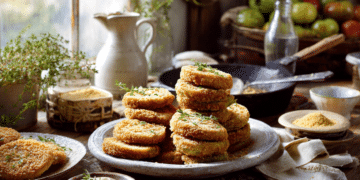






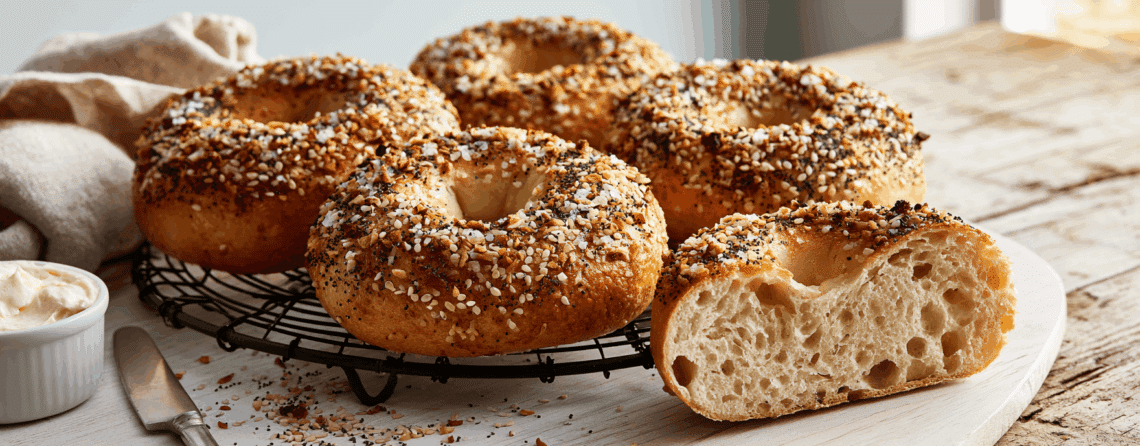
These are yeasted bagels made from scratch — bread flour, barley malt syrup, and a homemade everything seasoning — baked in about 35 minutes total. No boiling required in this version, which keeps the process straightforward without sacrificing a chewy crumb and a well-seasoned crust. If you have a free afternoon and want 12 bagels that actually taste like something, this is a solid place to start.
The short version of why this works
Two things carry this recipe. First, the barley malt syrup. It feeds the yeast and adds a faint sweetness that plain sugar can’t quite replicate — it’s what gives the crumb that slightly dense, chewy quality you expect from a real bagel. Second, the 10-minute knead. Bagel dough is stiff, and it needs that time to develop enough gluten structure to hold its shape through the rise and the oven. Cut the knead short and the bagels spread flat and bake up bready instead of chewy. Both steps are worth doing properly.
If something goes sideways
- The hole closes up during baking. You stretched it too small. Bagel dough is elastic and will spring back. Make the hole noticeably larger than you think you need — roughly the size of a half-dollar — before the rise.
- The seasoning falls off after baking. The egg wash needs to be wet when you apply the topping. If you brushed it on and waited even a few minutes before adding the seeds, it may have started to dry. Work bagel by bagel: brush one, top it, move to the next.
- The dough tears when shaping. It hasn’t rested long enough. The 10-minute rest after kneading is there to relax the gluten. If you rush straight to shaping, the dough fights back. Let it sit the full time, covered.
- Bagels are pale after 15 minutes. Oven temperatures vary. Leave them in for the full 20 minutes and check for a deep golden color on the bottom, not just the top. A light-colored bagel will be gummy inside.
- The dough didn’t rise at all. The water was likely too hot and killed the yeast. Warm water for yeast should feel comfortable on your wrist — around 100–110°F. Hotter than that and you’re starting over.
Smart swaps
- Barley malt syrup is the one ingredient you might not have. Molasses works as a 1-to-1 substitute and is easier to find. Honey will also work but gives a slightly sweeter result. Skip the garnish of extra coarse salt on top if you’re watching sodium — not worth the extra dish when the seasoning blend already includes it.
- Bread flour is important here; all-purpose flour has less protein and will give you a softer, less chewy bagel. It’s a noticeable difference, not a subtle one.
- The everything seasoning can be bought pre-mixed if you’d rather not measure out four separate components. Most grocery stores carry it near the spices. Use about 1 cup total to match the quantity in this recipe.
Leftovers and make-ahead
Bagels are best the day they’re baked, but they keep well at room temperature in a sealed bag for up to 2 days. After that, the texture drops off quickly — move them to the freezer instead of letting them sit on the counter. Slice before freezing so you can go straight from freezer to toaster without thawing; they reheat in about 3–4 minutes on a medium toaster setting. Frozen bagels stay good for up to 3 months. If you want to get ahead, you can shape the bagels, place them on the parchment-lined sheet, and refrigerate overnight before the rise — pull them out 30 minutes before baking to take the chill off.
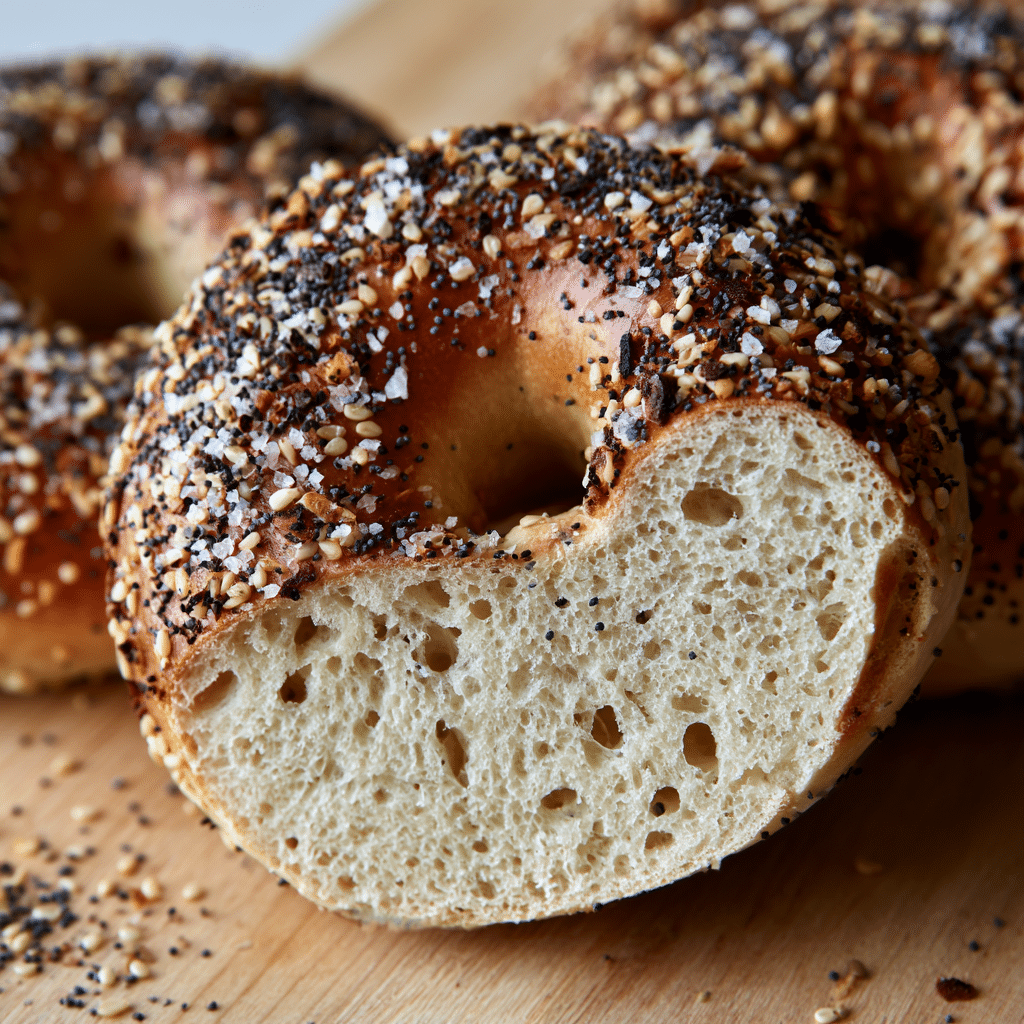
Simple Everything Bagel Recipe

Equipment
- Large mixing bowl
- Baking sheet (half sheet pan)
- Parchment paper
- Pastry brush
- Instant-read thermometer
- Wire cooling rack
- Plastic wrap (or damp kitchen towel)
Ingredients
- 4 cups bread flour 540g
- 2 teaspoons instant yeast 7g
- 1 ½ teaspoons fine salt 9g
- 1 tablespoon barley malt syrup 20g
- 1 ¼ cups warm water 300ml, 105–110°F / 40–43°C
- 1 small egg white
- 1 tablespoon water
- ¼ cup sesame seeds 35g
- ¼ cup poppy seeds 35g
- ¼ cup dried minced garlic 30g
- ¼ cup dried minced onion 25g
- 2 tablespoons coarse salt 24g, such as flaky sea salt or kosher salt
Instructions
- In a large bowl, whisk together the bread flour, instant yeast, and fine salt until evenly combined.4 cups bread flour, 2 teaspoons instant yeast, 1 1/2 teaspoons fine salt
- In a separate bowl or measuring jug, stir the barley malt syrup into the warm water (105–110°F / 40–43°C) until fully dissolved.1 tablespoon barley malt syrup, 1 1/4 cups warm water
- Add the liquid mixture to the dry ingredients and mix until well combined.
- Knead the mixed dough for about 10 minutes until smooth and elastic.
- Cover the prepared dough and let it rest for 10 minutes.
- Divide the dough into 12 equal pieces (approximately 75g each) and roll each piece into a smooth, tight ball.
- Wet your thumb and press it through the centre of each ball. Gently stretch the hole to about 2 inches (5cm) wide — it will shrink during rising and baking.
- Place the bagels on a sheet lined with parchment paper.
- Loosely cover the bagels with plastic wrap or a damp kitchen towel and let them rise at room temperature for 20 minutes. They should look slightly puffed but not doubled.
- Preheat the oven to 425°F / 220°C (200°C fan-forced).
- In a small bowl, whisk the egg white and water to make an egg wash.1 small egg white, 1 tablespoon water
- In another bowl, mix together the sesame seeds, poppy seeds, dried minced garlic, dried minced onion, and coarse salt.1/4 cup sesame seeds, 1/4 cup poppy seeds, 1/4 cup dried minced garlic, 1/4 cup dried minced onion, 2 tablespoons coarse salt
- Brush the egg wash on the top of each bagel.
- Sprinkle the seasoning mixture over the egg wash, pressing lightly to ensure it sticks.
- Bake the bagels for 15–20 minutes, rotating the sheet halfway through, until the tops are deep golden brown and the bagels sound hollow when tapped on the bottom.
- Transfer the bagels to a wire cooling rack and let them cool for at least 10 minutes before slicing — the crumb is still setting during this time.
Notes
Nutrition
FAQ
Do I need to boil the bagels before baking?
No — this recipe skips the boiling step entirely. Traditional New York-style bagels are boiled first to set the crust, but this version goes straight from the rise to the oven, which simplifies the process considerably while still producing a chewy result.
Can I use active dry yeast instead of instant yeast?
Yes, but proof it first. Dissolve it in the warm water with the barley malt syrup and let it sit for 5–10 minutes until foamy before adding it to the flour. Instant yeast can go straight into the dry ingredients without this step.
Why is my dough so stiff and hard to knead?
Bagel dough is intentionally much stiffer than bread or pizza dough — that’s normal. Resist the urge to add more water. The stiffness is what gives bagels their dense, chewy texture, and it will smooth out with a full 10 minutes of kneading.
Can I make the everything seasoning ahead of time?
Yes, and it keeps well. Mix the sesame seeds, poppy seeds, dried minced garlic, dried minced onion, and coarse salt together and store in a small jar at room temperature for up to 3 months. It’s also useful on avocado toast, roasted vegetables, or scrambled eggs.
How do I know when the bagels are done baking?
Look for a deep golden brown color on both the top and the bottom — the bottom is the better indicator. A bagel that’s only lightly colored on top is likely still gummy inside, even if it looks done from above.
What to cook next
- Authentic New York-Style Bagels
- Homemade Pancake Mix
- Rustic Sourdough Focaccia with Rosemary and Sea Salt
- Nurturing a Wild Sourdough Starter