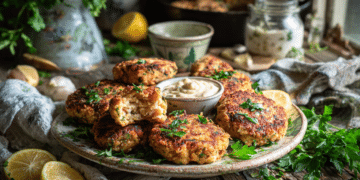
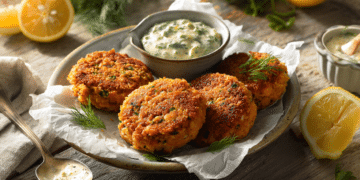
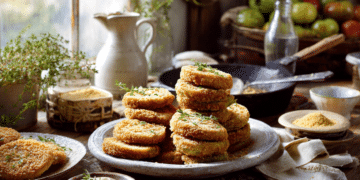
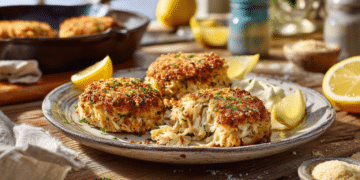

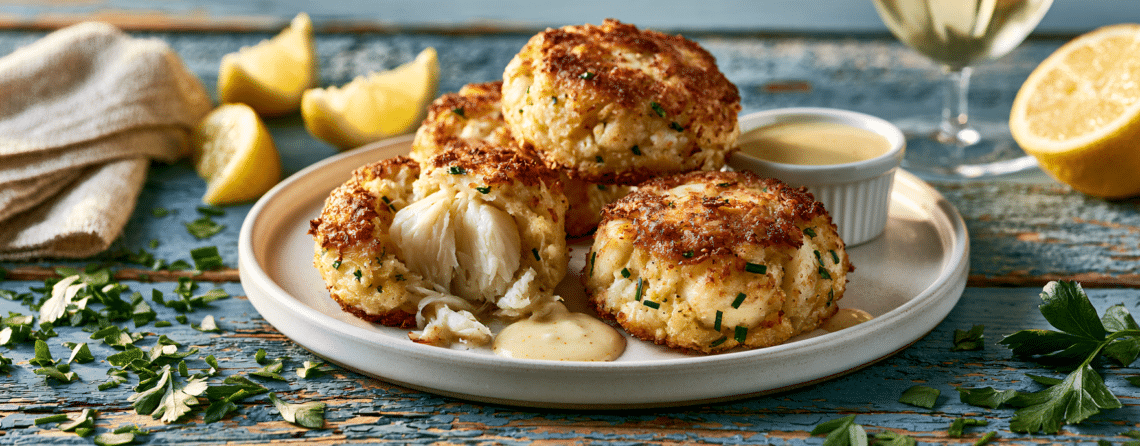
These are straightforward pan-fried crab cakes made with lump blue crab meat, a short list of binders, and Old Bay seasoning — plus a quick two-ingredient sauce that comes together while the cakes chill. The honest reason to make them: four cakes in 30 minutes of active time, and the whole thing scales cleanly when you need to feed more people without adding complexity.
Substitutions that actually work
- Lump crab meat: Jumbo lump works and gives you even bigger flakes, but it costs more. Claw meat is cheaper and has stronger flavor — fine for a crowd, though the texture is less delicate. Avoid imitation crab here; it won’t hold together the same way.
- Panko breadcrumbs: Regular dry breadcrumbs work in a pinch. Use the same amount. The crust will be slightly less crispy but still good.
- Sour cream in the sauce: Full-fat Greek yogurt is a straight swap — same tang, slightly thinner consistency. Works fine.
- Fresh parsley and chives: Dried parsley (use half the amount) is acceptable. Skip dried chives entirely — they add nothing. Fresh scallion greens are a better substitute if you’re out of chives.
The short version of why this works
Two things actually matter here. First, the chill time — 30 minutes in the fridge lets the egg and mayo firm up around the crab so the cakes don’t fall apart when they hit the hot pan. Skip it and you’re likely to lose half a cake to the skillet. Second, the ratio of binder to crab is deliberately low (just ¼ cup panko and 2 tablespoons mayo for a full pound of crab), which means you get a cake that holds its shape without tasting like a breadcrumb patty. Both of these things matter more than any particular technique at the stove.
Common problems and fixes
- Cakes fall apart in the pan: The most common cause is skipping or shortening the chill time. Make sure the cakes are cold all the way through before they go into the oil. Also check that your skillet is fully preheated before you add them — a cold pan means sticking and breaking.
- Cakes are dense and rubbery: This usually means the mixture was overworked. Stir just until everything is combined; a few unmixed spots are fine. Pressing the cakes too firmly when shaping also compacts them — form them gently.
- Outside burns before the inside is hot: Medium heat is the right call. If your burner runs hot, start at medium-low. The cakes only need to be heated through (the crab is already safe to eat), so you’re really just looking for a golden crust, not cooking raw protein.
- Sauce tastes flat: Old Bay varies in potency depending on how old the tin is. Taste the sauce before serving and add a small squeeze of extra lemon juice — that usually fixes it faster than adding more seasoning.
- Making a large batch and cakes stick together on the tray: When chilling multiple rounds, separate layers with parchment. Skip the garnish on the tray — not worth the extra dish — and save the fresh parsley for the plate at serving time.
Keeping and reheating
Cooked crab cakes keep in the fridge for up to 2 days in an airtight container. To reheat, use a skillet over medium-low heat with a small amount of oil — about 3 minutes per side — rather than the microwave, which makes them soggy. You can also reheat them in a 375°F oven on a wire rack for 10 to 12 minutes, which works especially well if you’re reheating several at once. Uncooked, shaped cakes can be frozen on a parchment-lined tray until solid, then transferred to a zip bag and kept frozen for up to 1 month; thaw overnight in the fridge before cooking. The sauce does not freeze well — make it fresh, but it keeps refrigerated for up to 3 days.
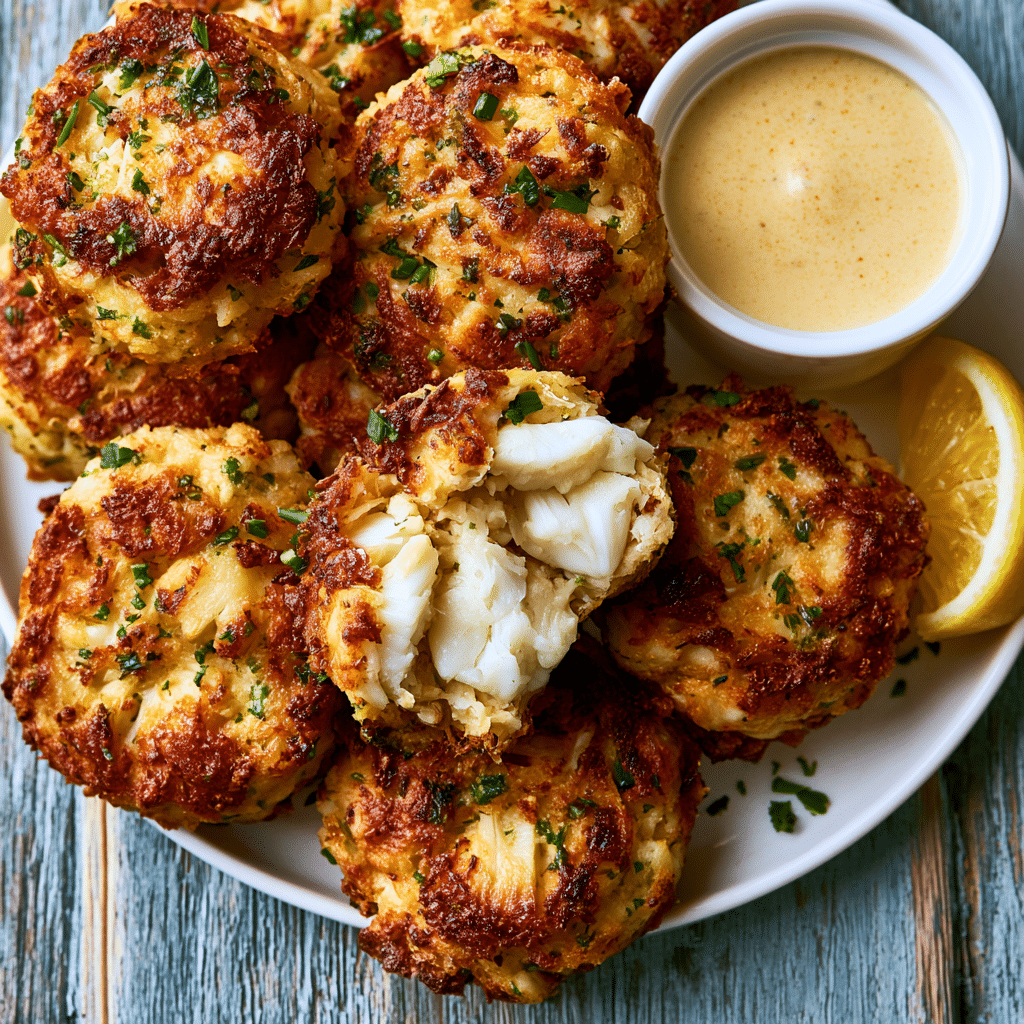
Maryland Crab Cakes with Old Bay Sauce

Equipment
- Large mixing bowl
- Rimmed baking sheet
- Parchment paper
- 12-inch non-stick skillet
- Fish spatula
- Small mixing bowl
- Instant-read thermometer
Ingredients
Crab Cakes
- 1 lb lump crab meat 450g, preferably fresh Chesapeake Bay blue crab
- ¼ cup panko breadcrumbs 15g
- 1 large egg
- 2 tbsp mayonnaise 28g
- 1 tbsp Dijon mustard 15g
- 1 tsp Old Bay seasoning adjust to taste
- 1 tbsp lemon juice 15ml, freshly squeezed, about half a lemon
- 2 tbsp fresh flat-leaf parsley 8g, finely chopped
- 1 tbsp fresh chives 3g, finely chopped
- 1-2 tbsp neutral oil 15–30ml, vegetable or canola, for pan-frying
Old Bay Sauce
- ½ cup sour cream 120g, full-fat
- ¼ cup mayonnaise 56g
- 1 tbsp Old Bay seasoning
- 1 tbsp lemon juice 15ml, freshly squeezed
Instructions
- In a large mixing bowl, whisk together the egg, mayonnaise, Dijon mustard, Old Bay seasoning, and lemon juice. Add the panko breadcrumbs, parsley, and chives and stir to combine. Gently fold in the lump crab meat using a rubber spatula, taking care not to break up the large pieces.1 lb lump crab meat, 1/4 cup panko breadcrumbs, 1 large egg, 2 tbsp mayonnaise, 1 tbsp Dijon mustard, 1 tsp Old Bay seasoning, 1 tbsp lemon juice, 2 tbsp fresh flat-leaf parsley, 1 tbsp fresh chives
- Shape the mixture into 4 equally sized cakes and place them on a baking sheet lined with parchment paper. Chill in the refrigerator for at least 30 minutes to help the cakes hold their shape during cooking.
- Meanwhile, prepare the Old Bay sauce by mixing the sour cream, mayonnaise, Old Bay seasoning, and lemon juice in a small bowl. Cover and chill until ready to serve.1/2 cup sour cream, 1/4 cup mayonnaise, 1 tbsp Old Bay seasoning, 1 tbsp lemon juice
- In a 12-inch non-stick skillet, heat 1–2 tablespoons of neutral oil over medium heat until the oil shimmers. Carefully place the crab cakes in the skillet, leaving at least 1 inch between them, and cook for about 5 minutes on each side until golden brown and crispy on the outside and the internal temperature reaches 165°F / 74°C.1-2 tbsp neutral oil
- Serve the crab cakes warm with a dollop of the Old Bay sauce on top, garnished with additional fresh parsley if desired.
Notes
Nutrition
FAQ
Can I use canned crab meat instead of fresh?
Yes, canned lump crab meat works and is what most home cooks use. Drain it well and pick through it for any shell fragments before mixing — excess moisture is the main thing that causes cakes to fall apart.
How do I double or triple this recipe without anything going wrong?
Scale the ingredients directly — the ratios hold up. The main thing to plan for is chill time: a sheet pan of 8 or 12 cakes still needs the full 30 minutes in the fridge, so build that into your schedule. Cook in batches and keep finished cakes warm on a rack in a 200°F oven while you finish the rest.
Can I bake these instead of pan-frying?
You can bake them at 400°F for about 15 to 18 minutes, flipping once halfway through. The crust won’t be as crispy as pan-fried, but it’s a practical option when you’re cooking a large batch and don’t want to stand at the stove.
What oil should I use for frying?
Any neutral oil with a medium-high smoke point works — vegetable, canola, or avocado oil are all fine. Avoid extra-virgin olive oil here; it smokes at lower temperatures and can give the cakes a bitter edge.
How do I know when the crab cakes are done?
Look for a deep golden-brown crust on both sides and an internal temperature of 165°F if you want to be precise. Since the crab is already cooked, you’re mainly making sure the egg binder is set and the cake is hot all the way through.
Can I make the crab cakes ahead of time for a dinner party?
Yes — shape and chill them up to 24 hours in advance, covered on the tray in the fridge. The sauce can also be made a day ahead. When guests arrive, all you need to do is cook the cakes, which takes about 10 minutes.
What to cook next
- Coastal Elegance: Fresh Lemon-Herb Crab Salad
- Creamy New England Clam Chowder
- Authentic Spanish Seafood Paella
- Sweet Corn Chowder