







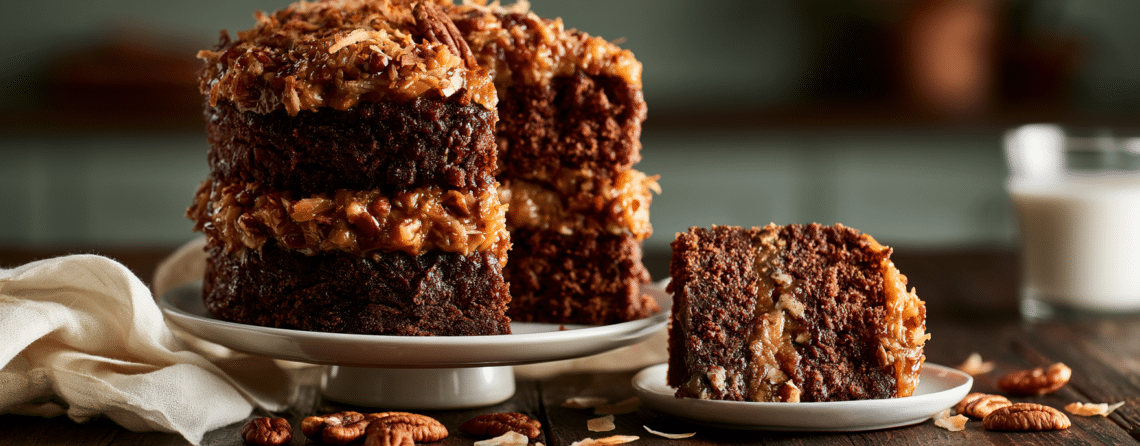
This is a three-layer chocolate cake with a cooked coconut-pecan topping that sets thick and chewy — nothing like a standard frosting. The cake uses German sweet chocolate, which is milder and sweeter than bittersweet, so the chocolate flavor stays gentle and the topping gets to be the main event. If you want a showstopper that actually holds up over several days and gets better as it sits, this is the one to make.
Why this recipe works
Two things make this cake work. First, beating the egg whites to stiff peaks and folding them in separately keeps the crumb light — without that step, the batter’s richness would make the layers dense and heavy. Second, the coconut-pecan topping is cooked on the stovetop with egg yolks and evaporated milk until it genuinely thickens, not just warms through. That cooking time is what gives it the fudgy, almost caramel-like consistency that holds its shape between layers instead of sliding out when you slice. Skip either step and you get a different, lesser cake.
What can go wrong
- Topping stays runny: This almost always means it wasn’t cooked long enough. It needs a full 12–15 minutes over medium heat with constant stirring. Pull it when it coats the back of a spoon and has visibly thickened — it will firm up more as it cools, but it needs to start thick.
- Layers dome and crack: Overfilling the pans or an oven running hot causes this. Use a scale to divide the batter evenly, and check your oven temperature with a thermometer. Domed layers are hard to stack without the filling squeezing out.
- Egg whites deflate when folded in: If the base batter is still warm from the melted chocolate, it will knock the air out of the whites immediately. Let the chocolate mixture cool to room temperature before you start folding.
- Cake sticks to the pans: Greasing and flouring isn’t always enough here — line the bottoms with parchment. These layers are tender and will tear if you force them out.
- Topping tastes flat: Toasting the coconut and pecans before they go into the filling makes a real difference in flavor. Spread them on a dry sheet pan and bake at 350°F for 8–10 minutes, watching closely. Skip the garnish of extra untoasted coconut on top — not worth the extra dish.
Leftovers and make-ahead
The assembled cake keeps well at room temperature under a cake dome for up to 2 days, and in the fridge for up to 5 days — the topping actually firms up and slices more cleanly after a night in the fridge. Individual slices can be frozen: wrap each one tightly in plastic wrap, then foil, and freeze for up to 2 months. Thaw overnight in the fridge or at room temperature for about an hour. If you want to spread the work out, the coconut-pecan topping can be made up to 3 days ahead and stored in an airtight container in the fridge — just bring it back to a spreadable consistency by letting it sit at room temperature for 30 minutes before assembling. The cake layers can be baked, cooled completely, wrapped in plastic, and stored at room temperature for 1 day or frozen for up to 1 month.
German Chocolate Cake with Coconut-Pecan Topping

Equipment
- Three 9-inch round cake pans
- Wire cooling racks
- Medium heavy-bottomed saucepan
- Large mixing bowl
- Hand mixer or stand mixer with whisk attachment
- Silicone spatula
- Offset spatula
Ingredients
Cake Ingredients
- ½ cup water boiling, 120ml
- 4 oz German sweet chocolate chopped, about 120g
- 1 cup unsalted butter softened, 225g
- 2 cups granulated sugar 400g
- 4 large eggs separate whites and yolks
- 1 tsp vanilla extract pure
- 2 ½ cups cake flour sifted, 285g
- 1 tsp baking soda
- ½ tsp salt fine sea salt
- 1 cup buttermilk at room temperature, 240ml
Coconut-Pecan Filling & Topping
- 1 ½ cups evaporated milk 360ml
- 1 ½ cups granulated sugar 300g
- ¾ cup unsalted butter cut into pieces, 170g
- 4 large egg yolks
- 1 ½ tsp vanilla extract pure
- 2 cups sweetened shredded coconut toasted, 150g
- 1 ½ cups chopped pecans toasted, 170g
Instructions
Preparing the Cake
- Preheat your oven to 350°F / 180°C (160°C fan-forced). Grease and flour three 9-inch (23cm) round cake pans.
- In a small saucepan, pour the boiling water over the chopped German sweet chocolate. Remove from heat and stir until the chocolate is completely melted and smooth. Set aside to cool to room temperature, about 15 minutes.1/2 cup water, 4 oz German sweet chocolate
- In a large mixing bowl, cream the softened butter and granulated sugar until light and fluffy. Add the egg yolks one at a time, beating well after each addition. Stir in the cooled chocolate mixture and vanilla extract.1 cup unsalted butter, 2 cups granulated sugar, 4 large eggs, 1 tsp vanilla extract
- Sift together the flour, baking soda, and salt in another bowl.2 1/2 cups cake flour, 1 tsp baking soda, 1/2 tsp salt
- Alternately add the flour mixture and buttermilk to the chocolate mixture, beginning and ending with the flour. Mix until just combined.1 cup buttermilk
- In a separate bowl, beat the egg whites until stiff peaks form, then fold them into the batter gently.4 large eggs
- Divide the batter evenly among the prepared cake pans and smooth the tops. Bake for 30-35 minutes or until a toothpick inserted into the center comes out clean.
- Let the cakes cool in their pans for 10 minutes before transferring them to wire racks to cool completely.
Making the Coconut-Pecan Filling & Topping
- In a medium saucepan, whisk together the evaporated milk, sugar, butter, and egg yolks.1 1/2 cups evaporated milk, 1 1/2 cups granulated sugar, 3/4 cup unsalted butter, 4 large egg yolks
- Cook over medium heat, stirring constantly, until the mixture thickens, about 10-12 minutes. Remove from heat.
- Stir in the vanilla extract, toasted coconut, and pecans. Let the mixture cool to room temperature, it will continue to thicken as it cools.1 1/2 tsp vanilla extract, 2 cups sweetened shredded coconut, 1 1/2 cups chopped pecans
Assembling the Cake
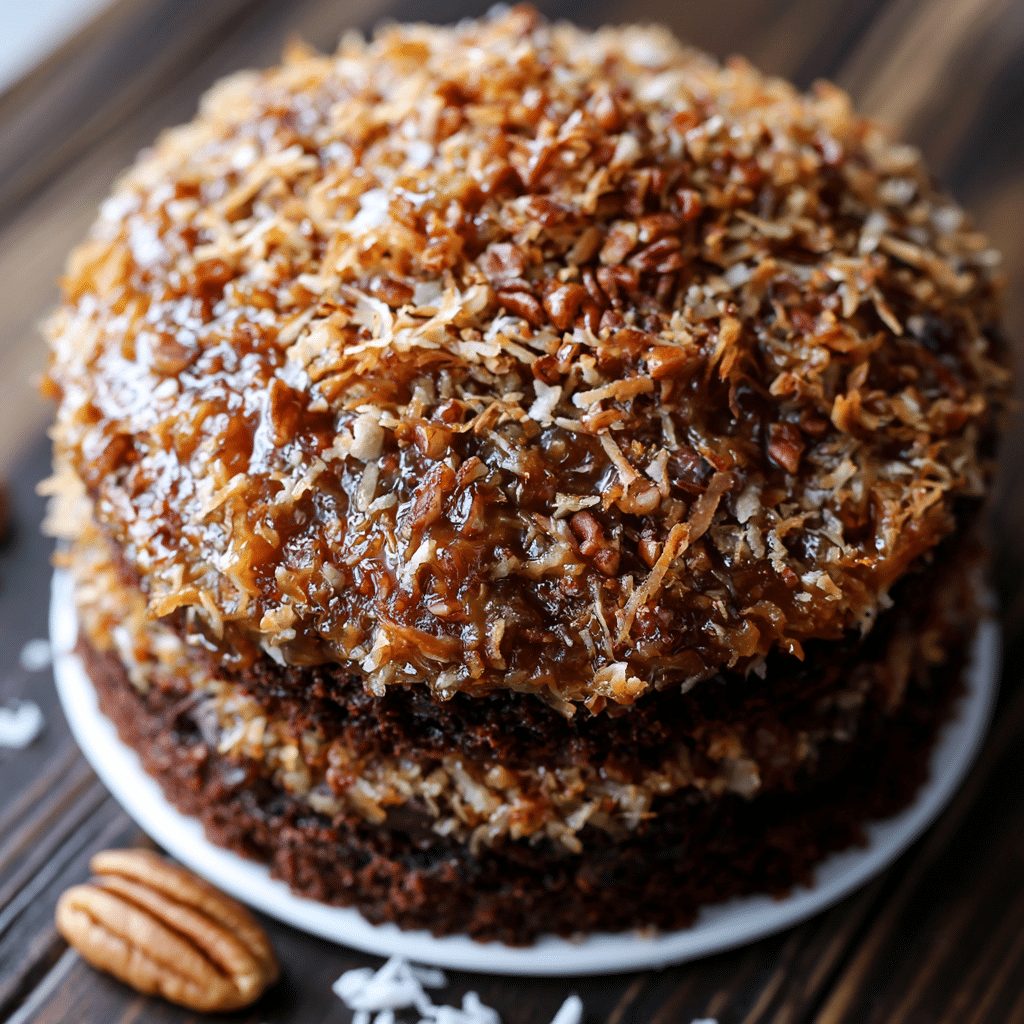
- Place one cake layer on a serving platter, spread one-third of the coconut-pecan mixture on top. Repeat with the second and third layers, finishing with the filling on top. Leave the sides of the cake unfrosted — this is traditional for German Chocolate Cake and lets the layers and topping be the visual centrepiece.
Notes
Nutrition
Frequently asked questions
Can I use regular semi-sweet or dark chocolate instead of German sweet chocolate?
You can, but the flavor will be noticeably more intense and less sweet. German sweet chocolate has added sugar built in, so if you substitute, reduce the granulated sugar in the cake batter by about 2 tablespoons and expect a stronger chocolate taste that competes more with the topping.
Do I need to frost the sides of the cake?
No — traditional German chocolate cake is left unfrosted on the sides, and the recipe is designed that way. The topping is thick enough to fill and cover the top without needing anything else, and leaving the sides bare makes assembly much simpler.
My topping hardened in the fridge and won’t spread. What do I do?
Let it sit at room temperature for 20–30 minutes before you try to spread it. If it’s still too stiff, stir in a teaspoon of evaporated milk or cream and warm it very gently in a small saucepan over low heat, stirring constantly, until it loosens up.
What to cook next
- Chocolate Brownies
- Giant Chocolate Chip Cookie Cake
- Heavenly Strawberry Cake
- Dark Chocolate Brownies with Espresso and Sea Salt