














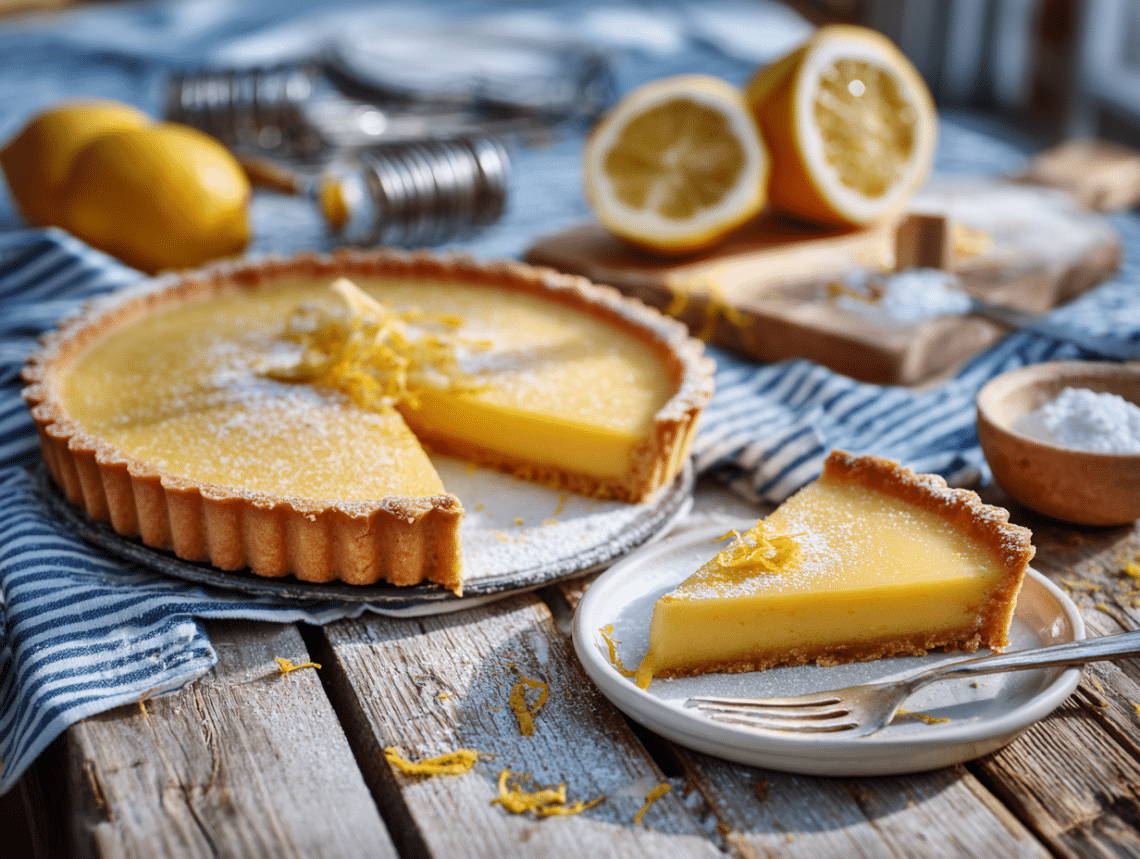
This is a classic French-style lemon tart — a crisp shortcrust shell filled with a thin, set lemon custard made from eggs, cream, and fresh lemon juice. It happens to be gluten-free, but the reason to make it is the tart itself: sharp, smooth, and clean-tasting. Nine ingredients, one tart tin, and it holds up well in the fridge, which makes it genuinely useful for feeding people without last-minute stress.
The technique that matters
Two things determine whether this tart works. First, the chilling step for the pastry is not optional — gluten-free dough has no gluten network to hold it together, so the cold butter needs time to firm back up after handling. Skip the chill and the pastry tears when you roll it and shrinks badly in the tin. Second, the filling needs to go into a hot pastry case and bake gently — the moment the edges are set and the centre still wobbles like loose jelly, pull it out. Overbaking drives off moisture and the custard turns grainy and slightly rubbery rather than silky. If you are unsure, err on the side of underdone; it firms up completely as it cools and again overnight in the fridge.
Substitutions that actually work
- Xanthan gum: Do not skip it or substitute it with psyllium husk here — psyllium absorbs differently and makes the pastry gummy rather than crisp. If your gluten-free flour blend already contains xanthan gum, leave it out of the recipe.
- Double cream (heavy cream): Full-fat single cream works but produces a slightly softer set. Do not use half-and-half or any lower-fat alternative — the filling may not set at all.
- Caster sugar in the filling: Regular granulated sugar dissolves fine when whisked with the eggs. No need to buy caster sugar specifically for this.
- Lemon juice: Bottled lemon juice gives a flat, slightly bitter result. Fresh lemons only — you need the zest anyway, so there is no shortcut worth taking here.
If something goes sideways
- Pastry cracks when lining the tin: Gluten-free pastry tears more easily than wheat pastry. Patch cracks with spare dough scraps pressed firmly into place before blind baking — the filling will hide any repairs.
- Pastry base is soggy after blind baking: The five-minute uncovered bake after removing the baking beans is doing real work. If the base still looks pale and damp, give it another three minutes before adding the filling.
- Filling has bubbles on the surface: Whisk the filling gently and let it rest for five minutes before pouring so surface bubbles can settle. A few small bubbles will not affect the texture, but a foamy top can leave a pitted surface once baked.
- Filling leaks under the pastry during baking: This usually means a crack in the blind-baked shell that was not patched. For future batches, brush the hot pastry case with a thin layer of beaten egg white right after removing the baking beans, then return it to the oven for two minutes — it seals hairline cracks effectively.
- Tart sticks in the tin: A loose-bottomed tin is strongly recommended. If you only have a solid tin, line the base with a circle of baking paper before pressing in the pastry.
Make-ahead notes
This tart is at its best made the day before you need it — the filling firms up and the flavour sharpens noticeably after a night in the fridge. Once fully cooled, cover it loosely with cling film (avoid pressing the film against the surface) and refrigerate for up to three days. Serve it cold or at room temperature; skip the garnish — not worth the extra dish. The baked pastry shell can also be made up to two days ahead and stored uncovered at room temperature, then filled and baked on the day. Freezing the finished tart is possible — wrap individual slices tightly and freeze for up to one month — but the custard texture softens slightly on thawing, so the fridge-ahead approach is the better option for gatherings.
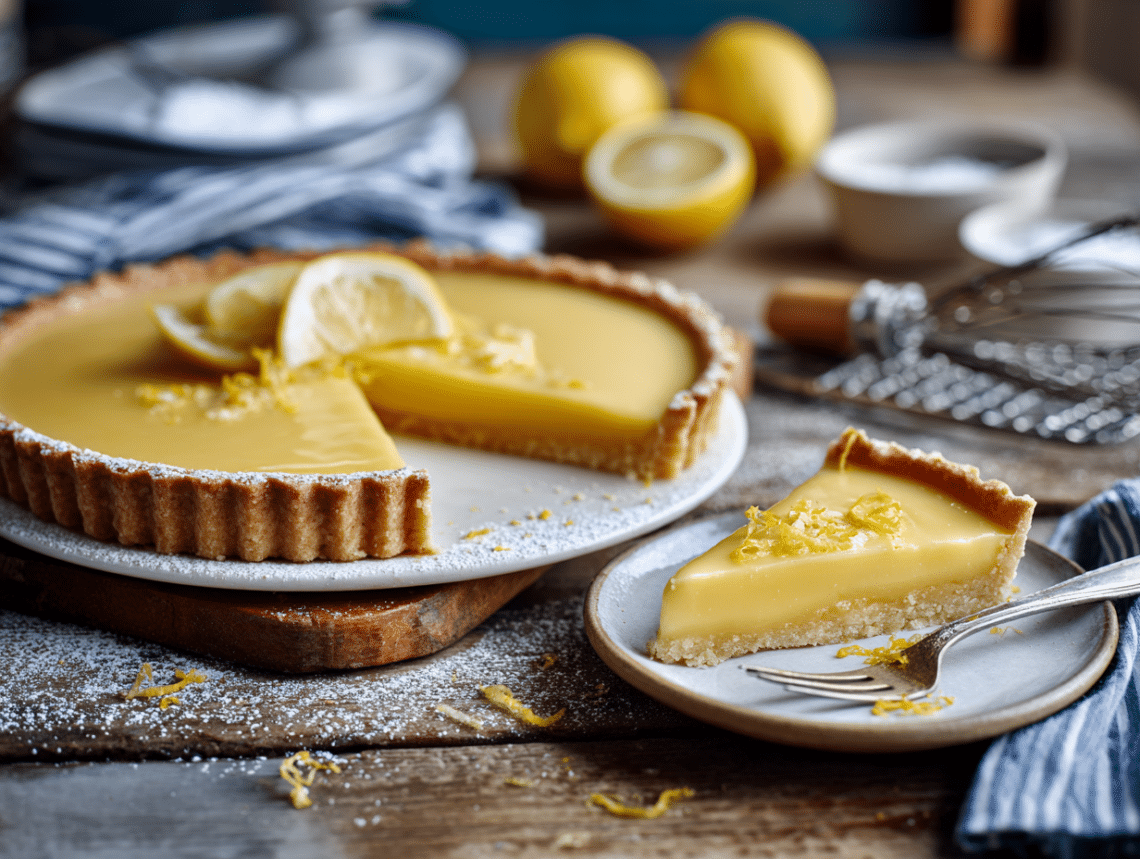
Gluten-Free Lemon Tart

Equipment
- 1 sheet of greaseproof paper (for blind baking)
Ingredients
Pastry Ingredients
- 1 ¾ cups gluten-free plain flour
- 2 tablespoons icing sugar powdered sugar
- ½ teaspoon xanthan gum
- ¼ teaspoon salt
- ½ cup unsalted butter cold, cubed
- 1 large egg beaten
- 2 tablespoons cold water
Filling Ingredients
- 3 large eggs
- ½ cup caster sugar superfine sugar
- ⅔ cup double cream heavy cream
- 3 large lemons zest and juice, zest finely chopped and juice strained
Instructions
Pastry Instructions
- Preheat your oven to 180 degrees Celsius. Grease your preferred tin. (Try and get a loose-bottomed one for your own sake)
- Place flour, xanthan gum, sugar and salt in a bowl, then add the butter and rub it with your fingers until it looks like breadcrumbs.
- Make a well in the middle of your mix, add your eggs and water, then mix it with your hands again. It then forms a lovely dough. Knead it on a floured surface. Wrap in clingfilm and put it in the fridge for 20-30 minutes.
- Remove the dough from the fridge after 20-30 minutes. It should be firm but still pliable enough to roll. Avoid using a freezer to speed this up — the dough becomes too brittle and will crack when rolling.
- Roll the pastry out on a lightly floured surface to about 3mm (1/8 inch) thickness. Carefully drape it over your 9-inch (23cm) loose-bottomed tart tin and press gently into the edges. Trim any excess pastry hanging over the rim.
- Scrunch up some greaseproof paper and add baking beans. Blind bake the pastry case for 12-15 minutes until the edges are lightly golden. Remove the greaseproof paper and baking beans, then return to the oven for a further 5 minutes to dry out the base.
Filling Instructions
- In a large bowl, whisk the eggs and caster sugar together until combined. Add the double cream, lemon zest, and strained lemon juice. Whisk gently until smooth — avoid over-beating as too many air bubbles will prevent a silky set.
- Pour into your pastry case right up near the top.
- Put the pastry back into the oven at 180 degrees Celsius and bake for up to 20 minutes. It can take less time if you put your mix into the hot tin right away (Mine took about 16 minutes doing this). The filling is done when the edges are set but the centre still has a gentle wobble — like a barely-set panna cotta. It will firm up fully as it cools.
- Leave it to cool in the case for 20-30 minutes, and then when you take it out, leave it for another 20 minutes.
Nutrition
Frequently asked questions
Can I make this tart without baking beans?
Yes — dried rice, dried lentils, or even dried chickpeas work just as well as baking beans for blind baking. Use enough to fill the paper-lined case in a single deep layer so the pastry walls are fully supported and do not slump.
How do I know when the filling is actually done?
The filling is done when the outer two inches are set and the centre jiggles as a single mass rather than rippling like liquid. It will look underdone when you pull it out — that is correct. It sets fully as it cools, and slicing it too soon is the most common reason for a runny result.
My gluten-free flour blend already has xanthan gum in it — do I still add more?
No, leave it out. Adding extra xanthan gum on top of a blend that already contains it makes the pastry tough and slightly gluey. Check the ingredients list on your flour bag before measuring.
Can I use a different size tart tin?
You can use a slightly smaller or larger tin, but it will affect bake time. A smaller tin means a deeper filling that needs a few extra minutes; a larger tin means a thinner layer that sets faster. Watch the wobble, not the clock.