



























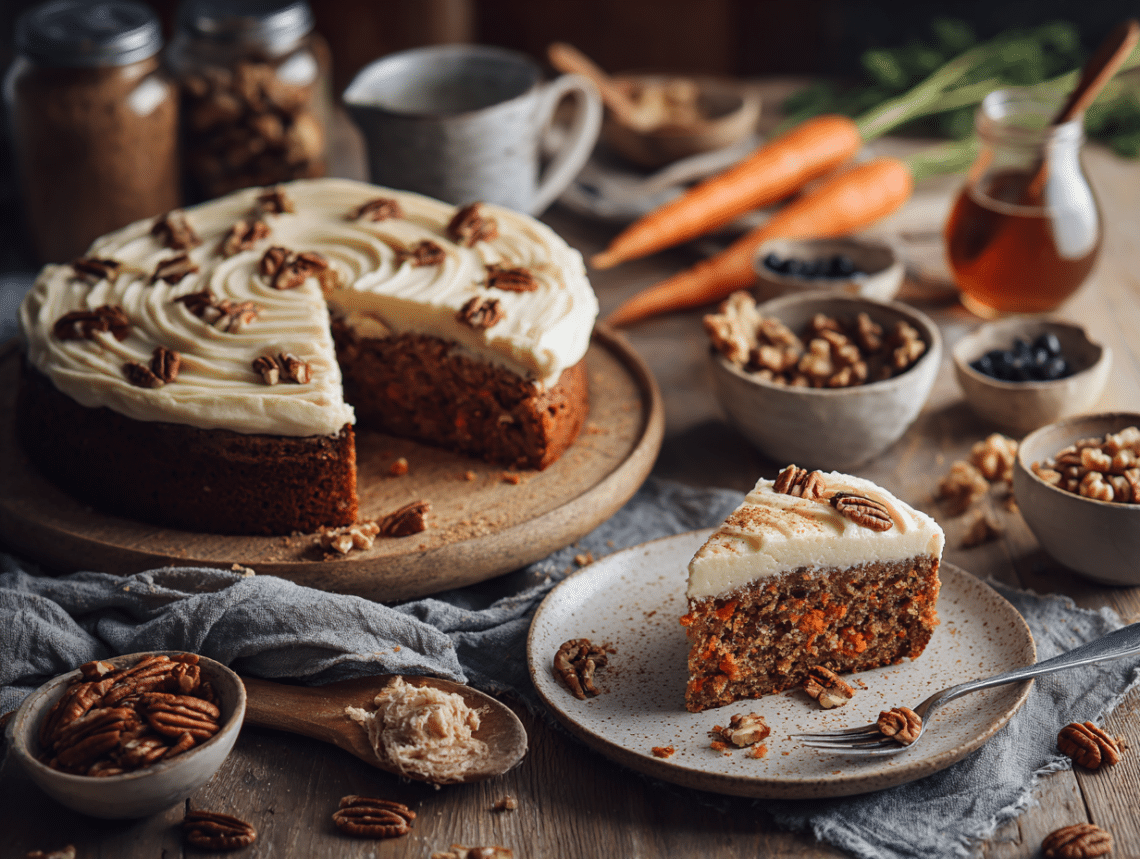
This carrot cake skips refined sugar entirely, using puréed Medjool dates, ripe bananas, and a small amount of maple syrup to sweeten both the cake and the cashew cream frosting. It’s a genuinely moist, well-spiced cake — not a compromise version — and it happens to be dairy-free as written. If you’re baking for someone avoiding added sugar, or you just want a cake that doesn’t leave you feeling heavy, this is a solid choice.
The short version of why this works
Two things carry this cake. First, the dates are puréed rather than chopped, which distributes their sweetness evenly through every slice instead of leaving it in pockets — this is what lets you cut the maple syrup down to just two tablespoons without the cake tasting flat. Second, the bananas do double duty: they add sweetness and replace eggs, binding the batter without making it dense, as long as they’re properly ripe. Underripe bananas won’t mash smoothly and won’t sweeten enough, so yellow-with-brown-spots is the minimum you want here.
Mistakes to avoid
- Skipping the cashew soak. The recipe requires raw cashews soaked for at least 2 hours before blending. If you skip this, the frosting will be grainy no matter how long you run the blender. If you’re short on time, a 30-minute soak in just-boiled water is a workable shortcut.
- Grating the carrots too coarsely. Large shreds stay fibrous and don’t release enough moisture into the crumb. Use the fine side of a box grater or the fine shredding disc on a food processor.
- Opening the oven early. This batter is denser than a standard cake batter. Opening the oven before the 30-minute mark causes the centre to sink and it won’t recover. Wait until you can smell it baking, then check.
- Frosting a warm cake. Cashew cream frosting melts at low heat. The cake needs to be completely cool — not just room temperature on the outside — before you frost it. An hour on a wire rack is the minimum; two is safer.
- Over-measuring the flour. Spooning flour straight from the bag into a measuring cup packs it down and can add 20–30% more flour than the recipe intends, producing a dry, dense result. Spoon flour into the cup and level it off, or weigh it.
Substitutions that actually work
- Medjool dates: Deglet Noor dates work but are drier and less sweet. Soak them in warm water for 10 minutes before puréeing and use about 25% more by volume to match the sweetness level.
- Coconut oil: Melted butter works if you’re not keeping this dairy-free. A neutral vegetable oil like sunflower also works and is usually cheaper.
- Pecans and almonds: Any combination of walnuts, hazelnuts, or sunflower seeds works fine — skip the garnish of pecan halves on top if you’re low on nuts, it’s not worth holding back the good ones just for decoration.
- Raisins: Use 3 tablespoons (about 30g / 1oz) as a consistent measure. Dried cranberries or chopped dried apricots are good swaps.
- Whole wheat flour: All-purpose flour gives a lighter, softer crumb. A 50/50 blend of whole wheat and all-purpose is a good middle ground if you want some of the nuttier flavour without the denser texture.
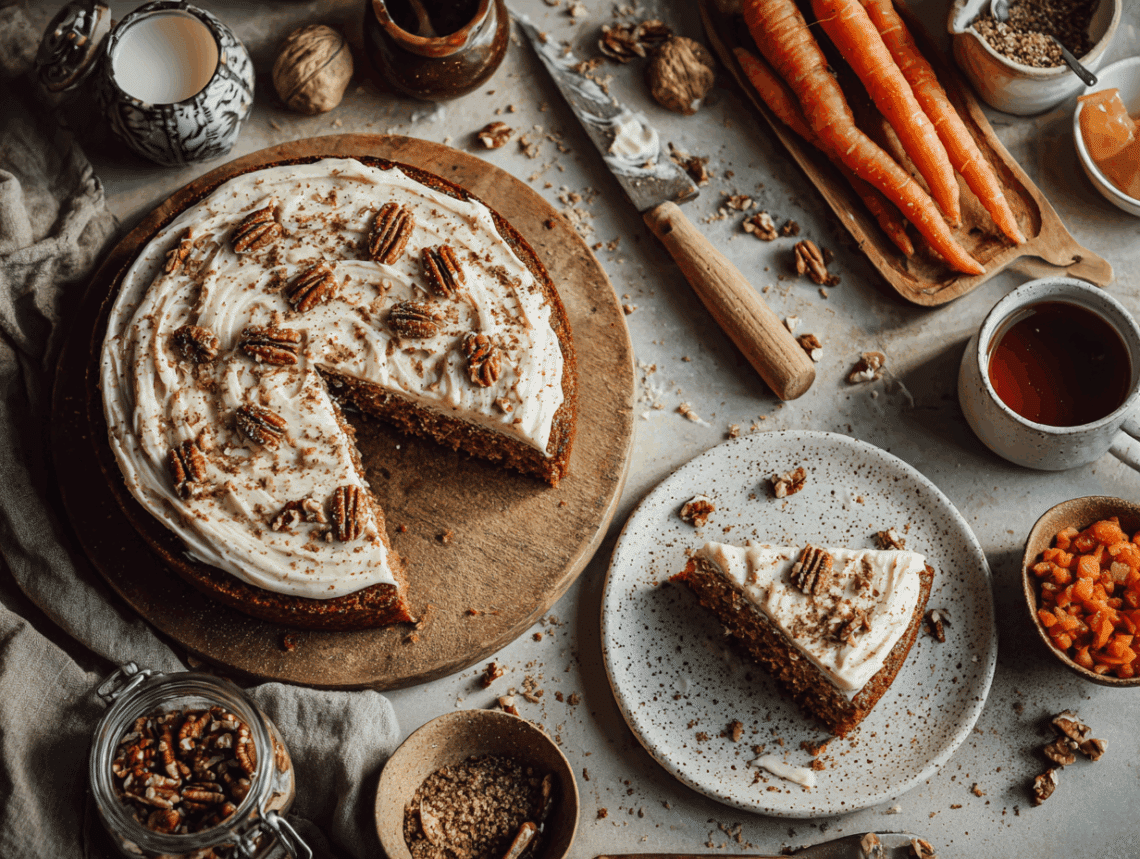
Sugar-Free Carrot Cake

Ingredients
- 2 cups whole wheat flour (or substitute all-purpose flour for a lighter texture)
- 3 teaspoons baking powder brand new
- 1 teaspoon baking soda
- ¾ teaspoon fine sea salt
- 2 teaspoons cinnamon
- 1 teaspoon nutmeg
- 1 cup pecans roughly chopped (plus extra halves for topping)
- ½ cup almonds roughly chopped
- 3 large carrots (approximately 300g / 10.5oz), peeled and finely grated
- 2 large bananas well mashed (or three if you love the taste!)
- 1 cup Medjool dates pitted and puréed
- ½ cup coconut oil melted
- ½ cup plain yogurt (use coconut yogurt for a dairy-free/vegan version)
- 2 tablespoons pure maple syrup
- 1 teaspoon vanilla extract
- 1 tablespoon lemon (juiced) (for the cake)
- ½ cup raisins finely chopped
- 2 large organic eggs fresh ; whisked
For the Frosting:
- 1 cup raw cashews soaked for at least 2 hours, drained and rinsed
- 1 tablespoon lemon (juiced) (for the cake)
- 2 tablespoons liquid coconut oil
- ⅓ cup pure maple syrup
- 1 teaspoon vanilla extract
Instructions
- Preheat the oven to 350°F (180°C). Set aside a round 8-inch cake pan lined with parchment paper.
- Combine the flour, baking powder, baking soda, salt, cinnamon, and nutmeg in a mixing dish.
- Thoroughly combine the nuts (not too much as you don’t want to powder them) or lightly chop them in a food processor, then add to the dry mix and set aside.
- In a separate large mixing bowl, combine the grated carrots and mashed bananas. Set aside.
- Blend the dates with the liquid coconut oil. When the mixture is uniform, add it into the carrot-banana mixture and stir everything together. Add the maple syrup, yoghurt, raisins, vanilla extract, half a lemon juice, and whisked eggs (optional).
- Fold the dry flour-nut mixture into the wet carrot-banana mixture, stirring gently until just combined. The batter should be thick and moist — do not overmix.
- Pour the batter into the prepared cake pan and smooth the top with a spatula. Bake for 35-40 minutes, or until a toothpick inserted into the centre comes out clean. If using a 9x5 inch loaf pan instead, bake for 50-55 minutes.
- Remove from the oven and set aside to cool.
While the cake is in the oven, whip together the icing:
- Blend the soaked and drained cashews in a high-speed blender for 1-2 minutes until completely smooth and paste-like. Add 1-2 tablespoons of water if needed to help the blender process.
- Add the melted coconut oil, lemon juice, vanilla extract, and maple syrup to the blended cashews and blend again until silky smooth. Transfer to a bowl and place in the freezer for 15-20 minutes, stirring every 5 minutes, until the frosting thickens to a spreadable consistency.
- Then, before serving, spread the frosting evenly over the cake and top with pecan halves.
Nutrition
Frequently asked questions
Can I make this cake ahead of time?
Yes — the unfrosted cake actually improves overnight as the moisture from the carrots and bananas settles into the crumb. Bake it the day before, wrap it tightly in plastic wrap once fully cooled, and store at room temperature. Make the frosting fresh on the day you plan to serve, since cashew cream can separate slightly after extended refrigeration.
How should I store leftovers, and how long will they keep?
Store frosted slices in an airtight container in the refrigerator for up to 4 days. The cashew frosting is perishable, so don’t leave the frosted cake out at room temperature for more than 2 hours. The unfrosted cake layers can be frozen for up to 2 months — wrap each layer in plastic wrap, then foil.
My dates are very dry and hard — can I still use them?
Yes, just soak them in warm water for 10–15 minutes first, then drain before puréeing. Dry dates won’t blend into a smooth purée without this step, and chunks of date in the batter will affect both texture and how evenly the sweetness distributes through the cake.
If you liked this one
- Ultimate Banana Bread
- Warm and Comforting Classic Apple Crumble
- Heavenly Strawberry Cake with Fresh Berries and Whipped Cream
- Classic Banana Nut Bread