




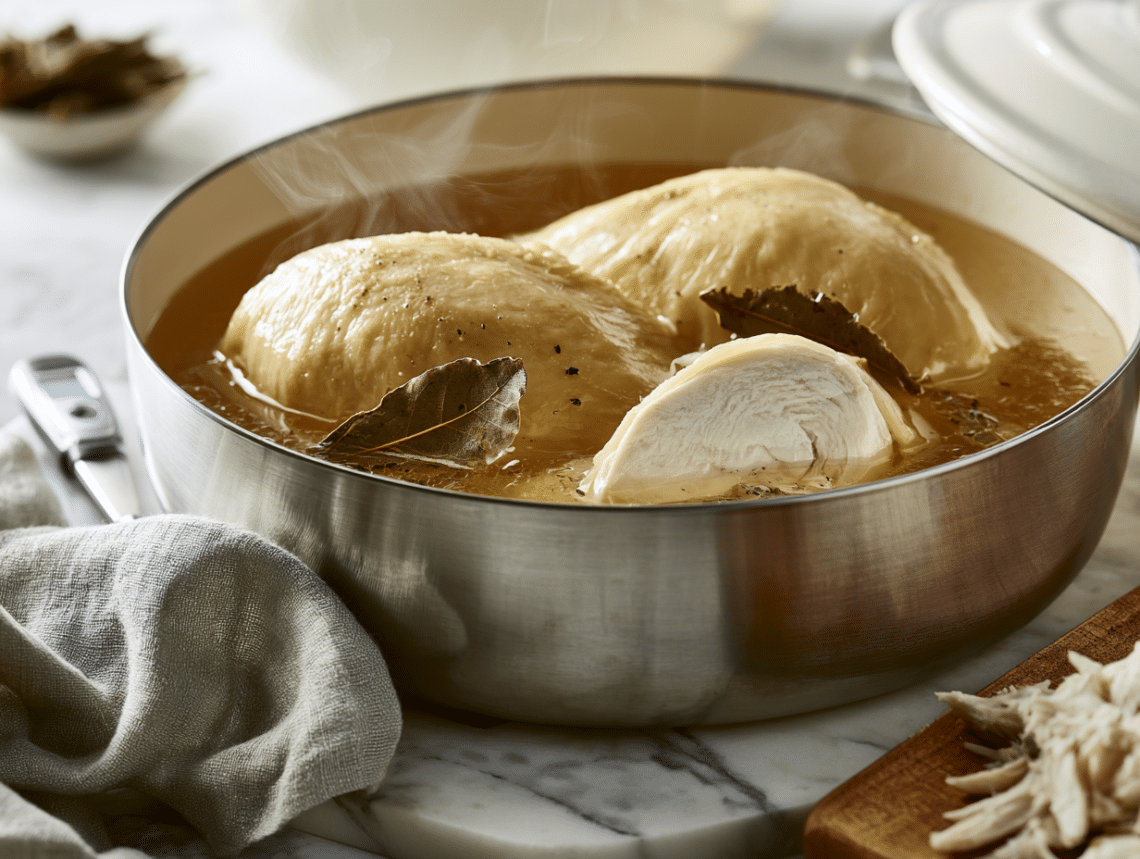
Poached chicken breast is one of those techniques that sounds fancier than it is — you’re essentially simmering chicken in seasoned broth, then letting it finish cooking off the heat. The result is genuinely moist, sliceable chicken that works in almost any meal. The honest reason to make it: one batch on Sunday means you have ready protein for four or five meals without turning on the stove again.
Before you start
Two things determine whether this works. First, keep the heat low — once you reduce to a simmer, you want small, lazy bubbles, not a rolling boil. A hard boil tightens the proteins quickly and turns breast meat chalky; a gentle simmer keeps the fibers relaxed. Second, don’t skip the resting step. Turning off the heat and leaving the chicken in the covered pot for 30 to 60 minutes isn’t optional — that’s when the thicker parts finish cooking through without the outside drying out. If you pull the chicken the moment the timer goes off, you’ll likely find the center is underdone or, if you compensate by cooking longer, the outside will be overdone. An instant-read thermometer takes the guesswork out entirely: 165°F at the thickest point before you lift anything out.
If something goes sideways
- The liquid never comes to a boil: Check that your burner is on medium-high and your pot isn’t too large for the element. A wide, thin-bottomed pot on a small burner takes much longer to heat. Give it more time before worrying.
- The chicken is still pink inside after resting: Put it back in the pot, add a splash of water if the liquid is low, bring it back to a bare simmer for 5 more minutes, then rest again with the lid on. Don’t crank the heat — that’s what causes rubbery texture.
- The meat shreds instead of slicing cleanly: It’s been overcooked, usually from too high a heat or too long on the burner before the rest period. It’s still perfectly usable — just shred it intentionally for wraps or salads rather than trying to slice it.
- The chicken tastes bland even after seasoning the broth: Broth and bay leaves season from the outside in, but only lightly. Slice or shred the chicken and toss it with a little salt, a squeeze of lemon, or a drizzle of olive oil right before serving — skip the extra garnish on top, not worth the extra dish.
- The breasts are very uneven in thickness: The thin end will overcook before the thick end is done. Pound the thicker part down or butterfly it slightly before adding to the pot — 30 seconds of prep prevents a dry, stringy thin end.
Make-ahead notes
Once cooled, store the chicken in airtight containers or wrapped tightly in foil in the fridge for up to 4 days — whole breasts hold moisture better than pre-sliced, so slice or shred only what you need each day. To reheat, place slices in a shallow pan with a few tablespoons of the reserved poaching liquid over low heat, covered, for 3 to 4 minutes; the steam keeps it from drying out. Microwaving works too — cover loosely and use 50% power in 60-second intervals. For freezing, portion the chicken into freezer bags, add a splash of the strained poaching liquid to each bag before sealing, and freeze for up to 3 months. Thaw overnight in the fridge rather than on the counter for food safety and better texture.
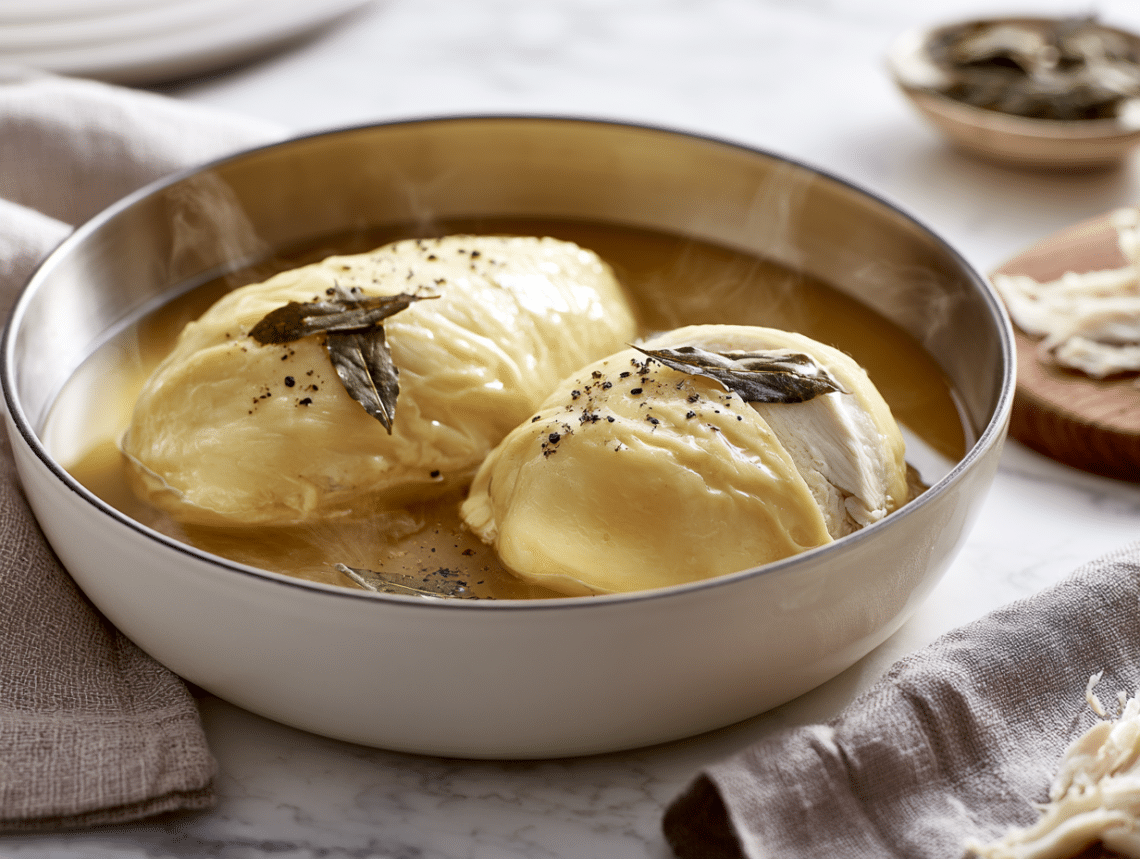
Easy Poached Chicken Breast – Juicy Meal Prep Recipe

Equipment
- Large pot or Dutch oven (5-quart / 4.7L minimum)
- Instant-read thermometer
- Tongs
- Cutting board
- Aluminum foil
- Fine-mesh strainer (for saving poaching liquid)
Ingredients
- 2 pounds boneless skinless chicken breasts
- 32 ounces chicken broth
- 2-4 cups water enough to cover chicken breasts
- 3 pieces bay leaves
- 1½ teaspoons fine sea salt adjust to taste
- 1 teaspoon freshly ground black pepper
Instructions
- Trim any visible fat or connective tissue from the chicken breasts using a sharp knife. If any breast is significantly thicker than the others, pound it gently to an even thickness so all pieces cook at the same rate.
- Place the chicken breasts in a single layer in a large pot or Dutch oven (5-quart / 4.7L minimum). Avoid stacking the breasts — they need to lie flat for even cooking.
- Pour in the chicken broth, then add enough cold water to cover the chicken by about 1 inch (2.5cm). This typically requires an additional 2–4 cups (475–950ml) depending on your pot size.
- Add bay leaves, salt, and pepper.
- Bring the liquid to a boil over medium-high heat, then immediately reduce to a gentle simmer (small bubbles only; approximately 180–190°F / 82–88°C liquid temperature). Cover and simmer for 10–15 minutes until the chicken reaches an internal temperature of 165°F / 74°C.
- Turn off the heat and leave the chicken in the covered pot to cool in the poaching liquid for 30–60 minutes. The residual heat will finish cooking the chicken gently. Before removing, verify the thickest part of the largest breast reads at least 165°F / 74°C on an instant-read thermometer.
- Once cool enough to handle, wrap each breast individually in foil or place in airtight containers. Store in the fridge for up to 4 days, or freeze with a splash of poaching liquid for up to 3 months.
Notes
- Storage: Wrap individual portions tightly in foil or store in airtight containers in the fridge for up to 4 days. Freeze for up to 3 months in freezer bags with a splash of the poaching liquid.
- Make-ahead: Poach on Sunday and use throughout the week in salads, wraps, pasta, and grain bowls. Slice or shred just before using for the freshest texture.
- Substitutions: Swap chicken breasts for boneless skinless thighs (reduce simmer time to 25–30 minutes). Use low-sodium broth and adjust salt to taste if watching sodium intake.
- Pro tip: Never boil the chicken vigorously — a gentle simmer with small bubbles breaking the surface keeps the breast meat tender and prevents the protein fibers from seizing up and turning rubbery.
- Poaching liquid: Strain and save the leftover liquid — it makes an excellent light chicken stock for soups and risottos. Store in the fridge for 4 days or freeze for up to 3 months.
Nutrition
Your questions, answered
Can I use frozen chicken breasts without thawing first?
Yes, you can cook from frozen. Add 10 to 15 extra minutes to the simmering time and always verify the internal temperature with a thermometer before resting — don’t rely on time alone when starting from frozen.
How do I know when the simmer is at the right temperature without a thermometer?
Look for small bubbles breaking the surface occasionally, not a constant vigorous roll. If the liquid is churning and steaming heavily, it’s too hot — reduce the heat and wait a minute for it to settle before covering.
Do I have to use chicken broth, or can I just use water?
Water works, but the chicken will taste noticeably plainer. If you don’t have broth, add an extra half teaspoon of salt and a few peppercorns — it won’t be as flavorful, but it won’t be bad either.
My chicken breasts are very large — over 10 ounces each. Does that change anything?
Yes, larger breasts need more time. Simmer for the full 15 minutes rather than 10, and extend the resting period to the full 60 minutes with the lid on. The thermometer is your real guide here — size varies too much to rely on a fixed time.
If you liked this one
- Sweet and Tangy Grape Chicken Salad
- Sizzling Chicken Quesadillas
- Authentic Japanese Chicken Teriyaki
- Smoky Oaxacan Chicken Enchiladas with Roasted Chili Sauce