


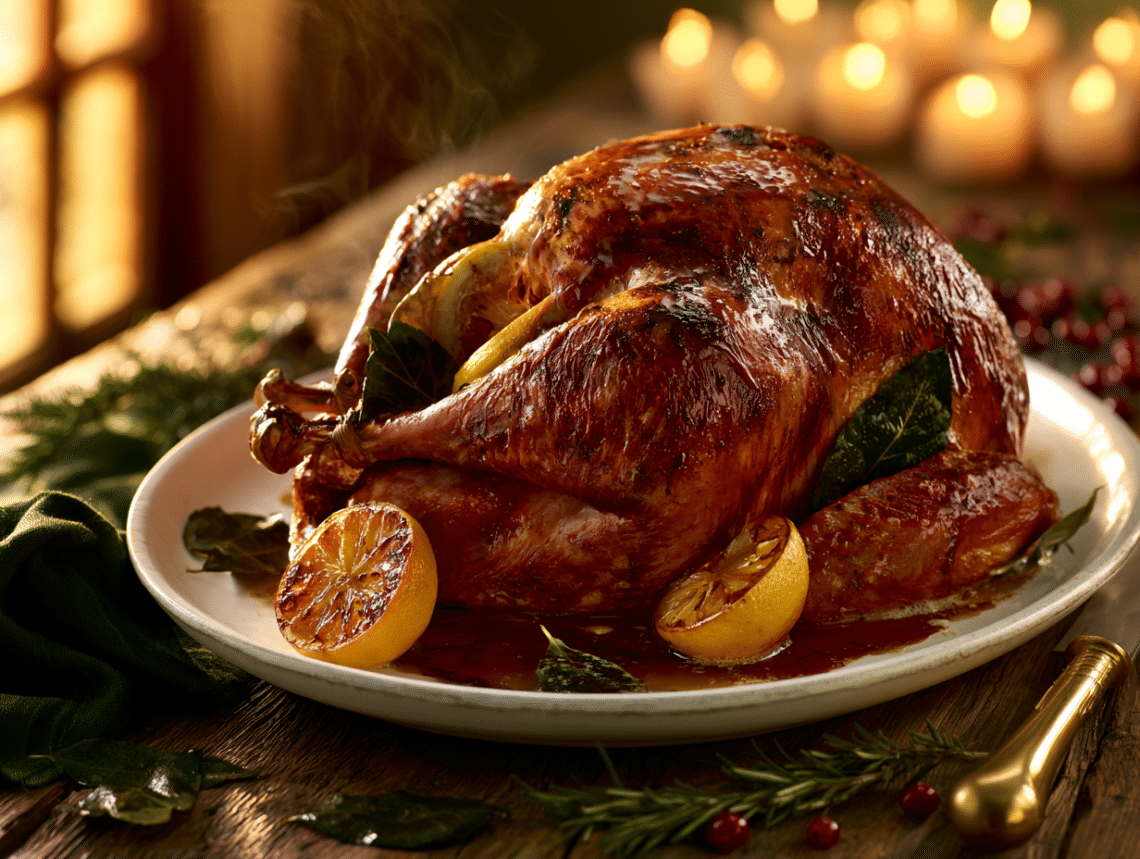
This post covers two roast turkey methods — a butter, lemon, and bay version and a honey-spiced glazed version — so you can pick the one that fits your table. Both work on a 12–15 lb bird, neither needs brining or overnight prep, and both are built around techniques that actually keep the breast meat from drying out. If you’re feeding a crowd and want useful leftovers for the days after, either bird will give you plenty to work with.
Shopping notes
- Fresh bay leaves: Dried bay leaves won’t give you the same result under the skin — the fresh ones release their oils into the butter as the bird roasts. Most grocery stores carry them near the fresh herbs.
- Ground allspice: If you don’t have it, a small pinch of cinnamon plus a smaller pinch of cloves is a workable substitute for the glaze.
- Turkey size: The lemon and bay recipe is written for a 12–15 lb bird; the honey-spiced version is written for 15 lb. If your bird is smaller, reduce the total roasting time using the 20-minutes-per-pound rule and check the thigh temperature early.
- Vegetable oil for the glazed version: Any neutral oil works — canola, sunflower, or light olive oil are all fine.
What makes this version work
For the lemon and bay turkey, the key move is getting the butter and aromatics directly under the skin rather than on top of it. Fat sitting on the outside of the skin mostly drips away; fat under the skin bastes the breast meat from the inside as it melts, which is why the meat stays moist even without brining. For the honey-spiced turkey, timing matters: the glaze goes on only in the last 45 minutes. Honey burns fast at oven temperatures, so applying it too early gives you a bitter, dark crust instead of a caramelised one — keep the foil on for the first stretch and don’t rush that final uncovered phase.
Common problems and fixes
- Butter won’t spread under the skin: If the skin tears, it’s usually because the butter is still too cold or you’re pushing too hard. Make sure the butter is genuinely soft — it should smear like thick cream cheese — and use your whole hand rather than just fingertips.
- Glaze darkens too fast before the turkey is done: Loosely tent the bird with foil as soon as the colour looks deep enough, then keep cooking to temperature. The glaze will hold its colour; it just won’t darken further.
- Juices run pink but the thermometer reads 165°F: Trust the thermometer. Pink juices near the bone can happen even in a fully cooked bird and don’t mean it needs more time.
- Skin goes soft after resting: This happens if you tent the foil too tightly during the rest. Keep the foil loose so steam can escape rather than condensing back onto the skin.
- Uneven cooking — breast done, thighs still under: This is common with large birds. If the breast hits temperature first, tent it with foil and keep roasting until the thigh catches up. Check both sides of the thigh, not just one spot.
Storage and reheating
Carved turkey keeps in the fridge for up to 4 days in an airtight container — store the meat and any pan juices or drippings separately so you can use the juices to moisten the meat when reheating. To reheat, spread slices in a baking dish, add a splash of stock or the reserved juices, cover tightly with foil, and warm at 325°F for 20–25 minutes. Skip the microwave for large portions; it dries the breast out fast. For longer storage, cooked turkey freezes well for up to 3 months — slice or shred it before freezing so it thaws and reheats more evenly. Leftover turkey works well in sandwiches, soups, fried rice, or tacos straight from the fridge without reheating at all, which is worth keeping in mind when you’re deciding how much to carve at once.
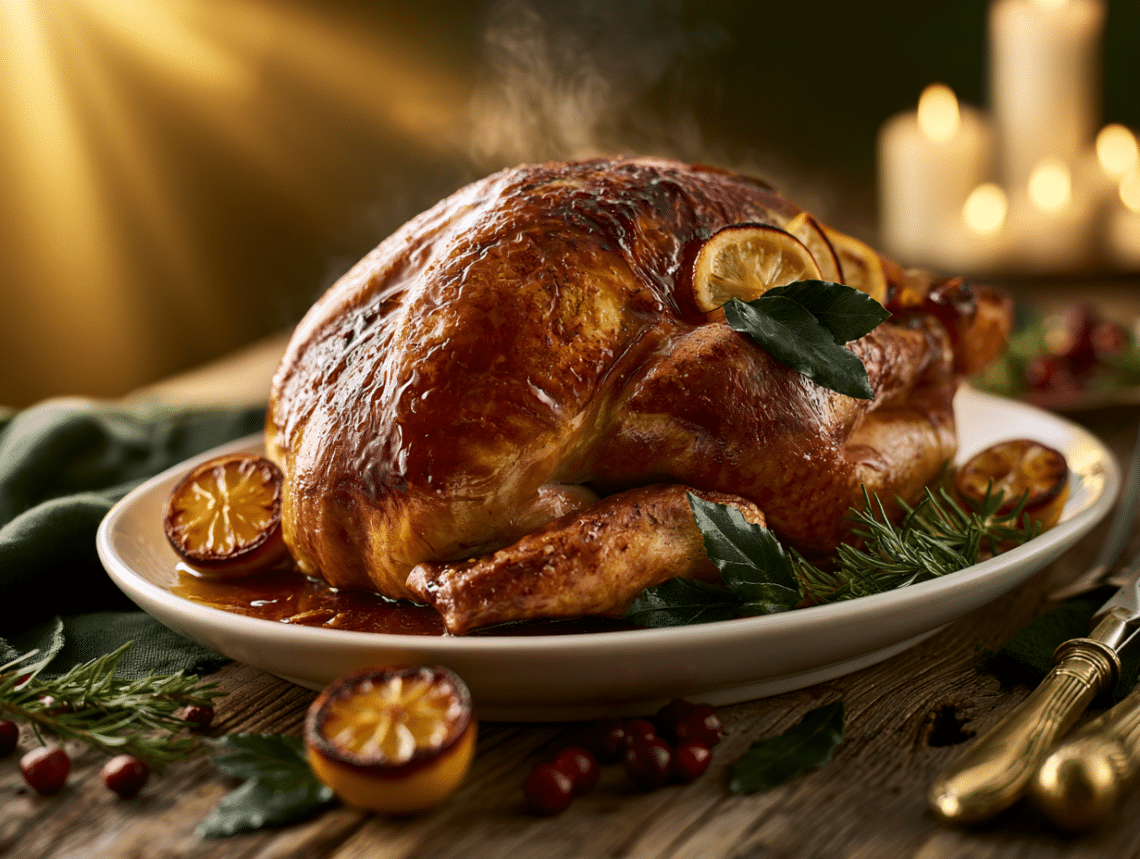
Christmas Turkey Recipe: 2 Easy Roast Methods

Ingredients
Lemon And Bay Basted Turkey:
- 1 whole turkey giblets removed; 12-15 lb / 5.4-6.8 kg
- 7 tablespoons butter or just under ½ cup; softened
- 3 large lemons 1 sliced, 2 reserved for roasting
- 6 pieces fresh bay leaves whole
Honey And Spiced Glazed Turkey:
- 2 teaspoons chili powder
- ½ teaspoon garlic powder
- ¼ teaspoon ground allspice
- ¼ teaspoon ground cumin
- ¼ teaspoon salt
- ⅛ teaspoon ground red pepper
- 2 tablespoons honey
- 1 teaspoon cold water
- 1 whole turkey neck and giblets removed; 15 lb / 6.8 kg
- 2 tablespoons vegetable oil
Instructions
Lemon And Bay Basted Turkey:
- Preheat the oven to 375°F / 190°C (170°C fan-forced). Soften 100 grams of butter in a bowl at room temperature.
- Put your fingers under the turkey breast to loosen it. Spread the softened butter under the skin of the turkey, lay the sliced lemon under the skin along with the bay leaves and cover the turkey in foil.
- Roast the turkey covered in foil, allowing approximately 20 minutes per pound (45 minutes per kg). 30 minutes before the end of the calculated cooking time, remove the foil, halve the 2 remaining lemons and place them cut-side down around the turkey. Return to the oven uncovered for the final 30 minutes until the skin is golden and the thickest part of the thigh registers 165°F / 74°C on an instant-read thermometer.
- Allow Turkey to stand for 15-20 minutes before you carve.
Honey And Spiced Glazed Turkey:
- First, preheat the oven to 325°F / 160°C (140°C fan-forced). In a separate bowl, mix chili powder, garlic powder, allspice, cumin, salt, red pepper, honey and water until it is well mixed. Remove the neck and giblets from the body and neck cavities of the turkey.
- Place the turkey breast-side up on a large roasting pan (at least 16 x 13 inches / 40 x 33 cm) fitted with a flat rack. Smear the turkey with oil.
- Roast it in the preheated oven for a total of 3 ½ hours. Make sure you cover the breast and top of drumsticks loosely with foil to prevent overcooking.
- 45 minutes before the end of the total cooking time, remove the foil and brush the turkey generously all over with the honey-spice mixture.
- Return the turkey to the oven uncovered for the remaining 45 minutes, or until the thickest part of the thigh reads 165°F / 74°C on an instant-read thermometer. If the glaze begins to darken too quickly, loosely tent with foil. Remove from the oven and let the turkey rest, loosely tented in foil, for at least 15-20 minutes before carving.
Nutrition
FAQ
Do I need to brine the turkey before roasting?
No — neither method requires brining. The butter-under-the-skin technique in the lemon and bay version and the foil cover in the honey-spiced version both protect the meat from drying out without any overnight prep.
How do I know when the turkey is actually done?
Use an instant-read thermometer inserted into the thickest part of the thigh, not touching bone — you’re looking for 165°F / 74°C. Don’t rely on pop-up timers or colour alone; they’re not reliable on large birds.
Can I make either of these with a frozen turkey?
Yes, but the turkey must be fully thawed before it goes in the oven. Allow 24 hours of fridge thawing time for every 4–5 lbs of bird, so a 15 lb turkey needs about 3 full days in the fridge.
Can I prep either turkey the night before?
You can apply the butter, lemon, and bay leaves under the skin the night before and refrigerate the bird uncovered — the skin will actually dry out slightly overnight, which helps it crisp up. For the honey-spiced version, mix the glaze ahead and refrigerate it, but apply it only during roasting.
My oven runs hot — should I adjust the temperature?
Yes, drop the temperature by 25°F and start checking the internal temperature about 30 minutes before the calculated end time. A thermometer is more reliable than the clock here regardless of oven type.
What size roasting pan do I actually need?
For a 15 lb bird, you need a pan of at least 16 x 13 inches fitted with a flat rack — the rack keeps the bird off the pan floor so heat circulates underneath. A disposable foil pan without a rack will work in a pinch but the underside of the bird won’t brown.
More recipes to try
- Homemade Classic Cranberry Sauce
- Traditional Homemade Eggnog
- Caramelized Brussels Sprouts with Balsamic Glaze
- Hearty Shepherd’s Pie