










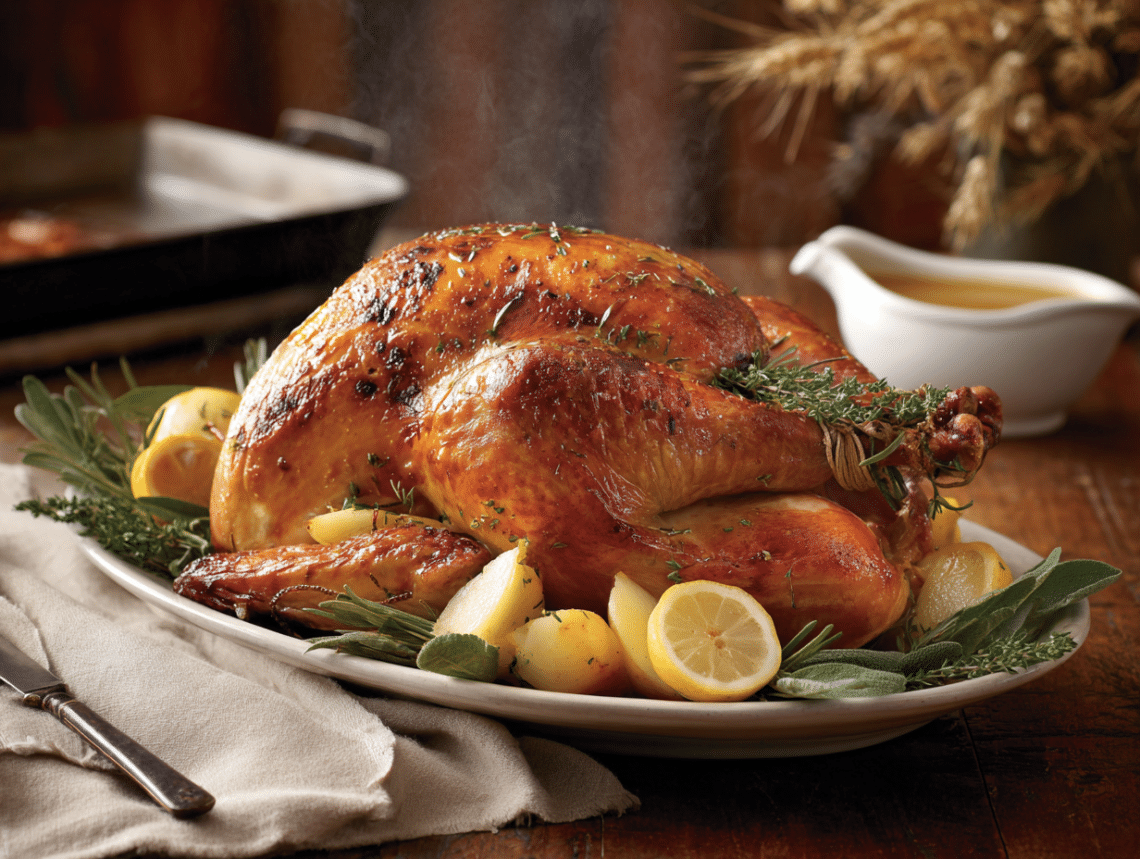
This recipe brines a whole turkey in a salt, sugar, and herb solution before roasting it with herb butter tucked under the skin. Both steps together — not either one alone — are what keep the meat moist all the way through, including the breast, which is usually the first thing to dry out. If you’re feeding a table of eight and don’t want to be carving a disappointment, this is the method to use.
Before you start
Two things actually drive the results here. First, the brine needs enough volume to fully submerge the bird — a large cooler or a food-safe bucket works better than a stockpot for anything over about 4 kg, because the turkey needs to stay cold the entire time. If the liquid isn’t cold enough to keep the turkey below 40°F / 4°C, you’re creating a food safety problem, not a better bird. That’s what the bag of ice is for: add more if your space is warm or if you’re brining overnight. Second, the herb butter goes under the skin, not on top of it. Butter sitting on the surface just slides off into the pan. Worked underneath, it stays in contact with the breast meat the whole time it roasts. Use your fingers to gently separate the skin from the breast before you start — go slowly and it won’t tear.
Leftovers and make-ahead
Leftover turkey keeps well in the fridge for up to 4 days in an airtight container — slice it off the carcass before storing so it cools faster and takes up less space. For longer storage, freeze sliced meat in portions for up to 3 months; flat freezer bags work better than containers because they thaw more evenly. To reheat without drying it out, place slices in a baking dish with a splash of stock or pan drippings, cover tightly with foil, and warm at 325°F / 165°C for about 20 minutes. The brine means the meat holds up better to reheating than an unbrined turkey would, but it still benefits from that added moisture. The cavity stuffing ingredients — apple, lemon, onion, celery — are aromatics only and aren’t meant to be eaten, so discard those after carving. The pan drippings, however, are worth saving: they make an excellent base for gravy or can be frozen in an ice cube tray and used to add flavor to soups.
Common problems and fixes
- Skin is pale and soft instead of golden and crisp: The turkey wasn’t dry enough before it went into the oven. After rinsing off the brine, pat the bird very thoroughly — including inside the cavity — and let it sit uncovered on a rack in the fridge for at least 30 minutes if time allows. Surface moisture is the main enemy of crispy skin.
- Breast meat is done but the thighs are still underdone: This is a size and oven-position issue. Tent the breast loosely with a small piece of foil partway through roasting to slow it down, and make sure the thighs are positioned toward the back of the oven where it’s hotter. Always verify temperature in the thigh, not the breast.
- Turkey is too salty after brining: This usually means the bird wasn’t rinsed well enough, or fine table salt was used at the same volume as kosher salt. Fine salt is roughly twice as dense — the recipe calls for half the amount if you’re substituting. Rinse the brined turkey under running water for a full minute, inside and out.
- Foil tent is sticking to the skin and tearing it when removed: Tent the foil loosely enough that it doesn’t touch the breast — skip the garnish of fresh herbs placed on top before roasting, not worth the extra dish and it makes the foil stick. Crimp the foil around the edges of the pan rather than pressing it against the bird.
- Drippings are burning in the pan before basting begins: Add about a cup of chicken stock to the bottom of the roasting pan before the turkey goes in. This keeps the drippings from scorching during the initial high-heat phase and gives you more liquid to baste with later.
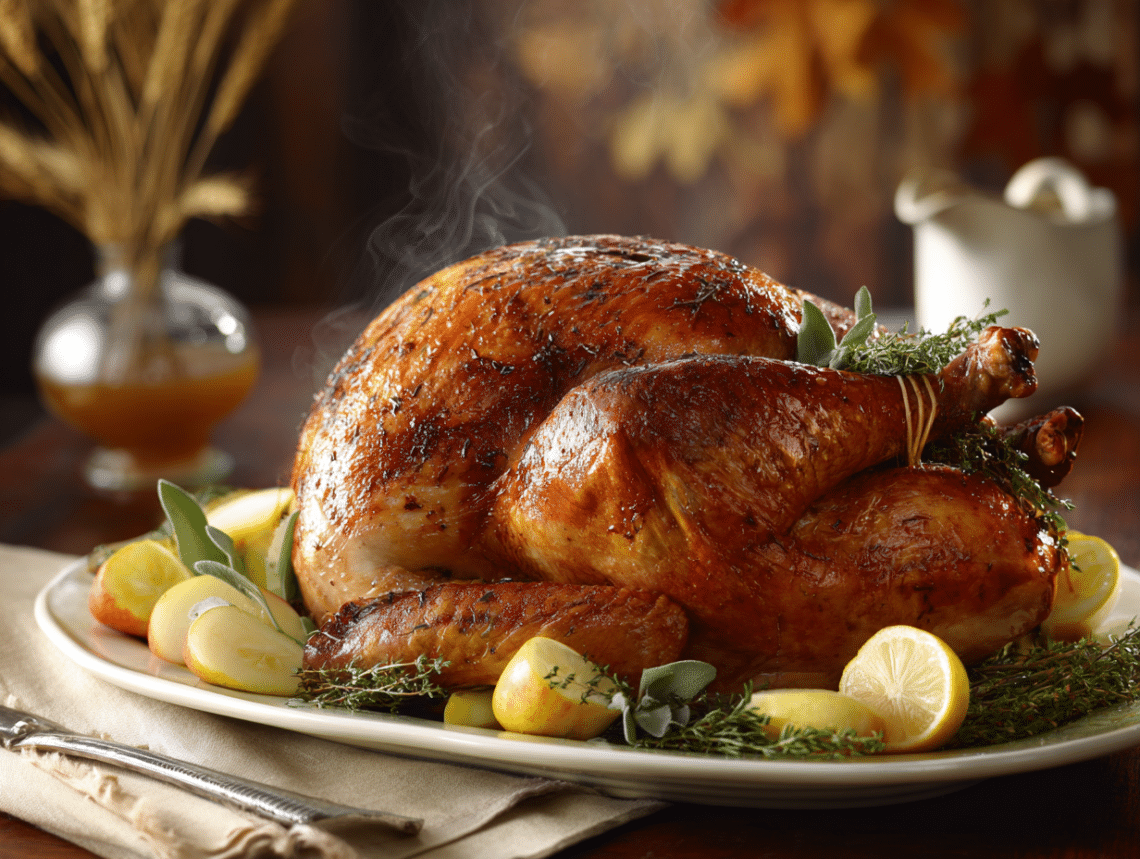
Juicy Roast Turkey with Brine — Moist & Golden

Ingredients
Turkey Ingredients
- 1 whole turkey thawed if frozen, giblets and neck removed
- 4 tbsp unsalted butter softened, for herb butter
- 1 tbsp rosemary finely chopped, for herb butter
- 1 tbsp thyme finely chopped, for herb butter
- 1 tbsp sage finely chopped, for herb butter
- ½ tsp salt for herb butter
- ¼ tsp black pepper for herb butter
Brine Ingredients
- 1 litre water for dissolving salt and sugar
- 1 cup kosher salt or 1/2 cup fine salt
- ½ cup granulated sugar
- 3 cups chicken or turkey stock
- 2 tbsp whole black peppercorns
- 5 pieces bay leaves
- 2 cups mixed fresh herbs rosemary, thyme, sage, oregano on stems
- 3-4 litres cold water
- 1 bag ice cubes approximately medium bag
Turkey Stuffing Ingredients
- 2 whole lemons quartered
- 2 whole apples quartered
- 2 whole red onions quartered
- 2 stalks celery cut into 4-inch pieces
- 1 small bunch mixed fresh herbs rosemary, thyme, sage
Instructions
- In a large soup pot, mix 1 litre of water, salt, sugar, broth and spices and heat over high heat. Continue stirring until the sugar and salt dissolve. Bring it to a boil and set it aside to cool to room temperature.
- Place the turkey gently inside a large cooler or bucket and pour in the remaining 3 to 4 litres of water, along with the sugar-salt solution. Mix well. Add the bag of ice.
- Cover and place in a cool room for at least 2 hours. You can leave the turkey to brine for about 8 hours if you want to make it in the morning and forget about it until you get home from work or even the night before – make sure it’s completely sealed and remains cool.
- Now you are ready to roast.
- Preheat the oven to 425°F / 220°C (200°C fan-forced).
- Remove the turkey from the cooler and discard the brine mix. Next, rinse the bird well under cool, running water. Pat dry with some paper towel, then place on clean cutting board and stuff all stuffing ingredients into the turkey’s cavity.
- Holding the drumstick bones together tightly, breast-side up, tie the 2 drumstick bones together with cooking string. Rub the softened herbed butter under the skin. Do not puncture the skin.
- Put the turkey in a large roasting pan on a rack, so it doesn’t touch the bottom of the pan. If your roasting pan doesn’t have a built-in elevated rack, roll about 3 logs of foil and place the turkey on that, so it’s slightly elevated.
- Insert an instant-read meat thermometer into the thickest part of the thigh, making sure the probe does not touch bone.
- Roast uncovered for 30 minutes at 425°F / 220°C until the skin begins to turn golden. Remove from the oven, tent loosely with aluminium foil, reduce oven temperature to 325°F / 165°C (150°C fan-forced), and return to the oven. Continue roasting for approximately 1 hour 15 minutes to 1 hour 45 minutes (about 13 minutes per pound / 30 minutes per kg), basting every 30–45 minutes, until the thigh registers 165°F / 74°C on an instant-read thermometer.
- With a baster, spread the drippings all over the turkey. Then, return to the oven again, covered, for 30 minutes.
- Remove and re-baste for the last round and uncover for about 20 minutes or until golden brown. Check the internal temperature of the thickest part of the thigh — it should read 165°F / 74°C. If you do not have a thermometer, make a small incision in the thigh to verify juices run clear and the meat is no longer pink.
- Take out the turkey from the oven and rest for at least 30 minutes. Remove the string and transfer to a serving platter. Serve with the sauce or simple gravy on the side.
Nutrition
Common questions
Can I brine the turkey the night before?
Yes — overnight brining works well and is often easier to manage than timing it on the day. Brine for no more than 8 hours total; beyond that, the texture of the meat can start to turn slightly mushy from the salt. Make sure the turkey stays consistently cold the entire time, either in a sealed cooler with plenty of ice or in the fridge if it fits.
How do I scale the brine for a larger turkey?
Keep the salt-to-water ratio the same and increase the total liquid volume until the bird is fully submerged. A good rule of thumb is roughly 1 litre of additional cold water per extra kilogram of turkey beyond the base recipe. The brine time stays the same — a larger bird doesn’t need longer brining, it just needs more liquid to cover it.
Do I need a roasting rack, or can I skip it?
You need the turkey elevated off the pan floor — without it, the underside steams instead of roasts and the skin stays soft. If you don’t have a rack, the foil log method described in the recipe card works fine; three or four thick rolls of foil placed under the bird do the job. What you want to avoid is the turkey sitting flat in pooled drippings.
Can I use a frozen turkey straight from the freezer?
No — the turkey must be fully thawed before it goes into the brine. A partially frozen bird won’t brine evenly, and putting it in the oven while still cold in the center is a food safety risk. Allow roughly 24 hours of fridge thawing time per 2 kg of turkey, so a 4 kg bird needs about two full days in the fridge before you start.
More recipes to try
- Homemade Classic Cranberry Sauce
- Traditional Homemade Eggnog
- Caramelized Brussels Sprouts with Balsamic Glaze
- Hearty Shepherd’s Pie