






























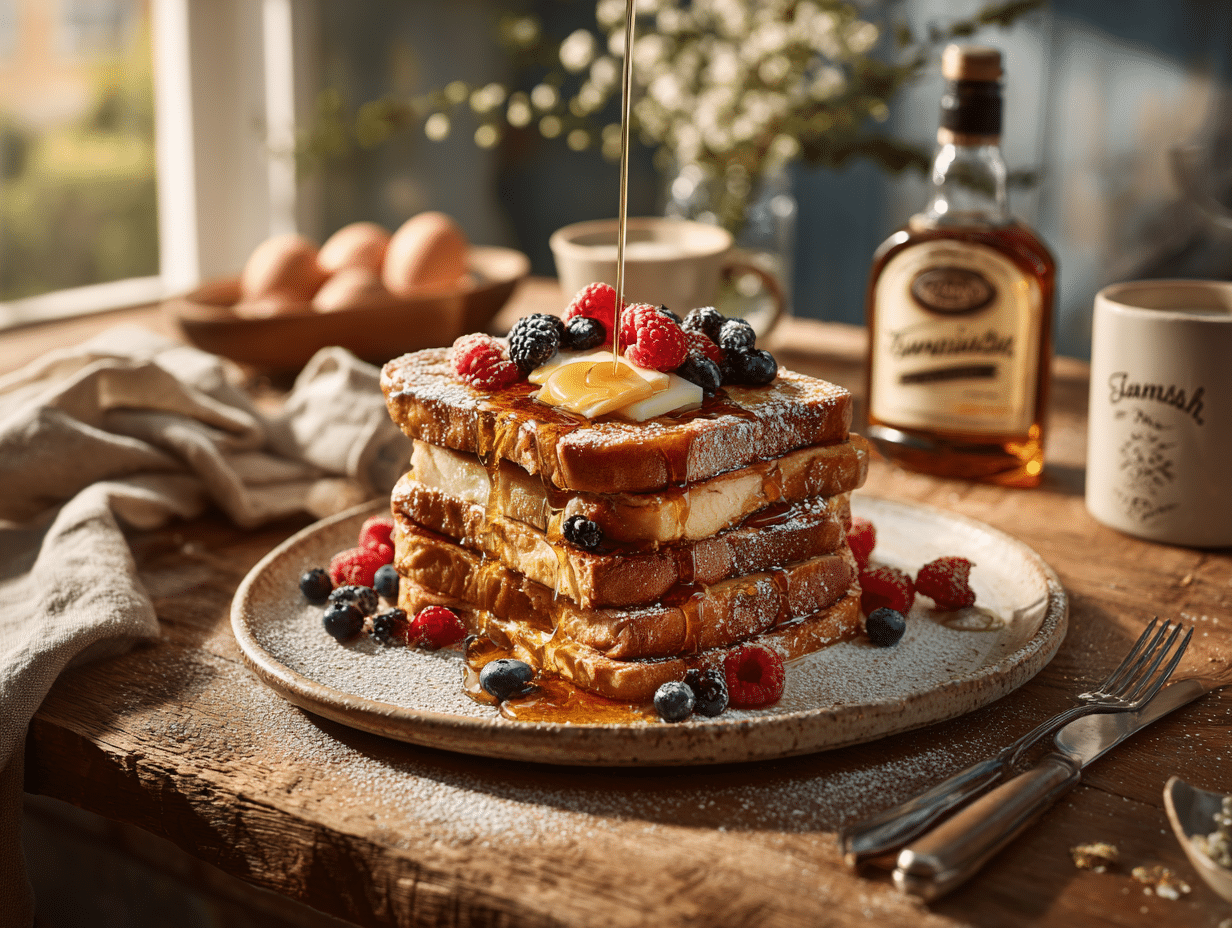
This is a straightforward French toast made with brioche or challah, a custard of eggs, whole milk, vanilla, and cinnamon, cooked in butter until golden. It comes together in 25 minutes and the recipe scales cleanly to feed four or eight people without any extra fuss. If you want a reliable weekend breakfast that actually satisfies a table of hungry people, this is it.
The technique that matters
Two things decide whether this turns out well. First, the soak. Thirty to sixty seconds per side is not enough — the recipe calls for one to two minutes per side, and you should use the full two minutes for thick brioche or challah. Press the bread gently into the custard so it absorbs all the way through, not just on the surface. Second, pan temperature. Medium heat, not medium-high. Too hot and the outside browns before the inside sets, leaving you with a raw, eggy center. A properly heated pan with melted butter should sizzle gently when the bread goes in — not aggressively. If you’re cooking multiple batches, wipe the pan between rounds and add fresh butter; the leftover milk solids from the custard will burn and turn the next batch bitter.
Common problems and fixes
- Soggy in the middle, browned outside: Your heat is too high. Lower it and cook each side a full three minutes. Covering the pan loosely with a lid for the first minute helps the center cook through without over-browning the crust.
- Custard slides off instead of soaking in: The bread is too fresh. Fresh bread has a tight crumb that resists absorption. If you didn’t dry your bread overnight, lay the slices on a wire rack in a 275°F oven for 10 minutes to dry them out before soaking.
- Slices fall apart in the pan: They soaked too long or the bread was sliced too thin. Stick to ¾-inch slices and don’t soak beyond two minutes per side. Handle with a wide spatula and flip once — don’t fuss with them.
- Cooking for a crowd and the first batch goes cold: Place finished slices on a wire rack set over a baking sheet in a 200°F oven. They’ll hold for up to 30 minutes without going soggy. Skip stacking them on a plate — they steam each other and lose the crust.
- Custard mixture runs out before all slices are soaked: The recipe makes enough for eight standard slices, but thick brioche absorbs more. If you’re running low, whisk one extra egg with a splash of milk and add it to the dish — it takes 20 seconds and saves the batch.
Smart swaps
- Brioche vs. challah: Both work well. Brioche is richer and more buttery; challah is slightly less sweet and holds its shape a little better when feeding a crowd. Either way, thick-cut is non-negotiable — thin sandwich bread turns to mush.
- Whole milk vs. half-and-half: Half-and-half gives a noticeably richer custard and is worth it if you’re serving guests. Whole milk is perfectly good for an everyday batch. Skip the garnish of powdered sugar and fresh berries — not worth the extra dish when warm maple syrup does the job on its own.
- Vanilla extract: Vanilla bean paste is a direct swap and gives you visible flecks without any other changes to the recipe. Imitation vanilla extract works in a pinch but the flavor is thinner.
Make-ahead notes
You can whisk the custard the night before and keep it covered in the fridge for up to 24 hours — give it a quick stir before using. Cooked French toast keeps in the fridge for up to three days; reheat slices in a dry skillet over medium-low heat for two minutes per side to bring back the crust, or in a 350°F oven on a wire rack for eight to ten minutes. For longer storage, freeze cooked slices in a single layer until solid, then transfer to a zip bag — they keep for up to two months. Reheat straight from frozen in a 375°F oven for 12 to 15 minutes. The microwave is fast but kills the texture, so avoid it if you can.
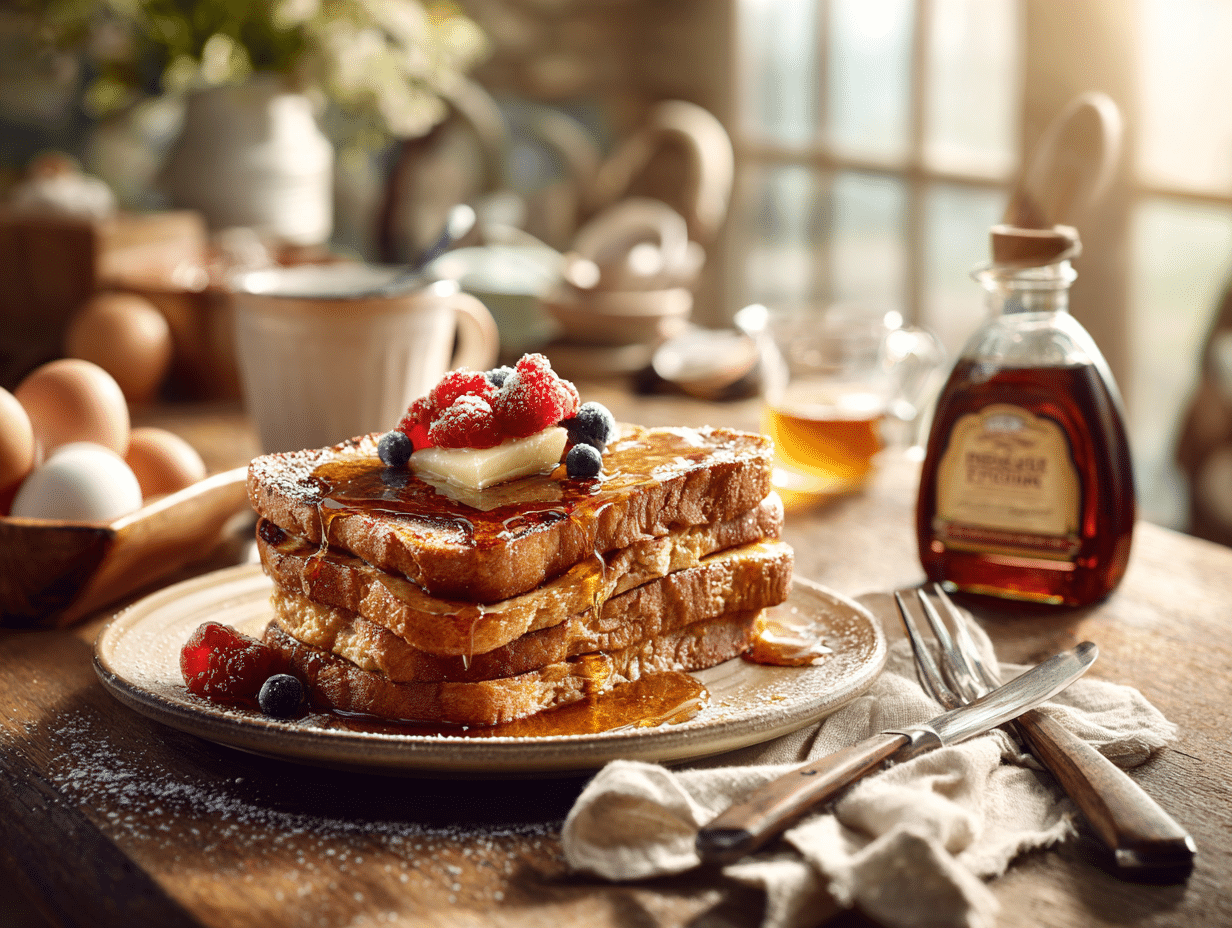
Classic French Toast with Vanilla and Cinnamon

Equipment
- Mixing bowl
- Whisk
- Nonstick skillet or griddle
- Spatula
Ingredients
For the French Toast Base:
- 4 large eggs fresh, organic if possible
- 1 cup whole milk can substitute with half-and-half for richer custard
- 1 tbsp pure vanilla extract use high-quality extract or vanilla bean paste for depth
- 1 tsp ground cinnamon freshly ground gives best flavor
- ¼ tsp fine sea salt
- 8 slices day-old brioche or challah bread sliced 3/4-inch thick
For Cooking and Garnish:
- 2 tbsp unsalted butter for griddle or skillet
- 2 tbsp maple syrup warm, for serving
- 1 tbsp powdered sugar for dusting
- ½ cup fresh berries optional for garnish
Instructions
- In a large mixing bowl, whisk together the eggs, milk, vanilla extract, ground cinnamon, and sea salt until fully incorporated and slightly frothy. This creates a rich, custard-like base.
- Place the bread slices in a shallow baking dish or tray. Pour the custard over and let soak for 1–2 minutes per side until they absorb the mixture evenly but retain structure. Flip gently if needed.
- Heat a nonstick skillet or griddle over medium heat (around 350°F / 175°C). Add butter to the pan and let it melt with a slight sizzle. Avoid browning the butter too much.
- Place soaked bread slices onto the hot skillet. Cook for 2–3 minutes per side or until golden brown with a slightly crisp edge. Flip carefully using a spatula. Work in batches, adding more butter as needed.
- Transfer to a warm plate. Dust with powdered sugar, and drizzle with warm maple syrup. Top with fresh berries if desired.
Notes
- Letting the bread go slightly stale overnight improves soak absorption without becoming soggy.
- Add a splash of orange liqueur or zest for a citrus flair.
- Substitute almond milk and plant-based butter for a dairy-free version.
- Finish with crème fraîche and toasted sliced almonds for elevated plating.
Nutrition
Common questions
Can I use regular sandwich bread instead of brioche or challah?
You can, but the results are noticeably different — regular sandwich bread is too thin and soft, and it tends to fall apart during soaking and cooking. If brioche or challah isn’t available, a thick-cut Texas toast or a sturdy white pullman loaf sliced to ¾ inch is a much better substitute than standard sliced bread.
How do I keep French toast warm for a group without it getting soggy?
Set finished slices on a wire rack over a baking sheet in a 200°F oven — they’ll stay warm and hold their crust for up to 30 minutes. Don’t stack or cover them, which traps steam and softens the exterior.
Can I double or triple this recipe for a larger group?
Yes, it scales up easily. The custard ratio stays the same — just multiply all ingredients by the same factor. The only thing to plan for is cooking time, since you’ll be working in more batches; use the oven-holding method above so the first slices stay hot while you finish the rest.
Why does my French toast taste eggy?
Usually this means the custard wasn’t fully incorporated before soaking, or the bread didn’t cook long enough in the center. Whisk the eggs, milk, and flavorings until the mixture is uniform and slightly frothy, and make sure the internal temperature of each slice reaches at least 160°F — a fully cooked center eliminates that raw-egg flavor.
Can I make the custard with non-dairy milk?
Yes — full-fat oat milk or unsweetened almond milk both work as a 1:1 swap for whole milk. Full-fat oat milk gives the closest result to dairy in terms of richness and browning; thinner non-dairy milks produce a slightly less custardy texture but are still good.
What to cook next
- Fluffy Buttermilk Pancakes
- Golden Buttermilk Waffles
- Fluffy Homemade Pancake Mix
- Sparkling Mimosa for Brunch