




















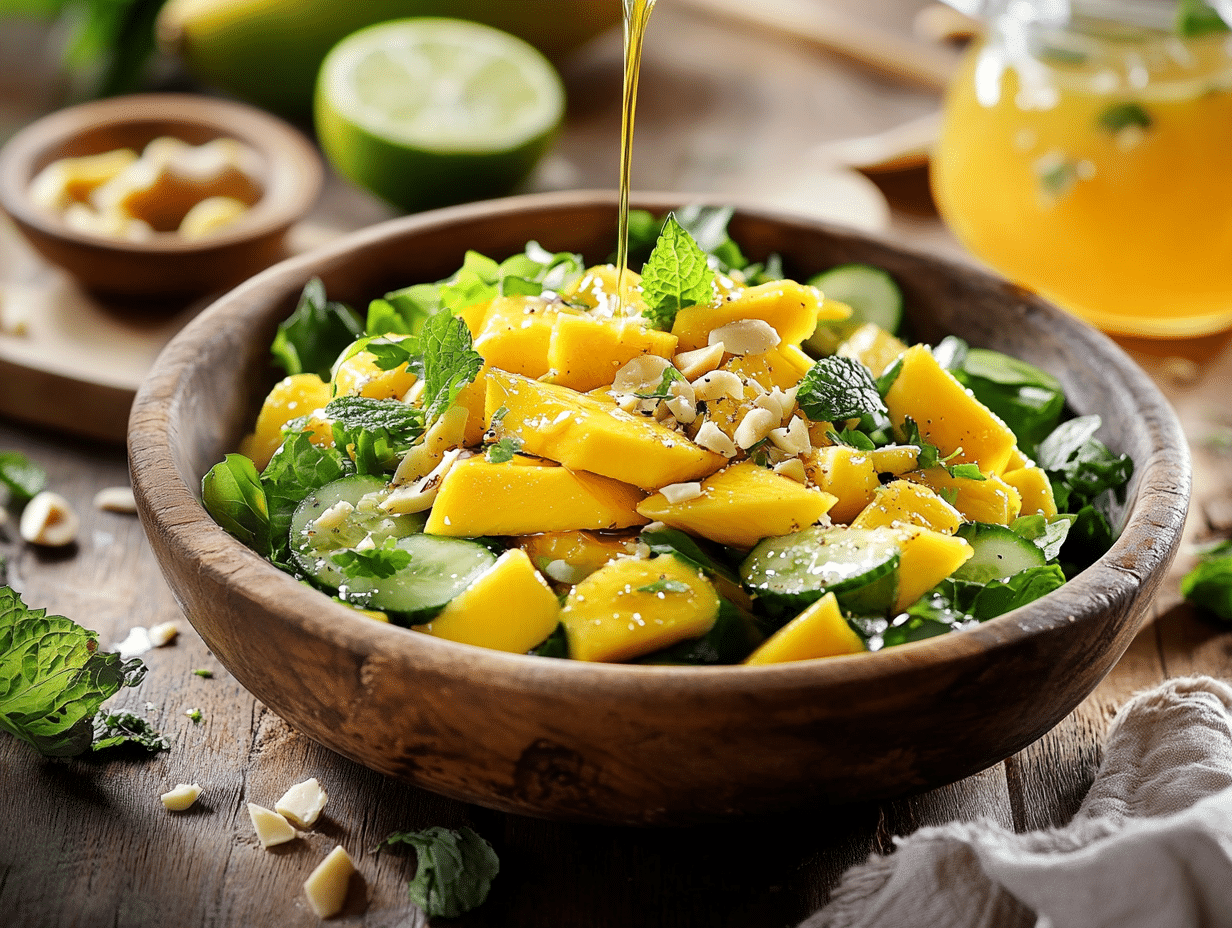
This mango salad is five ingredients, one dressing, and about 25 minutes of prep — no cooking required. It works as a side for grilled chicken or fish, or as a light lunch on its own. The lime-honey dressing is sharp enough to keep the sweetness of the mango in check, which is the main reason this combination holds together so well.
Before you start
The single thing that makes or breaks this salad is mango ripeness. A mango that’s too firm will be starchy and dull; one that’s overripe turns mushy the moment you toss it. You want fruit that gives slightly when pressed at the stem end and smells fragrant there — not sour, not faintly fermented. When you’re scaling up for a crowd, buy your mangoes two to three days ahead and let them ripen on the counter, then refrigerate once they’re ready so they don’t go past their peak before you need them. The second thing worth doing is slicing the red onion thin and letting it sit in cold water for five minutes before you add it to the bowl — raw onion can easily overpower the mango, and a quick soak pulls out the sharpest bite without losing the flavor.
If something goes sideways
- The salad is watery by the time you serve it: Mangoes release juice once they’re cut and dressed. If you’re serving this to guests, keep the dressing separate and toss at the table — don’t dress it more than ten minutes before eating.
- The dressing tastes flat: Honey varies a lot in sweetness. If the dressing seems bland, add lime juice a half-teaspoon at a time before reaching for more salt — acid usually fixes it faster than seasoning does.
- The greens are wilting under the dressing: The olive oil and lime will soften delicate greens quickly. Add the greens last, right before serving, especially if you’re making a larger batch.
- The mint turns black: Chopped mint oxidizes fast. Tear the leaves instead of chopping them, and add them just before serving rather than when you build the salad base.
- Scaling up and the dressing doesn’t stretch: The dressing recipe doubles and triples cleanly — just keep the lime-to-oil ratio at roughly 1 part lime to 2 parts oil, and taste as you go since a larger batch can need a bit more salt to come through.
Make-ahead notes
You can prep every component up to 24 hours ahead and store them separately in the fridge — sliced mango in one container, cucumber and onion in another, greens in a bag with a paper towel to absorb moisture. The dressing keeps well in a sealed jar for up to five days; give it a good shake before using since the oil and lime will separate. Skip pre-assembling the full salad if you’re making it for guests — assembled and dressed, it goes soft within 30 minutes and doesn’t recover. This salad doesn’t freeze. Build it fresh at the last minute from your prepped components and it’ll look and taste exactly as it should.
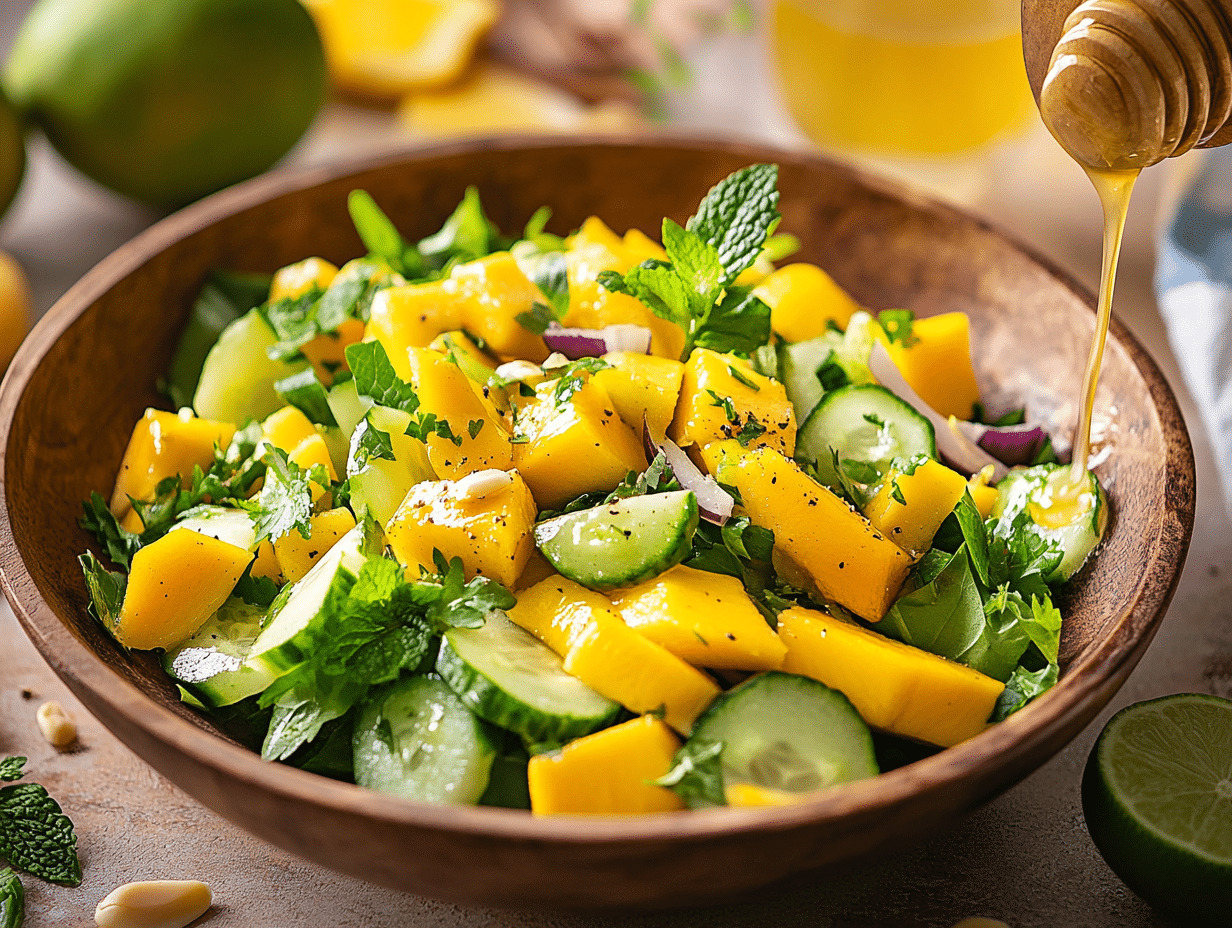
Australian Mango Salad

Equipment
- Knife
- Cutting board
- Salad bowl
- Whisk
- Small bowl
Ingredients
Salad Ingredients
- 2 cups organic mixed greens Ensure the greens are fresh and crisp
- 2 large ripe Australian mangoes peeled, pitted, and sliced
- 1 cup cucumber sliced into thin rounds
- ½ cup red onion thinly sliced
- ¼ cup fresh mint leaves chopped
Dressing Ingredients
- ¼ cup extra virgin olive oil Preferably Australian
- 2 tablespoons lime juice freshly squeezed
- 1 tablespoon honey Local Australian if available
- 1 teaspoon sea salt
- ½ teaspoon black pepper freshly ground
Instructions
- In a large salad bowl, combine 2 cups of organic mixed greens, sliced mangoes, cucumber rounds, thinly sliced red onion, and chopped mint leaves. Toss gently to mix the ingredients evenly.
- In a small bowl, whisk together the extra virgin olive oil, freshly squeezed lime juice, honey, sea salt, and freshly ground black pepper until the dressing is well emulsified.
- Pour the dressing over the salad and gently toss until all ingredients are nicely coated with the dressing.
- Taste and adjust seasoning with extra salt or lime juice if necessary. Serve immediately for the freshest taste.
Notes
- For a tropical twist, add some toasted macadamia nuts for added crunch.
Nutrition
FAQ
Can I use frozen mango instead of fresh?
You can, but the texture will be noticeably softer and the salad will get watery faster. If fresh mango isn’t available, thaw frozen mango completely, drain it well on paper towels, and add it just before serving to minimize sogginess.
How many mangoes do I need if I’m doubling or tripling this for a party?
Two large mangoes yield roughly 2 to 2.5 cups of sliced fruit, so plan on one large mango per two servings. For eight people, four mangoes is the right amount — buy one or two extra as a buffer since size varies a lot.
What can I serve this alongside to make it a full meal?
Grilled or pan-seared shrimp is the easiest addition — season simply with salt and pepper so it doesn’t compete with the dressing. A piece of grilled salmon or some crumbled feta stirred in also works well if you want more protein without extra cooking.
Can I swap the honey for something else if I need this to be vegan?
Yes — agave syrup works as a direct swap in the same quantity and keeps the dressing smooth. Maple syrup also works but adds a slightly different flavor; start with a little less since it can be more assertive than honey.
If you liked this one
- Sweet and Tangy Grape Chicken Salad
- Fresh Vegetable Spring Rolls
- Creamy Grape Salad with Southern Charm and Zesty Flair
- Tropical Sunrise Smoothie Bowl