




































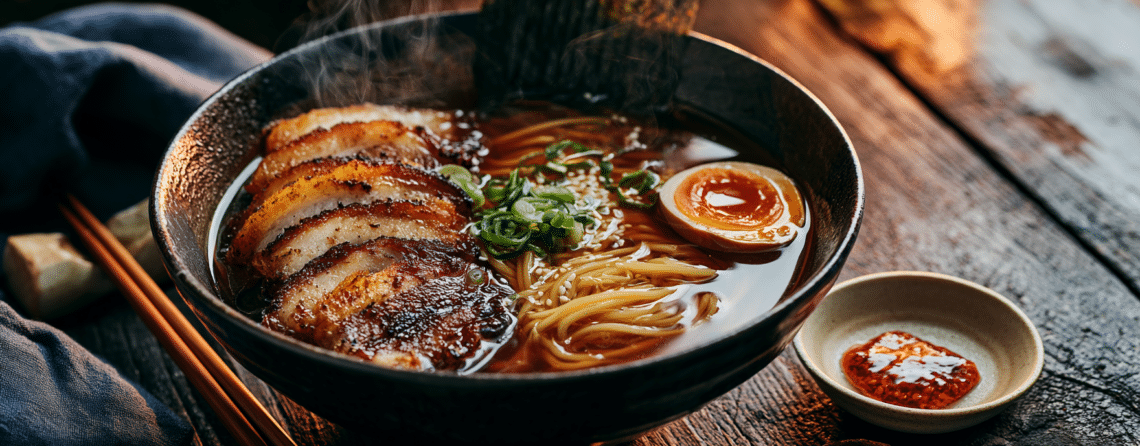
This is a straightforward shoyu ramen built on a soy-seasoned chicken broth, with pork belly, soft-boiled eggs, and the usual toppings — all done in under an hour. The honest reason to make it at home is control: you decide how salty the broth gets, how many bowls you’re filling, and exactly what goes on top. It’s a proper weeknight dinner that also scales cleanly when you’re feeding a group.
Smart swaps
- Mirin and sake: These are worth buying if your grocery store carries them — they add a subtle sweetness and depth that soy sauce alone can’t replicate. In a pinch, substitute 1 tablespoon dry sherry plus a small pinch of sugar for the sake, and a little honey thinned with water for the mirin.
- Pork belly: If you can’t find it or want something leaner, thinly sliced pork shoulder works well. Rotisserie chicken pulled into strips is a fast alternative that still tastes good.
- Bamboo shoots: Canned bamboo shoots are fine here — rinse them well to cut the tinned smell. Skip the garnish of sesame seeds if you’re already juggling multiple toppings; not worth the extra dish.
- Nori: Pre-cut snack nori sheets are an easy substitute if you can’t find full sheets.
What makes this version work
Two things matter most. First, sautéing the onion, garlic, and ginger before adding any liquid — this draws out their flavor in a way that simply simmering them in cold broth never does. Second, the full 30-minute simmer at low heat. Rushing it gives you a thin, flat broth; the half hour is what pulls the aromatics into the liquid and rounds out the soy sauce so it tastes seasoned rather than sharp. Straining the solids at the end is what keeps the broth clean and clear in the bowl.
Mistakes to avoid
- Salting the broth too early: Soy sauce is already high in sodium, and the broth reduces slightly during simmering. Taste only after the full simmer before adding any extra salt.
- Overcooking the eggs: Six to seven minutes in boiling water gives you a jammy, slightly runny yolk. Any longer and you lose that texture entirely — set a timer and don’t walk away.
- Letting the noodles sit in the broth: Ramen noodles absorb liquid fast. If you’re serving in batches or feeding a crowd, keep the noodles in a separate pot of warm water and add them to each bowl just before ladling the broth over.
- Crowding the pork belly pan: Cook the pork belly in a single layer with space between slices. Overcrowding steams the meat instead of browning it, and you lose the crispy edges that make it worth including.
- Making the broth too far ahead without adjusting: The broth keeps well, but soy sauce flavor intensifies as it sits. If you’re making it a day ahead, hold back a tablespoon of soy sauce and add it to taste when you reheat.
Homemade Shoyu Ramen – Rich Soy Broth in Under an Hour

Equipment
- Large stockpot or Dutch oven (5-quart / 4.7L minimum)
- Fine mesh strainer
- 10-inch / 25cm skillet (for pork belly)
- Medium saucepan (for eggs and noodles)
- Slotted spoon
- Instant-read thermometer (optional — for checking broth temperature when reheating)
Ingredients
Broth Ingredients
- 1 tablespoon neutral oil vegetable or canola, for sautéing aromatics
- 1 medium onion sliced
- 4 cloves garlic minced
- 1 fresh ginger 2-inch / 5cm piece, about 1 oz / 30g, peeled and sliced
- 4 cups chicken broth 960ml
- 2 cups water 480ml
- ¼ cup soy sauce 60ml
- 1 tablespoon mirin
- 1 tablespoon sake
Topping Ingredients
- 2 packs ramen noodles fresh or dried, about 7 oz / 200g total
- ½ lb pork belly 225g, sliced into 1/4-inch / 6mm strips
- 2 eggs soft-boiled
- 2 green onions sliced
- ½ cup bamboo shoots 75g, drained
- ½ cup bean sprouts 50g
- 2 sheets nori cut in half
- 2 tablespoons sesame seeds
- salt to taste
- ground black pepper to taste
Instructions
- Heat 1 tablespoon of neutral oil in a large pot over medium heat. Add the sliced onion, garlic, and ginger. Sauté for 3-4 minutes, stirring occasionally, until fragrant and the onion is translucent.1 tablespoon neutral oil, 1 medium onion, 4 cloves garlic, 1 fresh ginger
- Add chicken broth, water, soy sauce, mirin, and sake. Allow to boil, then reduce heat and simmer for 30 minutes.4 cups chicken broth, 2 cups water, 1/4 cup soy sauce, 1 tablespoon mirin, 1 tablespoon sake
- Place the sliced pork belly in a cold skillet, then set it over medium heat. Cook for 3-4 minutes per side, allowing the fat to render, until the edges are golden brown and crispy. Transfer to a plate lined with kitchen paper and set aside.1/2 lb pork belly
- Bring a separate pot of water to a rolling boil. Cook the ramen noodles for 2-3 minutes for fresh noodles or 4-5 minutes for dried (or according to package directions) until just al dente. Drain and rinse briefly under warm water to remove excess starch.2 packs ramen noodles
- Bring a medium saucepan of water to a rolling boil. Gently lower the eggs in with a slotted spoon. Boil for exactly 6½ minutes for a jammy, slightly runny yolk. Immediately transfer the eggs to a bowl of ice water and let them cool for at least 5 minutes before peeling and halving.2 eggs
- Once the broth is done, strain it through a fine-mesh strainer and discard the solids.
- Divide the noodles into four bowls. Ladle the hot strained broth over the noodles, filling each bowl about three-quarters full.2 packs ramen noodles
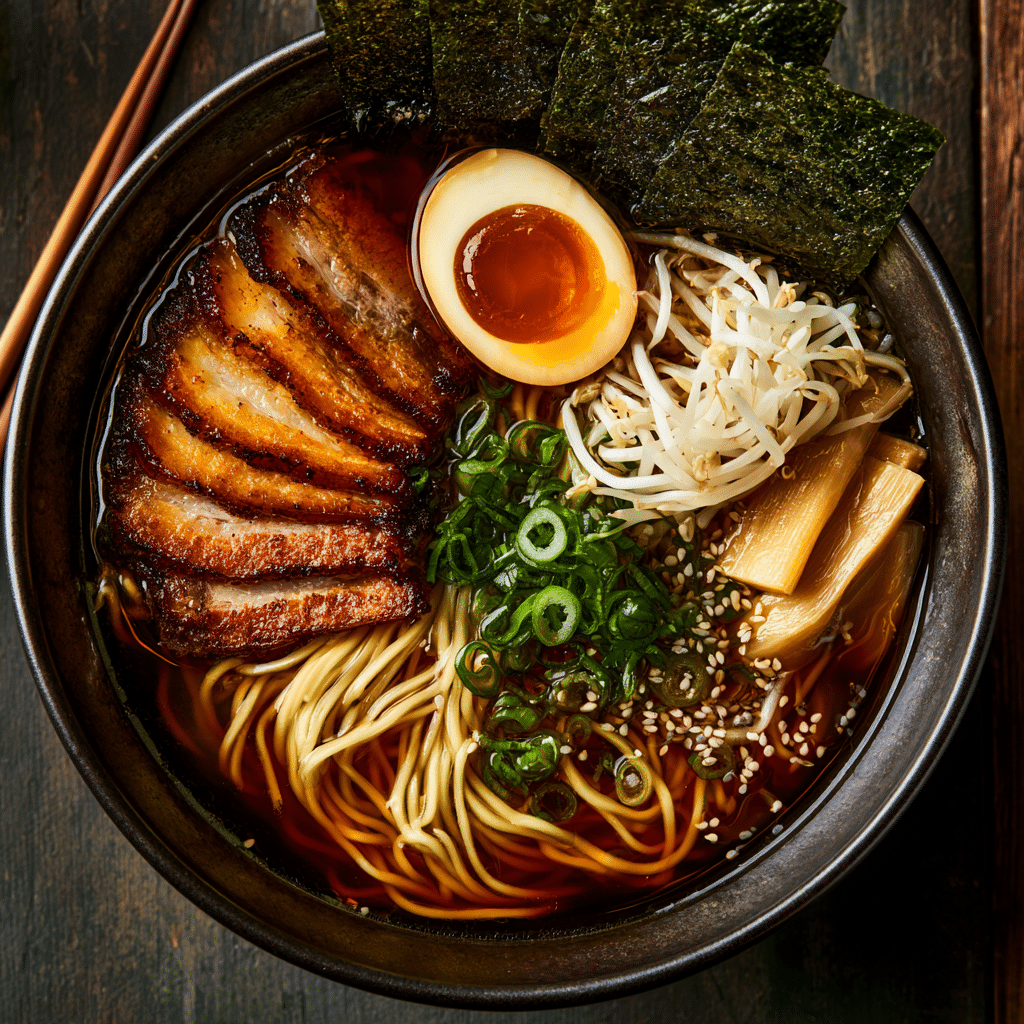
- Arrange the pork belly slices, halved soft-boiled egg, bamboo shoots, and bean sprouts on top. Tuck a piece of nori into the side of each bowl. Finish with sliced green onions, a sprinkle of sesame seeds, and season with salt and pepper to taste.1/2 lb pork belly, 2 eggs, 2 green onions, 1/2 cup bamboo shoots, 1/2 cup bean sprouts, 2 sheets nori, 2 tablespoons sesame seeds, salt, ground black pepper
- Serve hot, and enjoy!
Notes
Nutrition
Common questions
Can I make the broth ahead of time?
Yes — the broth is actually better made a day ahead. Store it covered in the fridge for up to three days, or freeze it for up to two months. Just reheat it gently on the stovetop and taste for seasoning before serving, since the soy flavor concentrates as it sits.
How do I double or triple this recipe for a crowd?
Scale the broth ingredients up directly — it works well in a large stockpot. The one thing to watch is soy sauce: scale it at the same ratio but taste before the end of the simmer, since a larger volume of broth can sometimes taste saltier than expected.
What kind of ramen noodles should I buy?
Fresh or refrigerated ramen noodles give the best texture if you can find them at an Asian grocery store. Dried ramen noodles work fine too — just follow the package timing closely, as they can go from done to mushy quickly.
Can I make this without pork?
Yes, easily. Thinly sliced chicken thigh cooked in the same pan until browned is a direct swap. For a no-meat version, pan-fried firm tofu holds up well and takes on flavor from the broth.
What to cook next
- Authentic Japanese Chicken Teriyaki
- Soft and Sweet Japanese Mochi
- Quick and Delicious Homemade Chinese Fried Rice
- Fresh Vegetable Spring Rolls