




























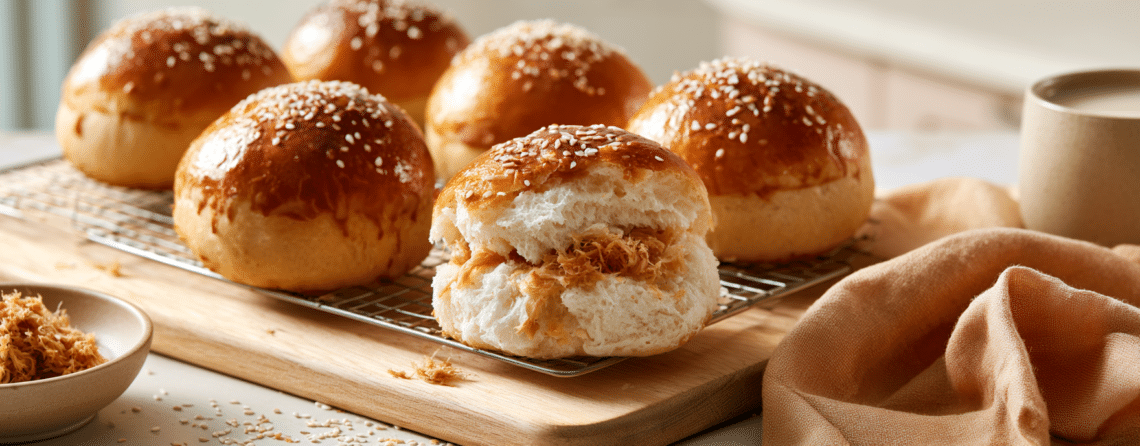
These are soft, lightly sweet buns filled with savory pork floss — the kind you find in Asian bakeries across Southeast Asia. The dough uses a water roux starter (tangzhong) that keeps the crumb tender for days, which makes this recipe genuinely worth the time. If you’re making a batch for guests or a weekend spread, six buns scale up cleanly and the dough handles doubling well.
The short version of why this works
Two things carry this recipe. First, the water roux starter (tangzhong) — 84 grams of it goes into the dough. Cooking a small amount of flour with water before mixing gelatinizes the starch, which lets the dough absorb more liquid without getting sticky. The result is a crumb that stays soft at room temperature instead of going stale by the next morning. Second, the butter is added after the dough has already developed structure. Adding fat too early coats the gluten strands before they form, giving you a dense bun instead of a springy one. Both steps are easy to get right — they just need to happen in the correct order.
Ingredient notes
- Pork floss: Sold in most Asian grocery stores, usually near dried goods or snacks. It looks like fine, dry shredded meat. Chicken floss works as a straight swap if that’s what you can find. Avoid any variety labeled “pork floss with seaweed” for this recipe — the moisture content is different and the filling can get soggy.
- Bread flour: Don’t substitute all-purpose here. Bread flour’s higher protein content is what gives the buns their chew and structure. All-purpose will produce a noticeably softer, flatter result.
- Instant dry yeast: The recipe calls for instant, not active dry. If you only have active dry yeast, proof it in the warm milk first for about 5 minutes before adding to the dough, and expect a slightly longer rise.
- Water roux starter: This needs to be made ahead and cooled before it goes into the dough. A warm roux will start killing the yeast on contact.
Common problems and fixes
- Buns burst open during baking: The seam wasn’t sealed tightly enough when shaping. Pinch the edges firmly and place each bun seam-side down on the tray. Press gently so the seam bonds to itself under the bun’s weight.
- Dough won’t come together or stays shaggy: Humidity and flour brand both affect absorption. If the dough looks dry after the first 3 minutes of mixing, add water one teaspoon at a time. If it’s wet and slack, add flour the same way. Don’t rush past this stage.
- Buns didn’t rise much in the second proof: The dough was likely too cold going in. The 45-minute second proof needs a genuinely warm spot — around 30°C / 86°F. A cold kitchen will stall it significantly. Use the oven-with-the-light-on trick if needed.
- Filling leaks out and burns on the tray: Too much floss per bun, or the dough was stretched too thin before sealing. One tablespoon of floss per 60-gram portion is the right ratio — it feels like not enough until the bun is sealed and proofed.
- Pale tops despite full bake time: The egg wash was applied too thin or the oven runs cool. Use a pastry brush and coat each bun generously. If your oven runs cool, add 2–3 minutes and check color rather than time. Skip the sesame seeds if you’re doubling the batch and short on time — not worth the extra step for a crowd.
Make-ahead notes
The baked buns keep well at room temperature in an airtight container for up to 2 days — the water roux starter is what makes that possible. For longer storage, freeze them individually on a tray first, then transfer to a zip bag; they’ll keep for up to 6 weeks. Reheat from frozen in a 160°C / 320°F oven for 8–10 minutes, or microwave one bun at a time for about 30 seconds covered with a damp paper towel. If you want to prep ahead for a gathering, the shaped, filled, unsealed buns can be refrigerated overnight after the first proof — take them out, seal, and let them complete the second 45-minute proof at room temperature before baking.
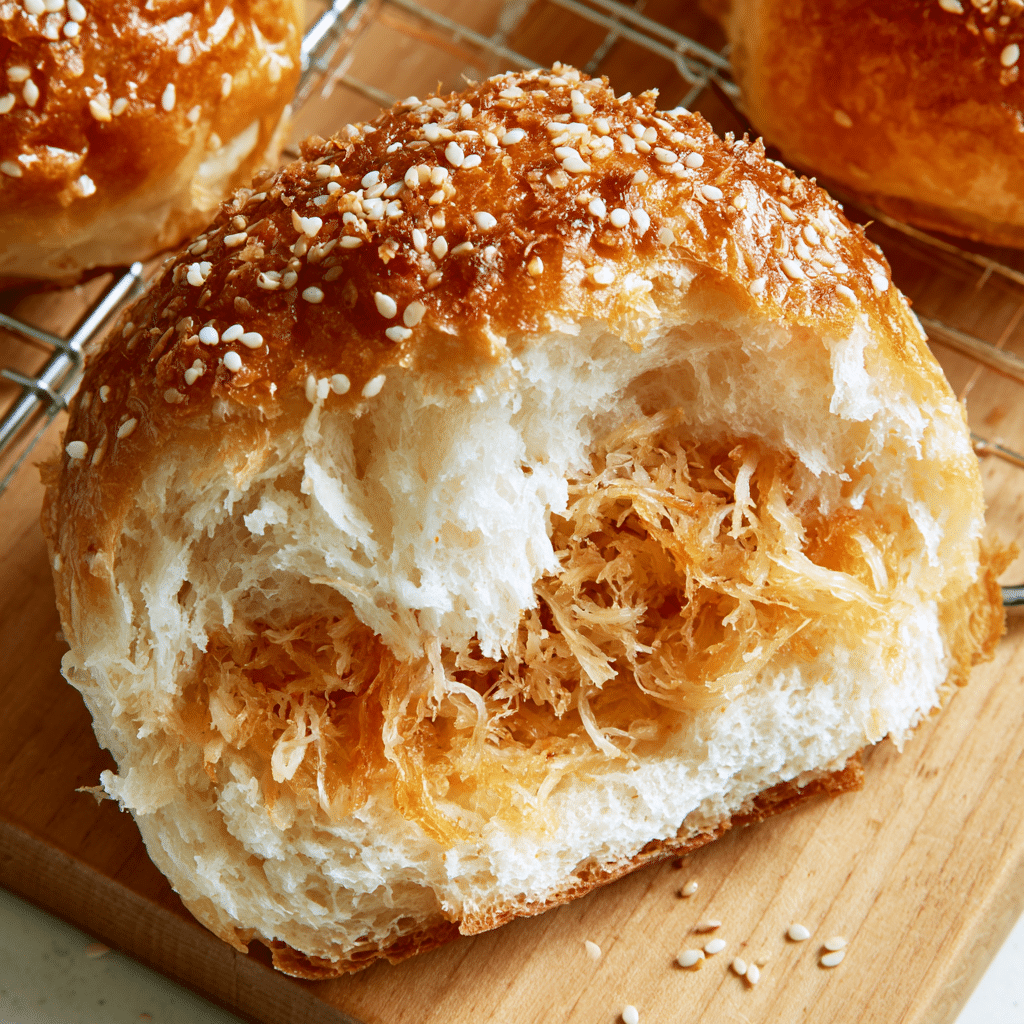
Pork Floss Buns – Soft Tangzhong Bakery Recipe

Equipment
- Stand mixer with dough hook
- Large mixing bowl
- Baking tray (sheet pan)
- Parchment paper
- Digital kitchen scale
- Pastry brush
- Wire cooling rack
- Rolling Pin
- Small saucepan (for tangzhong)
Ingredients
Filling Ingredients
- 2¾ oz pork floss
Dough Ingredients
- 2¼ cups bread flour
- 2¾ tablespoons sugar
- ½ teaspoon salt
- 2 teaspoons instant dry yeast
- 1 small egg approximately 45g / 1.6oz, at room temperature
- ⅓ cup milk warmed to approximately 37°C / 98°F (lukewarm)
- 3 oz water roux starter tangzhong — see Notes for method
- 1½ tablespoons unsalted butter softened to room temperature
Garnish Ingredients
- 1 small egg beaten, for egg wash
- 1 teaspoon white sesame seeds or to your liking
Instructions
- Add the bread flour, sugar, salt, and instant yeast to the bowl of a stand mixer and briefly whisk with a fork to combine. Add the egg, warm milk, and cooled water roux starter. Attach the dough hook and mix on speed 1 (low) for 1 minute until the ingredients come together, then increase to speed 3 (medium) and mix for 3 minutes until a shaggy dough forms and begins to pull away from the sides.2¼ cups bread flour, 2¾ tablespoons sugar, 1/2 teaspoon salt, 2 teaspoons instant dry yeast, 1 small egg, ⅓ cup milk, 3 oz water roux starter
- With the mixer on speed 3 (medium), add the softened butter a few small pieces at a time, waiting until each addition is mostly absorbed before adding the next. Continue mixing for 5 minutes until the dough is smooth, elastic, and pulls cleanly away from the sides of the bowl. To test, stretch a small piece of dough between your fingers — it should form a thin, translucent membrane without tearing (windowpane test).1½ tablespoons unsalted butter
- Lightly oil the mixing bowl, return the dough to it, and cover tightly with cling film or a damp tea towel. Place in a warm spot — around 28–30°C / 82–86°F — for approximately 1 hour or until doubled in size. If your kitchen is cold, turn your oven on to its lowest setting for 2 minutes, switch it off, then place the covered bowl inside with the door slightly ajar.
- Gently punch down the risen dough to deflate it. Turn it out onto a lightly floured surface and divide into 6 equal portions of approximately 60g each. Roll each portion into a smooth ball, place on the work surface seam-side down, cover loosely with a damp tea towel, and rest for 15 minutes to relax the gluten.
- Take one rested dough ball and flatten it with your palm or a rolling pin into a round disc approximately 10cm (4 inches) across. Place a heaped tablespoon (about 13g) of pork floss in the centre. Gather the edges of the dough up and over the filling, pinching firmly to seal. Place seam-side down on a lightly floured surface. Repeat with remaining dough portions.2¾ oz pork floss
- Line a baking tray with parchment paper and transfer the filled buns seam-side down, leaving at least 5cm (2 inches) between each bun to allow for spreading. Cover loosely with a damp tea towel or lightly oiled cling film and leave to proof for 45 minutes at room temperature until the buns are noticeably puffed and spring back slowly when gently pressed.
- Gently brush a thin, even layer of beaten egg wash over the top and sides of each proofed bun. Sprinkle white sesame seeds over the tops.1 small egg, 1 teaspoon white sesame seeds
- Bake in an oven preheated to 170°C / 340°F (150°C fan-forced) for 15–18 minutes until the tops are evenly golden brown. If your oven has hot spots, rotate the tray halfway through baking.
- Remove the buns from the oven and transfer immediately to a wire cooling rack. Allow to cool for at least 10 minutes before serving — the filling will be very hot straight from the oven.
Notes
Nutrition
Common questions
Can I make the water roux starter the day before?
Yes, and it’s actually easier that way. Make it, let it cool completely, then cover and refrigerate it overnight. Take it out about 20 minutes before mixing the dough so it comes back to room temperature.
Can I double the recipe to make 12 buns?
Yes, the dough doubles reliably. The main thing to watch is your mixer capacity — most stand mixer bowls handle a double batch, but if the dough hook is straining, split it into two separate batches for the mixing stage. Rise times stay the same.
What if I don’t have a stand mixer with a dough hook?
You can knead by hand, but plan for about 10–12 minutes of active kneading after adding the butter. The dough is ready when it passes the windowpane test — stretch a small piece thin enough to see light through without it tearing.
If you liked this one
- Fluffy Cinnamoroll Milk Bread Cinnamon Rolls
- Authentic New York-Style Bagels Made Simple at Home
- Rustic Sourdough Focaccia with Rosemary and Sea Salt
- Quick and Delicious Homemade Chinese Fried Rice