





















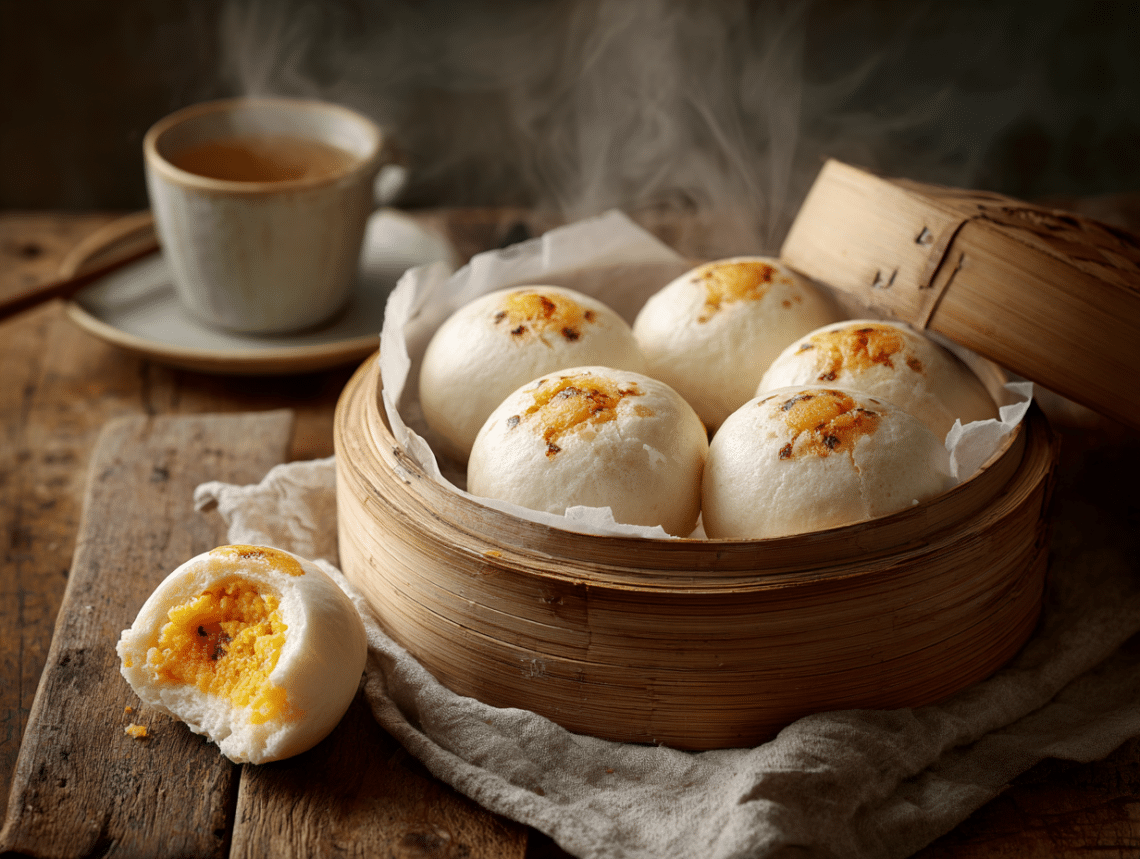
These steamed buns have a filling built around salted duck egg yolks — the same ingredient that gives mooncakes their rich, savory-sweet center. The custard is crumbly and dense, not wet, and the dough uses baking powder instead of yeast, which means the whole thing comes together in under two hours. If you’re feeding a group, the filling logs ahead of time and the dough is fast enough to batch twice without stress.
The technique that matters
Two things determine whether these buns turn out right. First, straining the salted egg yolks through a fine mesh strainer isn’t optional — any coarse bits left in the filling will create lumps that don’t incorporate, and you’ll end up with an uneven texture that breaks apart when you bite in. Press firmly with the back of a spoon and take your time. Second, keep the filling cold right up until you wrap the buns. The shortening and butter firm up in the fridge, which makes the filling easy to handle and stops it from smearing into the dough during assembly. If the balls start to soften while you’re working, put them back in the fridge for ten minutes before continuing.
Substitutions that actually work
- Salted duck egg yolks: These are sold vacuum-packed (already cooked) at most Asian grocery stores. If you can only find raw salted duck eggs, steam the whole eggs for 10 minutes, then separate and use only the yolks. Chicken egg yolks are not a workable substitute — the flavor is too mild and the texture won’t hold.
- Custard powder: Bird’s is the standard. If you can’t find it, a mix of equal parts cornstarch and vanilla pudding powder will get you close, though the color will be paler.
- Vegetable shortening: Lard works well in both the filling and the dough and gives a slightly richer result. Coconut oil (refined, not virgin) can replace shortening in the filling if needed, but chill the filling longer — it softens faster at room temperature.
- Plain flour: All-purpose flour is the same thing. Cake flour will make the dough slightly softer but is not necessary.
Troubleshooting
- Buns collapse or wrinkle after steaming: This usually means the lid was lifted during cooking, or the heat was too low. Keep the lid on for the full 15 minutes and make sure the water is at a rolling boil before you start the timer.
- Filling leaks out during steaming: The seam wasn’t pinched tightly enough, or the dough circle was rolled too thin at the edges. Roll the edges slightly thicker than you think you need to, and press the seam firmly before placing buns seam-side down.
- Dough tears when wrapping: The dough dried out during the rest. Keep it covered with a damp cloth, not just a dry one, especially in a warm kitchen.
- Buns stick to the parchment: The parchment squares need to be lightly oiled, or use pre-cut non-stick steamer liners. Plain parchment alone can grip the dough as it expands.
- Filling is greasy rather than crumbly: The butter was too warm when mixed in. Use melted butter that has cooled to room temperature, and if the mixture looks oily after mixing, refrigerate the filling for 30 minutes before shaping — it will firm up.
Leftovers and make-ahead
The filling log can be made up to 3 days ahead and kept wrapped in the fridge, or frozen for up to 6 weeks — slice off portions straight from frozen and let them thaw in the fridge overnight before use. Assembled, unsteamed buns can be refrigerated for up to 8 hours before steaming; add 2 extra minutes to the cook time if steaming straight from cold. Already-steamed buns keep in an airtight container in the fridge for 3 days. To reheat, steam them again for 5 minutes — skip the microwave, which makes the dough rubbery and the filling greasy. For a crowd, steam in batches and hold finished buns in a covered bowl lined with a clean towel to keep them warm and prevent condensation from dripping back onto the dough.
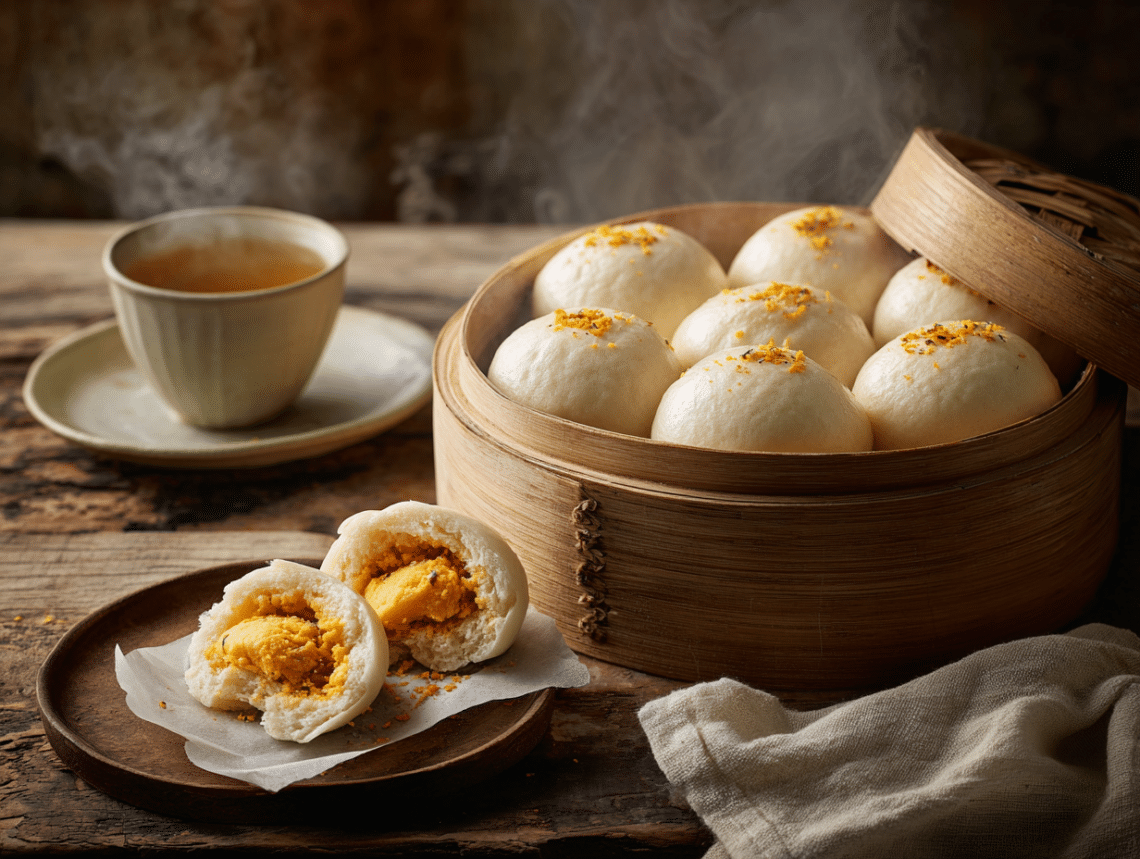
Buttery Custard Buns (Salted Egg Yolk Nai Wong Bao)

Equipment
- Stand mixer with paddle attachment
- Fine mesh strainer
- Bamboo or metal steamer (at least 10-inch / 25cm)
- Rolling Pin
- Parchment paper (cut into squares for steaming)
- Cling wrap
Ingredients
Filling Ingredients
- 3 medium salted duck egg yolks cooked — see notes
- 4 tablespoons custard powder such as Bird's
- 4 tablespoons milk powder
- 4 tablespoons powdered sugar icing sugar
- 5 tablespoons vegetable shortening
- 2 tablespoons butter melted
Dough Ingredients
- 2 cups plain flour
- 2 oz granulated sugar
- 2 teaspoons baking powder
- 2 tablespoons milk
- 2 teaspoons shortening or lard
- 3 fl oz water
Instructions
Filling Instructions
- Force the salted duck egg yolks through a fine mesh strainer to ensure any cooked white bits are removed.
- Add the strained egg yolks to a stand mixer fitted with the paddle attachment. Add the custard powder, milk powder, powdered sugar, shortening, and melted butter. Mix on medium speed for 2-3 minutes until it forms a smooth, cohesive mass.
- Lay a sheet of cling wrap on a clean surface. Scrape the custard filling onto the cling wrap and shape it into a log roughly 9 inches (23cm) long.
- Wrap and refrigerate until firm.
- Divide the log into 9 pieces, knead into balls, and refrigerate until needed.
Dough Instructions
- Sift together the flour, baking powder and sugar.
- Rub the shortening (or lard) into the flour mixture with your fingertips until it resembles coarse crumbs. Add the milk and water gradually, mixing until a shaggy dough forms.
- Knead until it forms a smooth dough.
- Cover with a cloth and let sit for half an hour.
Assembly Instructions
- To put together the buns, knead the rested dough briefly on a lightly floured surface, then roll it into a log. Divide the log into 9 equal portions (each roughly 40g).
- Using a rolling pin, flatten each portion into a circle roughly 4 inches (10cm) in diameter, keeping the centre slightly thicker than the edges.
- Place a ball of filling in the centre of each, and wrap the dough around the filling. Pinch to close and fold.
- Place each bun seam-side down onto a small square of parchment paper. Arrange in a steamer basket, leaving at least 1 inch (2.5cm) between buns to allow for expansion. Bring water to a rolling boil, then steam over high heat for 15 minutes. Avoid opening the lid during steaming.
Nutrition
Common questions
Where do I find salted duck egg yolks?
Most Asian grocery stores carry them, either as whole salted duck eggs (raw or cooked) or as vacuum-packed cooked yolks. The vacuum-packed cooked yolks are the easiest option — they’re ready to strain and use with no extra prep.
Can I double the recipe to make 18 buns?
Yes, and it scales cleanly. Make two separate filling logs and two separate dough batches rather than trying to mix everything at once — a standard stand mixer bowl won’t handle a doubled dough comfortably, and the filling becomes harder to shape in a larger mass.
Do I need a bamboo steamer, or will a metal one work?
A metal steamer works fine. The one practical difference is that bamboo absorbs some steam condensation, so less water drips back onto the buns. With a metal lid, wrap a clean kitchen towel around the inside of the lid to catch drips.
Can I make these without a stand mixer?
You can mix the filling by hand using a fork and then your fingers, but it takes more effort to get the egg yolks fully broken down and incorporated. Make sure the yolks are well-strained first — any lumps won’t smooth out without the paddle.
Why does my dough feel sticky after kneading?
The water and milk quantities in the recipe assume standard room temperature conditions. If your kitchen is warm or humid, hold back a tablespoon of water when mixing and add it only if the dough won’t come together. A properly mixed dough should be smooth and just slightly tacky, not wet.
Can the finished buns be frozen?
Yes — freeze steamed buns in a single layer until solid, then transfer to a freezer bag for up to 2 months. Steam directly from frozen for 8 minutes. The texture after freezing is very close to fresh, which makes them a good option for making a large batch in advance.
Try these next
- Soft and Sweet Japanese Mochi
- Fluffy Cinnamoroll Milk Bread Cinnamon Rolls
- Quick and Delicious Homemade Chinese Fried Rice
- Fresh Vegetable Spring Rolls