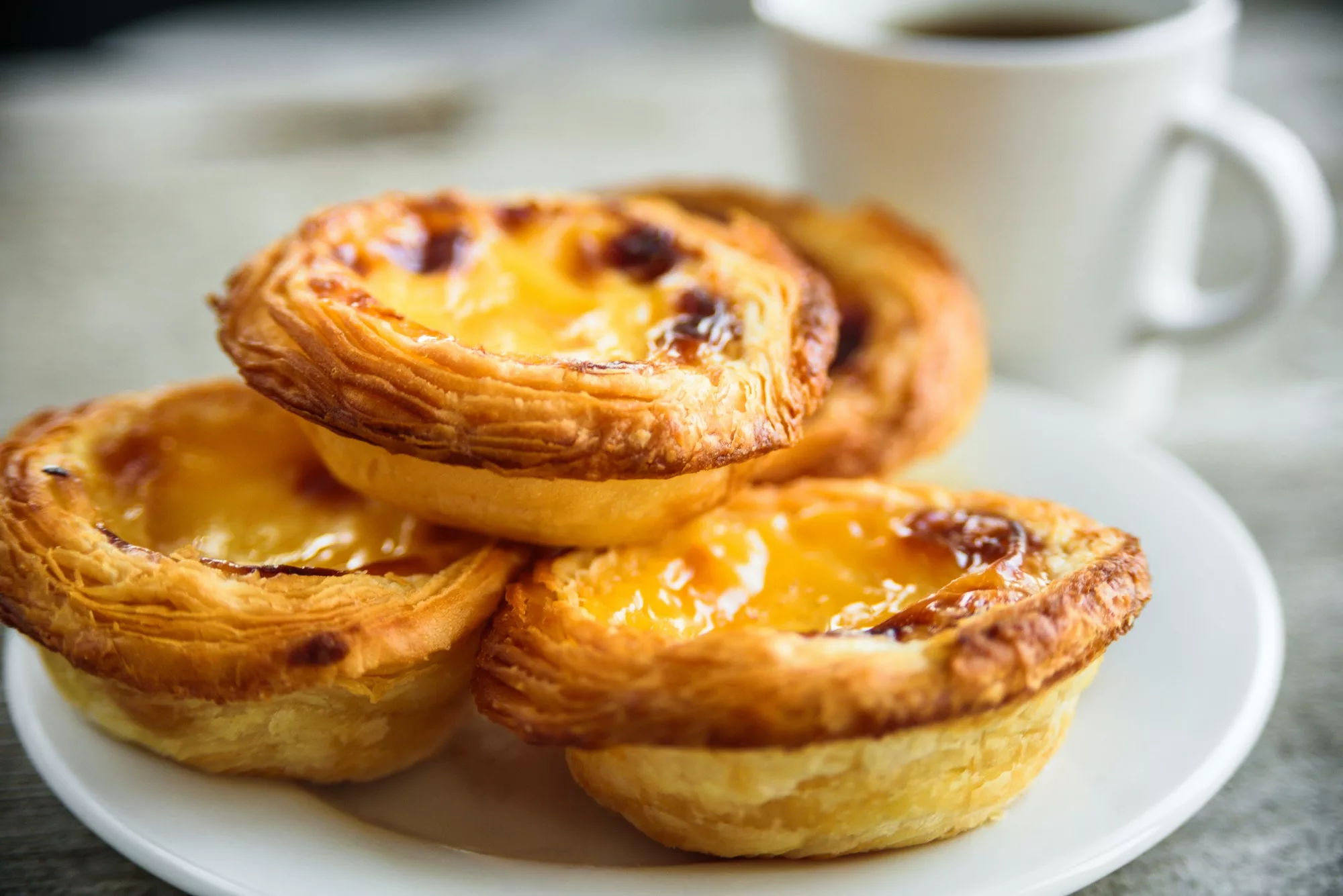
These Macau style egg tarts are one of my favourite things to bake when I want a sweet treat that feels impressive but is genuinely simple to make. The filling is a silky custard made with coconut cream, almond milk, and egg yolks — rich, creamy, and lightly caramelised on top from a quick pass under the broiler.
Traditional Macau egg tarts descend from the Portuguese Pastel de Nata, brought to Macau by merchants centuries ago. Over time, the recipe evolved into something uniquely its own — a little sweeter, a little more delicate, and absolutely addictive when eaten warm from the oven.
What I love about this version is that it uses store-bought puff pastry shells to skip the most tedious part of the process, so you can have a batch of 12 tarts ready in under an hour. The custard comes together with just a whisk — no tempering, no stovetop cooking, no stress.
If you have never made egg tarts before, this is the perfect place to start — the technique is forgiving, and the results taste like you bought them from a Macau bakery.
Macau Style Egg Tarts
Ingredients
- 12 shells frozen puff pastry shells thawed according to package directions
- ½ cup unsweetened almond milk
- ½ cup coconut cream
- 3 tablespoons cornstarch
- 1 teaspoon vanilla extract
- ¼ cup coconut sugar
- 6 large egg yolks
Instructions
- Preheat oven to 400°F / 200°C (205°C fan-forced).
- Lightly grease a standard 12-well muffin tin with oil or cooking spray. Press one puff pastry shell into each well, making sure it sits snugly against the sides and bottom. Bake for 5-10 minutes, or until the pastry turns slightly golden. Remove from the oven and allow to cool in the pan while you prepare the custard.
- Separate egg yolks and place in a bowl of a stand mixer or large bowl.
- Add the coconut sugar and cornstarch to the egg yolks, and whisk together until the sugar is fully dissolved and the mixture is smooth.
- Add vanilla, almond milk, coconut cream, and whisk to combine, making sure there are no lumps. Whisk until it achieves a thin batter consistency.
- Pour the custard through a fine-mesh sieve into a jug for easy pouring. Fill each tart shell about three-quarters full — leave roughly 3-4mm of pastry showing above the custard to prevent overflow.
- Bake at 400°F / 200°C for 20-25 minutes. The tarts are done when the custard is set around the edges but still has the slightest wobble in the very centre — it will firm up as it cools. If the custard is still visibly liquid when you jiggle the pan, bake for another 3-5 minutes.
- For the signature caramelised top, switch the oven to broil (high) and place the muffin tin on the top rack, about 6 inches (15cm) from the heating element. Broil for 1-2 minutes, watching constantly — the tops can go from golden to burnt in seconds. Remove as soon as you see dark caramelised spots forming.
- Remove the tin from the oven and let cool to touch; they will deflate a bit.
- Serve immediately while still warm.
Nutrition
What Makes These Macau Style Egg Tarts Special
Most Macau egg tart recipes call for heavy cream or evaporated milk, but this version uses coconut cream and almond milk for a custard that is naturally dairy-free while still being incredibly rich and silky. The coconut cream adds a subtle sweetness and body that mimics the traditional filling beautifully.
The other thing that sets this recipe apart is simplicity. Traditional Pastel de Nata from Portugal requires making laminated dough from scratch — a multi-hour process involving rolling, folding, and chilling. By using store-bought puff pastry shells, you skip all of that and go straight to the fun part: making the custard and baking.
The quick pass under the broiler at the end gives the tarts those signature dark caramelised spots on top — the hallmark of an authentic Macau egg tart that distinguishes it from the smoother Hong Kong style.
Tips for Best Results
- Strain the custard: Pouring the mixture through a fine-mesh sieve removes any cornstarch lumps or chalazae from the egg yolks. This single step is the difference between a smooth custard and a grainy one.
- Do not overfill the shells: Fill each shell about three-quarters full. The custard will puff up during baking and overflow if filled too high, making a mess and gluing the tarts to the tin.
- Watch the broiler like a hawk: The caramelisation happens in 60-90 seconds. Do not walk away. Stand at the oven with the door cracked and pull the tarts the moment you see dark golden spots forming.
- Use room temperature ingredients: Cold coconut cream can cause the cornstarch to clump. Let your coconut cream and almond milk sit at room temperature for 15-20 minutes before mixing.
- Let them cool slightly before removing: The custard needs 5-10 minutes to set after leaving the oven. If you try to remove the tarts immediately, the filling may collapse or crack.
Substitutions and Variations
- Coconut cream → heavy cream: If dairy is not a concern, substitute the coconut cream with an equal amount of heavy cream for an even richer custard with a more traditional flavour.
- Almond milk → whole milk or oat milk: Any milk works here. Whole dairy milk gives the most traditional result. Oat milk is a good nut-free alternative.
- Coconut sugar → white granulated sugar: Coconut sugar adds a mild caramel note. White sugar produces a paler, more neutral-tasting custard closer to Hong Kong style egg tarts.
- Cornstarch → all-purpose flour: You can substitute 3 tablespoons of cornstarch with 2 tablespoons of all-purpose flour, though the custard will be slightly less silky.
- Matcha variation: Whisk 1 teaspoon of culinary-grade matcha powder into the custard for a green tea egg tart with a beautiful colour and earthy flavour.
- Black sesame variation: Add 1 tablespoon of black sesame paste to the custard for a nutty, visually striking twist.
Storage and Reheating
Room temperature: Egg tarts can sit at room temperature for up to 2 hours after baking. Beyond that, the custard should be refrigerated for food safety due to the egg yolk content.
Refrigerator: Store in an airtight container for up to 3 days. The pastry will soften in the fridge, so reheating is essential to restore the texture.
Reheating: Place tarts on a baking sheet in a preheated 350°F / 175°C oven or toaster oven for 5-8 minutes until the pastry crisps up and the custard is warmed through. Do not microwave — it will make the pastry soggy and rubbery.
Freezer: Freeze baked and fully cooled tarts in a single layer on a sheet pan, then transfer to a freezer-safe bag. Reheat from frozen at 350°F / 175°C for 10-12 minutes. Best consumed within 1 month.
What to Serve With Macau Egg Tarts
- Hong Kong milk tea: The strong, slightly bitter tea is the classic pairing — it cuts through the richness of the custard perfectly.
- Black coffee or espresso: A simple espresso complements the sweet, eggy flavour without competing with it.
- Jasmine or oolong tea: For a lighter pairing, floral teas enhance the delicate vanilla notes in the custard.
- Fresh fruit: Sliced mango, lychee, or a simple berry bowl alongside the tarts makes for a beautiful dessert spread.
- Dim sum spread: In Macau and Hong Kong, egg tarts are traditionally served as part of a dim sum meal alongside savoury items like siu mai, char siu bao, and har gow.
Frequently Asked Questions
Why did my egg tart custard crack on top?
Cracking is caused by overbaking or baking at too high a temperature. The custard should still have the slightest wobble in the centre when you pull the tarts from the oven — it continues to set as it cools. If you see cracks forming, remove the tarts immediately and reduce the bake time by 3-5 minutes on your next batch.
Can I make the custard on the stovetop instead?
This recipe is designed as a no-cook custard that sets in the oven. Cooking it on the stovetop first would result in an overly thick, paste-like filling rather than the silky, barely-set custard you want. Stick with whisking the raw ingredients together and letting the oven do the work.
What is the difference between Macau egg tarts and Hong Kong egg tarts?
Macau egg tarts use a puff pastry shell and are baked at higher heat, producing a flaky, laminated crust with caramelised spots on the custard. Hong Kong egg tarts use a shortcrust pastry (more like a cookie dough) and have a smooth, pale yellow custard without the charred top. Both are delicious, but the textures and flavour profiles are quite different.
Can I use whole eggs instead of just yolks?
You can, but the result will be different. Whole eggs produce a firmer, slightly bouncy custard because of the proteins in the egg whites. Using only yolks gives a richer, creamier, more melt-in-your-mouth texture that is characteristic of Macau egg tarts. If you do use whole eggs, try 3 whole large eggs in place of the 6 yolks.
Why is my custard lumpy?
Lumps usually come from cornstarch that was not fully dissolved before the wet ingredients were added. To prevent this, whisk the cornstarch and sugar into the egg yolks first until completely smooth before adding any liquid. Always strain the finished custard through a fine-mesh sieve as a safety net.
Can I use homemade puff pastry instead of store-bought shells?
Absolutely. If you make your own puff pastry, roll it out to about 3mm thickness, cut circles slightly larger than your muffin wells, and press them in gently. You will need roughly one standard batch of puff pastry (about 450g / 1 lb) for 12 tarts. Pre-bake the shells for 5-7 minutes at 400°F / 200°C before adding the custard.
The History Behind Macau Egg Tarts
The Macau egg tart traces its roots to the Portuguese Pastel de Nata, a custard tart that originated in the Jerónimos Monastery in Lisbon before the 18th century. When Portuguese traders and settlers established Macau as a trading port, they brought their culinary traditions with them. Over centuries, the recipe adapted to local tastes and available ingredients, becoming sweeter and slightly lighter than its Portuguese ancestor.
The modern Macau egg tart as we know it was popularised in the 1980s by Andrew Stow, a British pharmacist who opened Lord Stow’s Bakery on Coloane Island in Macau. His version — which kept the caramelised puff pastry shell of the original but adjusted the custard — became an international sensation and put Macau egg tarts on the global food map. Today, Lord Stow’s Bakery still sells thousands of tarts daily, and the recipe has spread to bakeries across East and Southeast Asia.
If you try this recipe, I would love to hear how yours turned out — feel free to leave a star rating and a comment below sharing your experience or any variations you tried.


