








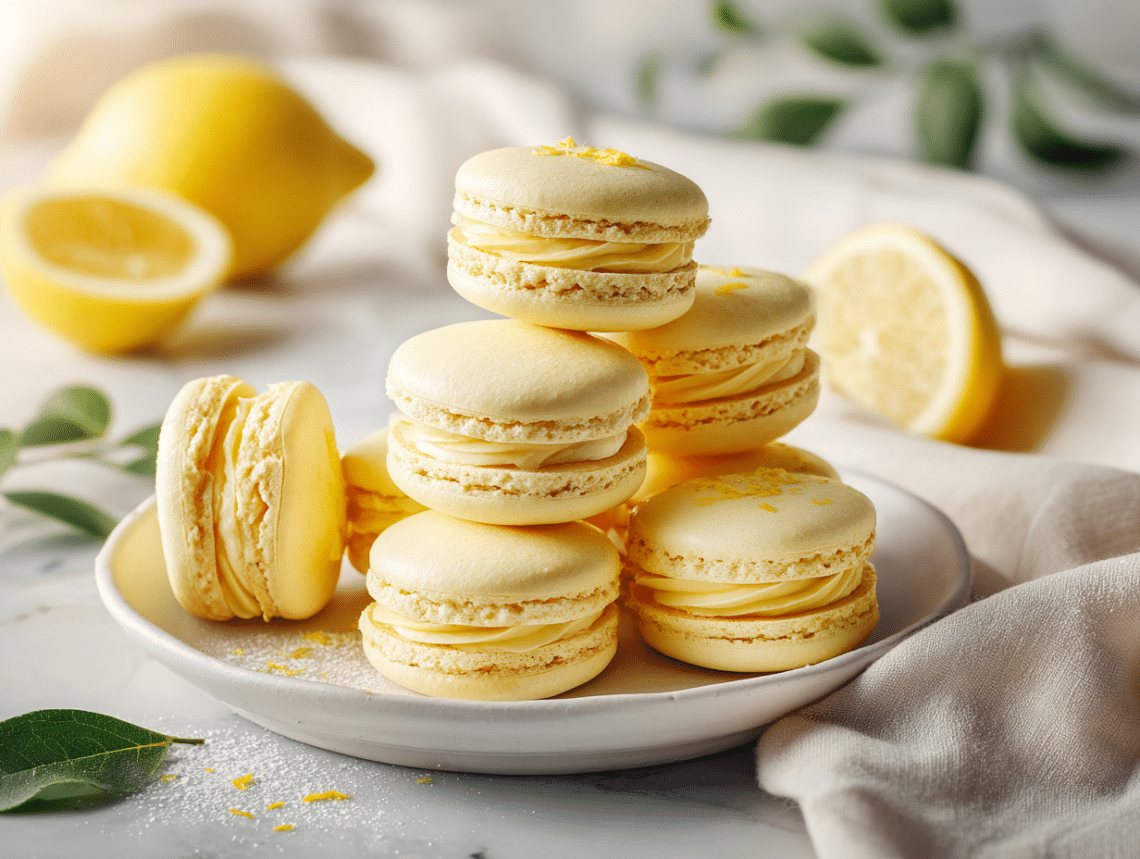
These lemon macarons use the Italian meringue method and a butter-enriched lemon ganache thickened with gelatin and almond flour. The shells soften fully after 24 hours in the fridge, which means you can make them a day ahead and they’ll actually be better when you serve them. If macarons have felt out of reach before, this is a genuinely manageable place to start.
What makes this version work
Two things carry this recipe. First, the Italian meringue — made by streaming hot sugar syrup into the egg whites rather than just whipping them plain — is far more stable than a French meringue. It holds up during folding, which means you have more time to get the batter to the right consistency without accidentally deflating it. Second, the ganache uses both gelatin and almond flour as thickeners alongside the butter. That combination gives the filling enough body to pipe cleanly and stay put inside the shell, but it stays soft rather than stiff. The lemon juice in the filling also speeds up how quickly the shells soften, so you get that chewy texture closer to the 24-hour mark than you would with a chocolate filling.
Troubleshooting
- Shells crack on top: The skin didn’t form long enough before baking. Humidity slows this down — on a humid day, give them a full 25 minutes or until the surface is completely matte and dry to the touch.
- No feet forming: Your oven is likely too hot, or the batter was over-folded and too loose. Bake one tray first as a test before committing all your shells.
- Shells stick to the parchment: They need more time in the oven, not less. Underbaked shells always stick. Add 2 minutes and test again.
- Ganache is too runny to pipe: It needs longer in the fridge. Give it at least 3 hours, and if it’s still soft, another hour usually fixes it. Don’t try to rush it at room temperature.
- Macarons taste hollow or dry after assembly: Not enough ganache was piped. The filling should reach the edge of the shell — it looks like too much but it’s what softens the cookie properly during the rest period.
Substitutions that actually work
- Gelatin sheet vs. powdered: Either works here. One sheet equals about 1 teaspoon powdered. Bloom powdered gelatin in 1 tablespoon of cold water for 5 minutes before adding.
- Gel food colouring: Stick with gel, not liquid. Liquid colouring adds too much moisture to the batter and can cause spreading. Skip the colouring entirely if you prefer — it doesn’t affect flavour or texture, and plain ivory shells look fine.
- Almond flour in the ganache: This is an unusual addition that thickens the filling and gives it a slightly nutty undertone. Don’t swap it for cornstarch — the texture won’t be the same. If there’s a nut allergy in the house, this recipe isn’t easily adapted and a different filling would be a better route.
Make-ahead notes
The ganache can be made up to 3 days ahead and kept covered in the fridge — just re-whip it briefly if it firms up too much to pipe. Baked, unfilled shells keep well in an airtight container at room temperature for up to 2 days, or freeze flat for up to 6 weeks; thaw them at room temperature for 30 minutes before filling. Once assembled, the macarons need at least 24 hours in the fridge before serving, and they’re at their best between 24 and 48 hours. After 3 days assembled, the shells start to get too soft and the ganache can weep slightly, so don’t push it much beyond that.
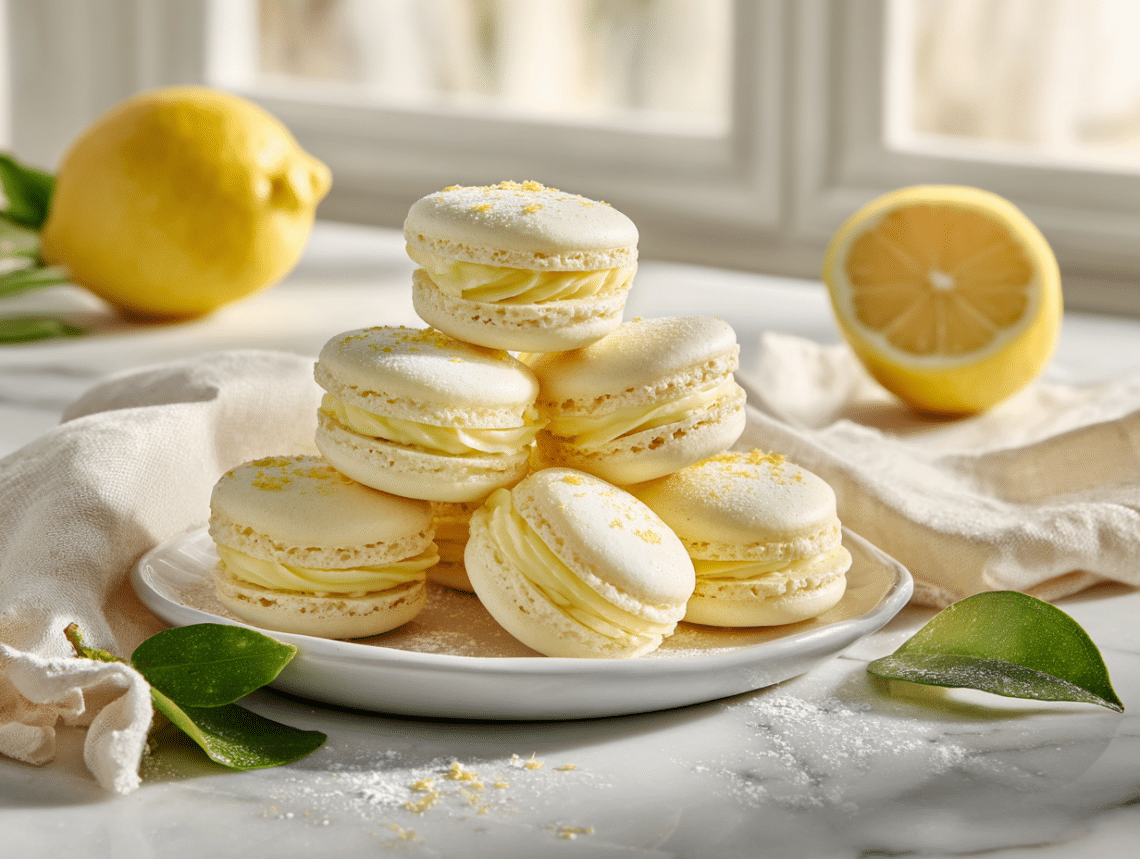
Soft Lemon Macarons with Lemon Butter Ganache

Ingredients
Lemon Macaron Ingredients
- 7 oz almond flour finely ground and sifted
- 7 oz confectioners’ sugar / powdered sugar sifted
- 7 oz granulated sugar divided: 160g for syrup, 40g for egg whites
- 4 large egg whites total, divided (2 for meringue, 2 for TPT)
- 3⅓ tbsp water for sugar syrup
- 2-3 drops yellow gel food colouring
Lemon Ganache Ingredients
- 1 sheet gelatin or 1 tsp powdered gelatin bloomed in cold water
- 3 large eggs whole eggs
- ⅔ cup granulated sugar
- 9 tbsp lemon juice fresh
- 1 tbsp lemon zest from 1 medium lemon
- 13 tbsp unsalted butter cubed, room temperature
- ¼ cup almond flour
Instructions
Lemon Macaron Instructions
- Put the almond flour and confectioners’ sugar together in a food processor or blender and mix. This is called the tant pour tant (TPT) because there is as much sugar as almond powder. Reserve in a bowl.
- In a pot, pour 160 grams of sugar into powder; add the water but do not mix. Bring to a temperature of 115°C / 239°F (soft ball stage). Do not stir the syrup — just swirl the pot gently if needed.
- Meanwhile, beat the egg whites with the remaining sugar until stiff (the mix should be consistent but not too much, avoid the beaten egg whites forming a beak).
- Continue whipping until the meringue cools to about 40°C / 104°F — the bowl should feel just barely warm to the touch. The meringue should be glossy and hold stiff peaks.
- At that moment, add the remaining egg whites (the unbeaten ones) and the colorant to the TPT. Mix gently. Add a third of the meringue to make it more supple. Mix gently and add the rest of the meringue. Mix softly. The final TPT should be soft but not liquid (it has to do a ribbon)!
- Fill a pastry bag with a piping nozzle of size 6 or 8 (diameter in millimeters). Pipe small rounds onto parchment paper. Space the shells (coques) by 2 centimeters at least. Let the piped shells rest at room temperature for 15 to 20 minutes, or until a dry skin forms on the surface and they no longer stick to your finger when lightly touched.
- Meanwhile, preheat the oven to 150°C / 300°F (140°C / 285°F fan-forced).
- Once the shells have developed a skin, bake for 12 to 15 minutes on the middle rack, one tray at a time. The macarons are done when they have formed feet at the base and feel firm when gently wiggled. Let cool completely on the baking sheet before peeling off the parchment.
Lemon Ganache Instructions
- Put the gelatin in cold water.
- In a saucepan, stir sugar and eggs.
- Add the lemon juice and constantly whisk at a first simmer over low-medium heat.
- Stir in the gelatin and lemon zest. Whisk for 1 minute.
- Pour the lemon cream over the butter. Using a food mixer, blend the cream and butter for 1 minute.
- Stir in the almond flour and mix gently using a spatula.
- Keep in the fridge for at least a couple of hours.
- When it is cold and consistent, fill a pastry bag with the ganache.
- Pipe the ganache on the center of the shell and top with another one (if you don’t put enough ganache, the shells will dry!)
- Refrigerate the assembled macarons in an airtight container for at least 24 hours — ideally 48 hours for a butter-based ganache. This resting period allows the moisture from the ganache to soften the shells, creating the signature chewy texture.
Nutrition
Common questions
Can I make these without a stand mixer?
Yes, but a hand mixer is the minimum — you cannot whip the Italian meringue by hand fast enough to get the right structure. You need to be streaming hot syrup into the egg whites while they’re beating continuously, so two free hands and a running mixer at the same time is the practical requirement.
Why do my macaron shells come out hollow inside?
Hollow shells are almost always caused by over-folding the batter, which knocks out too much air before baking. The batter should fall off the spatula in a thick, slow ribbon — if it flows like pancake batter, it’s gone too far and the batch won’t recover.
Can I freeze the finished macarons?
Yes, assembled macarons freeze well for up to 4 weeks in a single layer in an airtight container. Thaw them overnight in the fridge still in the container, then let them sit at room temperature for 15 minutes before serving — condensation on the shells is normal and disappears quickly.
Try these next
- Lemon curd from scratch
- French chocolate mousse
- Zesty French lemon cake
- Elegant pavlova with fresh berries