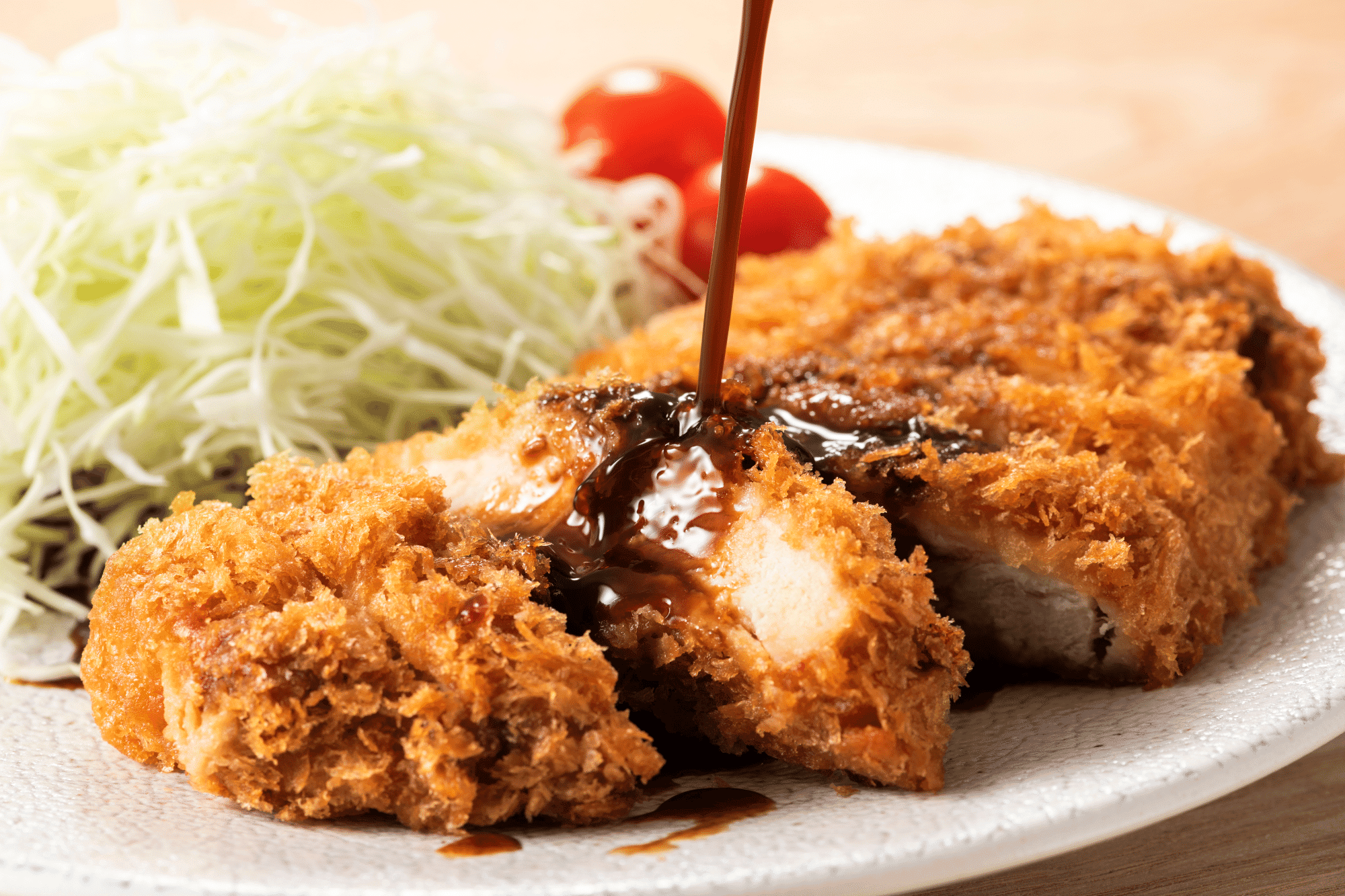

Pork tonkatsu is one of those dishes that sounds impressive but is surprisingly simple to make at home. A thick pork loin cutlet, double-coated in crispy panko breadcrumbs, shallow-fried until perfectly golden, and served with a tangy-sweet homemade tonkatsu sauce — it’s Japanese comfort food at its finest.
I adapted this recipe after my mum shared her memories of eating tonkatsu in Japan, where she and my dad lived for a time. She knew exactly what the real deal should taste like, and this version comes remarkably close. The secret is in the double breading technique — dipping the pork through egg and panko twice creates that signature shattering crunch that makes tonkatsu so irresistible.
Everything you need is available at the supermarket, the sauce comes together in five minutes on the stovetop, and the whole meal is on the table in half an hour. If you’ve been ordering katsu from takeaway menus and wondering whether you could nail it at home — this is your recipe.
Pork Tonkatsu: Crispy Japanese Cutlet Recipe
Ingredients
Sauce Ingredients
- 3 tablespoons tomato ketchup
- 2 tablespoons sake
- 1 tablespoon Worcestershire sauce
- 1 tablespoon soy sauce
- 1 clove garlic minced (about 1 tsp)
- 1 tablespoon fresh ginger finely grated (about 2.5cm piece)
- 1 teaspoon Dijon mustard
- 1 teaspoon mirin
- 2 teaspoons white caster sugar
Pork Ingredients
- 2 pieces boneless pork loin steaks approximately 150g each, pounded to 1cm thickness
- 1 cup panko breadcrumbs
- 1 medium egg whisked
- ¼ cup plain flour seasoned with 1/2 tsp salt and 1/4 tsp black pepper
- ¼ cup neutral oil vegetable or sunflower oil, plus more as needed
- 1 serving shredded white cabbage for serving
- 2 stalks spring onions thinly sliced, for serving
- 1 serving steamed rice for serving
Instructions
Sauce Instructions
- Combine all the ingredients together in a small saucepan and simmer on low heat for about 5 minutes, until quite thick and sticky. Then sieve it to remove the pieces of garlic and ginger and leave to cool to about room temperature. It should taste a bit like a Japanese version of BBQ sauce.
Pork Instructions
- Trim any excess fat from the pork loin steaks. Place each steak between two sheets of cling film and pound with a meat mallet or rolling pin to an even 1cm (½-inch) thickness. Set up a breading station with three shallow dishes: seasoned flour in the first, beaten egg in the second, and panko breadcrumbs in the third.
- Dip each pork loin into the seasoned flour, egg and breadcrumbs and then repeat with the egg and breadcrumbs so that the pork is well-coated.
- Pour enough oil into a heavy-based frying pan to come about 1cm (½ inch) up the sides. Heat over medium-high heat to 170–180°C / 340–355°F — if you don't have a thermometer, drop a panko crumb into the oil; it should sizzle immediately and turn golden within 15 seconds. Carefully lay the breaded pork into the hot oil and fry for 3–4 minutes per side until deep golden brown and cooked through (internal temperature of 63°C / 145°F). Briefly hold each cutlet on its side with tongs to crisp any pale edges.
- Transfer the cooked cutlets to a wire rack set over a plate and let rest for 2 minutes — this keeps the bottom crispy while draining excess oil. Slice each cutlet into 1.5cm (½-inch) strips, keeping the cutlet shape intact. Serve on a plate alongside a generous mound of finely shredded white cabbage, sliced spring onions, steamed rice, and a generous drizzle of the homemade tonkatsu sauce.
Nutrition
What Makes This Pork Tonkatsu Special
The difference between mediocre tonkatsu and the real thing comes down to three details: the double-coating technique, the sauce, and how you handle the oil.
Most Western recipes dip the pork through flour, egg, and breadcrumbs once. This recipe takes the cutlet back through the egg and panko a second time, building a thicker, more shatter-prone crust that stays crispy even after slicing. It’s a small extra step that completely transforms the texture.
The homemade tonkatsu sauce is another game-changer. Commercial bottled tonkatsu sauce is convenient, but this version — made from ketchup, sake, Worcestershire sauce, soy sauce, garlic, ginger, mustard, and mirin — has a depth and brightness that no bottle can match. Straining it after simmering gives you that signature smooth, glossy consistency.
Finally, shallow-frying rather than deep-frying means you need far less oil, the pork cooks more gently, and cleanup is simple. Keeping the oil at the right temperature (170-180°C) is the key to a golden crust without greasiness.
Equipment You’ll Need
- 10-inch / 26cm heavy-based frying pan or skillet — A heavy base holds heat steadily during frying, preventing the oil temperature from dropping when the pork goes in. This is what gives you an evenly golden crust instead of pale, greasy patches.
- Small saucepan — Essential for simmering the tonkatsu sauce. A small pan keeps the sauce at the right depth so it reduces evenly rather than scorching on a thin layer.
- Fine-mesh sieve — Used to strain the garlic and ginger pieces from the sauce after simmering, giving you that smooth, pourable consistency authentic tonkatsu sauce is known for.
- Meat mallet or rolling pin — Pounding the pork to an even thickness ensures it cooks uniformly. Without this step, thin edges overcook and dry out before the thick centre reaches a safe temperature.
- Three shallow dishes or plates — For setting up an efficient breading station. Having flour, egg, and panko in separate dishes keeps the double-coating process quick and mess-free.
- Instant-read thermometer (nice-to-have) — Takes the guesswork out of checking oil temperature and ensuring the pork reaches 63°C / 145°F internally. Especially useful if you’re new to shallow-frying.
- Wire cooling rack (nice-to-have) — Resting the fried cutlets on a rack rather than kitchen paper keeps the bottom crust crispy instead of steaming it soggy.
Tips for Best Results
- Pound the pork evenly. An even 1cm (½-inch) thickness means the pork cooks through in the same time the panko turns golden. Uneven cutlets lead to burnt crumbs or raw centres.
- Press the panko on firmly. After the second coating of egg and breadcrumbs, press the panko into the surface with your palms. Loose crumbs fall off in the oil and burn, making the oil dirty and giving the cutlet a patchy appearance.
- Use one dry hand and one wet hand. Designate one hand for the dry ingredients (flour, panko) and the other for the wet (egg). This prevents clumpy fingers that make breading a frustrating mess.
- Don’t crowd the pan. Fry one cutlet at a time if your pan is smaller than 26cm. Adding too much cold meat drops the oil temperature and results in a soggy, oil-logged coating.
- Let the sauce cool before serving. Tonkatsu sauce thickens as it cools and the flavours meld together. Serving it piping hot makes it too thin and the individual ingredients taste disjointed.
Substitutions and Variations
- Chicken katsu: Swap the pork loin for boneless, skinless chicken breast, pounded to the same thickness. Cook times remain the same — just verify the internal temperature reaches 74°C / 165°F.
- Gluten-free tonkatsu: Use rice flour instead of plain flour and gluten-free panko breadcrumbs. Ensure your soy sauce is tamari (gluten-free) and check the Worcestershire sauce label.
- No sake? Substitute dry white wine or dry sherry in the sauce. In a pinch, use rice vinegar mixed with a little water, though the flavour will be slightly sharper.
- No mirin? Mix 1 teaspoon of rice vinegar with ½ teaspoon of sugar as a substitute.
- Katsu curry: Skip the tonkatsu sauce entirely and serve the sliced cutlet over rice with a Japanese curry sauce for a classic katsu curry.
- Katsu sandwich (katsu sando): Layer sliced tonkatsu between thick white milk bread with tonkatsu sauce and shredded cabbage for the famous Japanese convenience store sandwich.
Storage and Reheating
- Fridge: Store cooked tonkatsu in an airtight container for up to 2 days. The coating will soften in the fridge — this is normal and expected.
- Reheating: Place on a wire rack set over a baking tray and reheat at 190°C / 375°F for 8-10 minutes until the crust crisps back up and the pork is heated through. Avoid the microwave — it turns the panko coating soft and chewy.
- Freezer (uncooked): Bread the cutlets but don’t fry them. Place on a parchment-lined tray, freeze until solid (about 2 hours), then transfer to a freezer bag. Keeps for up to 1 month. Fry directly from frozen, adding 1-2 extra minutes per side and checking the internal temperature.
- Sauce storage: The tonkatsu sauce keeps in a sealed jar in the fridge for up to 5 days. It actually tastes better the next day as the flavours marry together.
What to Serve With This
- Steamed Japanese short-grain rice — the classic and essential companion. The sticky rice soaks up the tonkatsu sauce beautifully.
- Finely shredded raw white cabbage — this isn’t optional in Japan. The fresh, crisp cabbage cuts through the richness of the fried pork. Shred it as finely as you can.
- Pickled ginger (gari) or pickled daikon — a sharp, vinegary contrast that cleanses the palate between bites.
- Miso soup — a bowl of simple miso soup with tofu and wakame seaweed rounds out the meal into a proper Japanese set meal (teishoku).
- Japanese potato salad — a creamy, slightly sweet side dish that’s a staple alongside tonkatsu in many Japanese restaurants.
Frequently Asked Questions
What cut of pork is best for tonkatsu?
Boneless pork loin (called rosu in Japanese) is the traditional choice and gives you a lean, clean-flavoured cutlet. For a richer, more tender result, use pork fillet or even a boneless pork chop. In Japan, you’ll also find hire katsu made from pork tenderloin, which is leaner but very tender. Whichever cut you use, pound it to an even 1cm (½-inch) thickness.
Why do you coat the pork twice?
The double coating — flour, egg, panko, then egg and panko again — creates a thicker, more uniform crust that shatters when you bite through it. A single coating tends to be thinner and can develop bare spots where the panko fell off during frying. The second pass fills in any gaps and builds that signature crunch that defines great tonkatsu.
Can I deep-fry instead of shallow-fry?
Absolutely. Deep-frying at 170-180°C / 340-355°F for about 4-5 minutes total (flipping once) gives you an even more uniform golden colour. You’ll need significantly more oil — enough to fully submerge the cutlet. Shallow-frying works brilliantly with less waste and easier cleanup, which is why this recipe uses that method.
How do I know when the pork is cooked through?
An instant-read thermometer is the most reliable method — you’re looking for 63°C / 145°F at the thickest point. Without a thermometer, the cutlet should feel firm when pressed (not squishy) and the juices should run clear if you make a small cut. If you pounded the pork to an even 1cm thickness, 3-4 minutes per side at the correct oil temperature will cook it through.
What’s the difference between tonkatsu sauce and regular brown sauce?
Tonkatsu sauce is a Japanese condiment that’s fruitier, sweeter, and more complex than British brown sauce or American steak sauce. Commercial versions (like Bull-Dog brand) are made from fruit and vegetable purées, vinegar, and spices. This homemade version uses ketchup, sake, Worcestershire sauce, soy sauce, garlic, ginger, mustard, and mirin to build a similar sweet-tangy-umami profile from scratch.
Can I make this with chicken instead?
Yes — chicken katsu uses the exact same breading and frying technique. Use boneless, skinless chicken breast pounded to an even thickness. The only difference is that chicken must reach a higher internal temperature of 74°C / 165°F for food safety, so you may need an extra minute per side.
A Brief History of Tonkatsu
Tonkatsu is a fascinating example of Japan’s talent for adopting foreign dishes and making them unmistakably Japanese. The dish evolved from European-style breaded cutlets (cotoletta in Italian, Schnitzel in German) that arrived in Japan during the Meiji era in the late 1800s, when the country opened its borders to Western influence.
Originally called katsuretsu (a Japanese rendering of “cutlet”), the dish was initially made with beef and served with a knife and fork in upscale Western-style restaurants in Tokyo. By the 1930s, cooks had switched to pork, adopted panko breadcrumbs for a lighter and crunchier coating, began slicing the cutlet into strips for chopstick-friendly eating, and paired it with shredded cabbage, rice, and miso soup. The dish was renamed tonkatsu — “ton” meaning pork and “katsu” from cutlet — and became firmly embedded in everyday Japanese cuisine.
Today tonkatsu is everywhere in Japan, from dedicated tonkatsu-ya restaurants to convenience store sandwiches, and the word katsu has taken on a life of its own — it’s a homophone for the Japanese word meaning “to win,” so tonkatsu is a popular pre-exam good luck meal for students across the country.
If you give this pork tonkatsu a try, I’d love to hear how it turned out — drop a star rating and leave a comment below to let me know!