





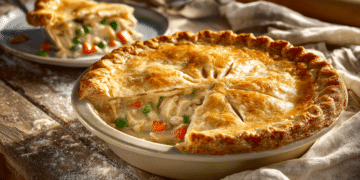










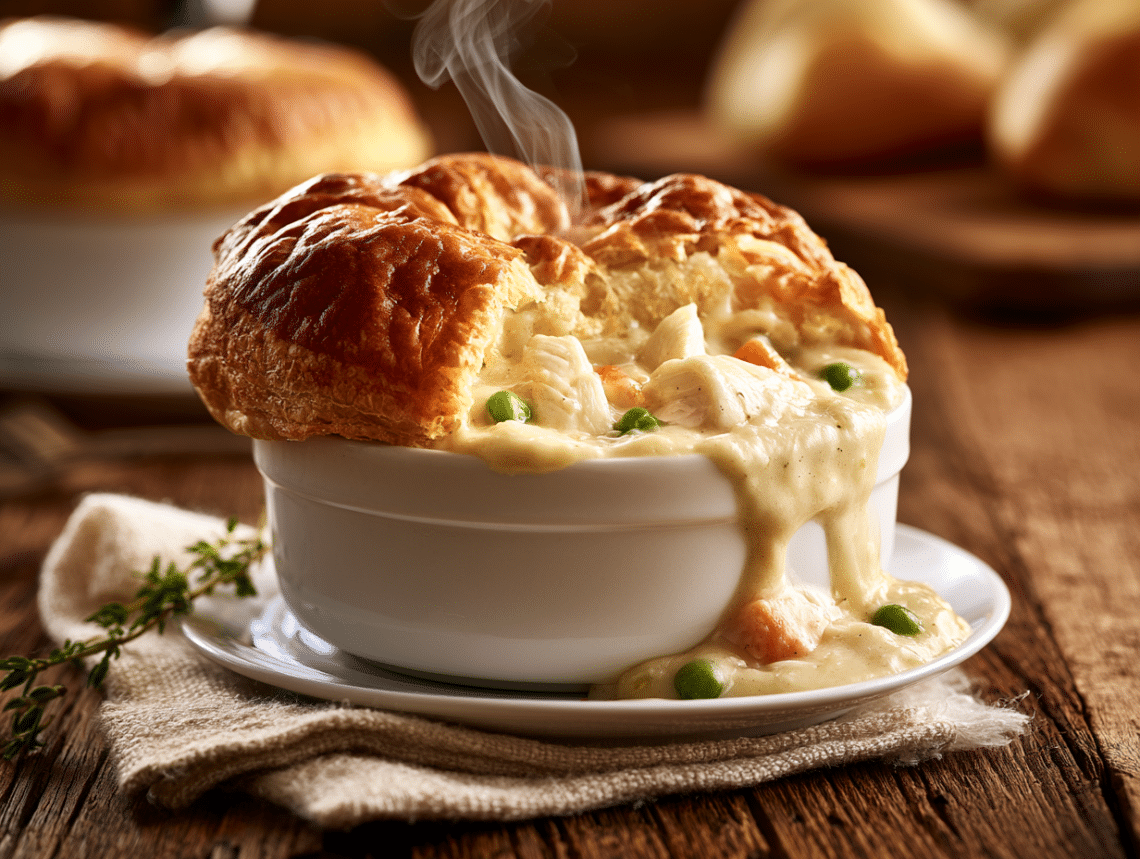
This is a chicken pot pie made in four individual dishes, with the puff pastry baked separately so it stays crisp instead of going soft against the filling. The cream sauce is built on a proper butter-flour roux with sautéed onion and garlic, which gives it more body and flavor than a shortcut sauce. If you want a filling dinner that can be mostly finished before guests arrive, this is a practical choice.
Why this recipe works
The single most important technique here is baking the puff pastry rounds on their own sheet pan at 400°F before they ever touch the filling. Pastry baked directly on a wet filling steams from below and turns dense — baking it separately means it puffs and crisps all the way through. The second thing that matters is cooking the roux for a full 2–3 minutes before adding any liquid. Raw flour has a starchy, pasty taste; a light blonde roux doesn’t. That extra time on the heat is what makes the finished sauce taste clean and rich rather than thick and floury.
Storage and reheating
Store the filling and the pastry lids separately — this is the key to keeping leftovers worth eating. The filling keeps in a sealed container in the fridge for up to 3 days. The baked pastry rounds keep at room temperature in an airtight container for up to 2 days; refrigerating them makes them go soft. To reheat, warm the filling in a small saucepan over medium-low heat, stirring occasionally, until bubbling — add a splash of cream or milk if it has thickened too much. Re-crisp the pastry in a 375°F oven for 5–7 minutes directly on the oven rack. The filling also freezes well for up to 2 months; thaw overnight in the fridge before reheating. Skip freezing the baked pastry — it won’t recover its texture.
If something goes sideways
- Sauce is lumpy: This usually means the cream was added too fast or the roux was too hot. Take the pan off the heat, switch to a whisk, and beat firmly — most lumps will smooth out. If not, pour the sauce through a fine mesh strainer and press through with a spatula.
- Filling is too thin: Let it simmer uncovered for a few extra minutes, stirring often. It should coat the back of a spoon before you add the chicken and vegetables. If it’s still loose, mix 1 teaspoon of softened butter with 1 teaspoon of flour, stir it into the simmering sauce, and cook for another 2 minutes.
- Pastry rounds shrink or lose their shape in the oven: Puff pastry needs to be cold when it goes into the oven — if it warmed up too much while you were cutting it, the butter layers melted before baking. Chill the cut rounds on the baking sheet for 15 minutes before brushing with egg wash and baking. Skip the garnish of fresh herbs on top of the pastry before baking — not worth the extra dish, and they burn before the pastry is done.
- Filling tastes flat: Chicken base varies a lot by brand. Taste the sauce before you add the chicken and vegetables, and adjust with a little more dissolved chicken base or a pinch of seasoned salt. Nutmeg is optional in the recipe, but even a small amount does real work here — it’s worth adding.
- Pastry lid won’t sit flat on the dish: The rounds need to be cut about ½ inch larger than the dish opening so they rest on the rim rather than falling in. If yours are too small, just lay them on top of the filled dish — they’ll still look fine and taste exactly the same.
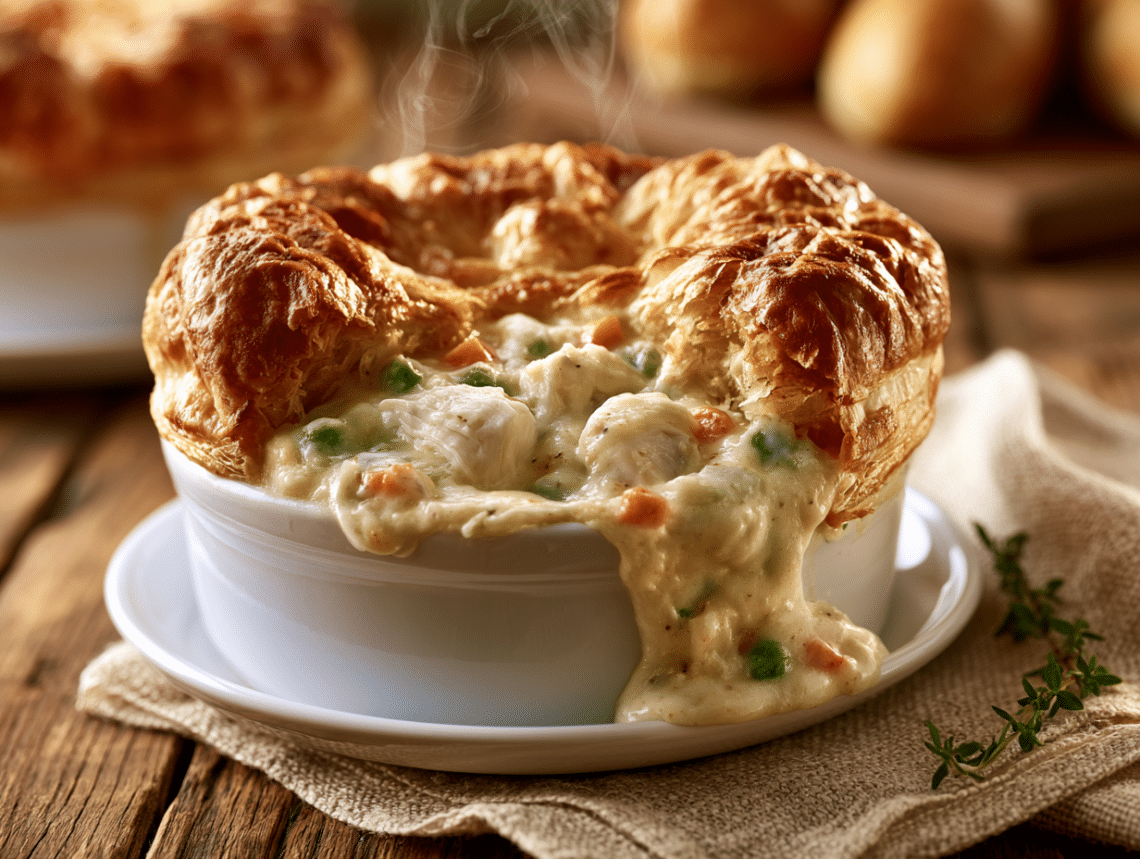
Creamy Chicken Pot Pie with Puff Pastry

Ingredients
- 2 sheets frozen puff pastry about 10x10 inches (25x25cm) each, thawed
- 1 tsp chicken base dissolved in 60ml warm water
- 1 tbsp garlic minced
- 4 medium chicken breast halves cooked and chopped
- 1 medium egg beaten with 1 tsp water for egg wash
- 2 tbsp cooking oil neutral oil
- 2 cups heavy cream or 1 cup cream + 1 cup milk
- 1 cup green peas frozen and thawed or cooked
- ⅓ cup butter unsalted
- ⅔ cup all-purpose flour for roux
- ½ medium yellow onion minced
- 1 cup carrots diced and cooked
- 1 pinch black pepper to taste
- 1 pinch seasoned salt to taste
- ⅛ tsp nutmeg fresh grated, optional
Instructions
- Preheat the oven to 350°F / 175°C (180°C fan-forced).
- Using a rolling pin, roll each pastry sheet slightly if needed. Cut into circles approximately ½ inch (1cm) larger than the diameter of your oven-proof dishes.
- Place the pastry circles on a parchment-lined baking sheet, brush with egg wash, and bake at 400°F / 200°C (200°C fan-forced) for 15-18 minutes or until deeply golden brown, puffed, and crisp. Set aside.
- Season the chicken with seasoned salt and black pepper.
- Sauté the chicken in the oil in a large skillet over medium-high heat for 5-7 minutes per side, or until the internal temperature reaches 165°F / 74°C and the juices run clear.
- Chop the cooked chicken into ½ or 1-inch chunks.
- Melt the butter in a pot, then sauté the minced onion for 3-4 minutes until softened and translucent. Add the minced garlic and cook for 30 seconds until fragrant.
- Add the flour slowly, stirring constantly to form a roux. Cook for 2-3 minutes until it thickens and turns a light blonde color.
- Add the cream slowly, stirring constantly.
- Add the dissolved chicken base and stir, then simmer for 2-3 minutes until the sauce is thick enough to coat the back of a spoon.
- Stir in the chicken, peas, carrot, and a pinch of nutmeg if liked.
- Spoon the chicken mixture into 4 oven-proof dishes and top each with one of the baked pastry lids.
- Bake at 350°F / 175°C (180°C fan-forced) for 5-10 minutes until the filling is bubbling around the edges. Serve right away.
Nutrition
Frequently asked questions
Can I make this ahead of time?
Yes — the filling can be made up to 2 days in advance and refrigerated. The pastry rounds can be baked the day before and kept in an airtight container at room temperature. When you’re ready to serve, reheat the filling on the stovetop, re-crisp the pastry in a hot oven for 5–7 minutes, then assemble and do the short final bake as directed.
Can I use rotisserie chicken instead of cooking the chicken breasts from scratch?
Yes, rotisserie chicken works well and cuts prep time significantly. Use about 3 cups of chopped cooked chicken and skip the sautéing step entirely — just stir it into the finished sauce with the peas and carrots.
What size dishes do I need, and can I use something I already own?
You need four oven-safe dishes with a capacity of roughly 12–16 oz each — standard soup crocks, large ramekins, or small casserole dishes all work. The main requirement is that they’re oven-safe and wide enough that the pastry round can rest across the top without sinking into the filling.
If you liked this one
- Hearty Shepherd’s Pie
- Elegant Chicken Marsala with Mushrooms
- Creamy New England Clam Chowder
- Sweet Corn Chowder