

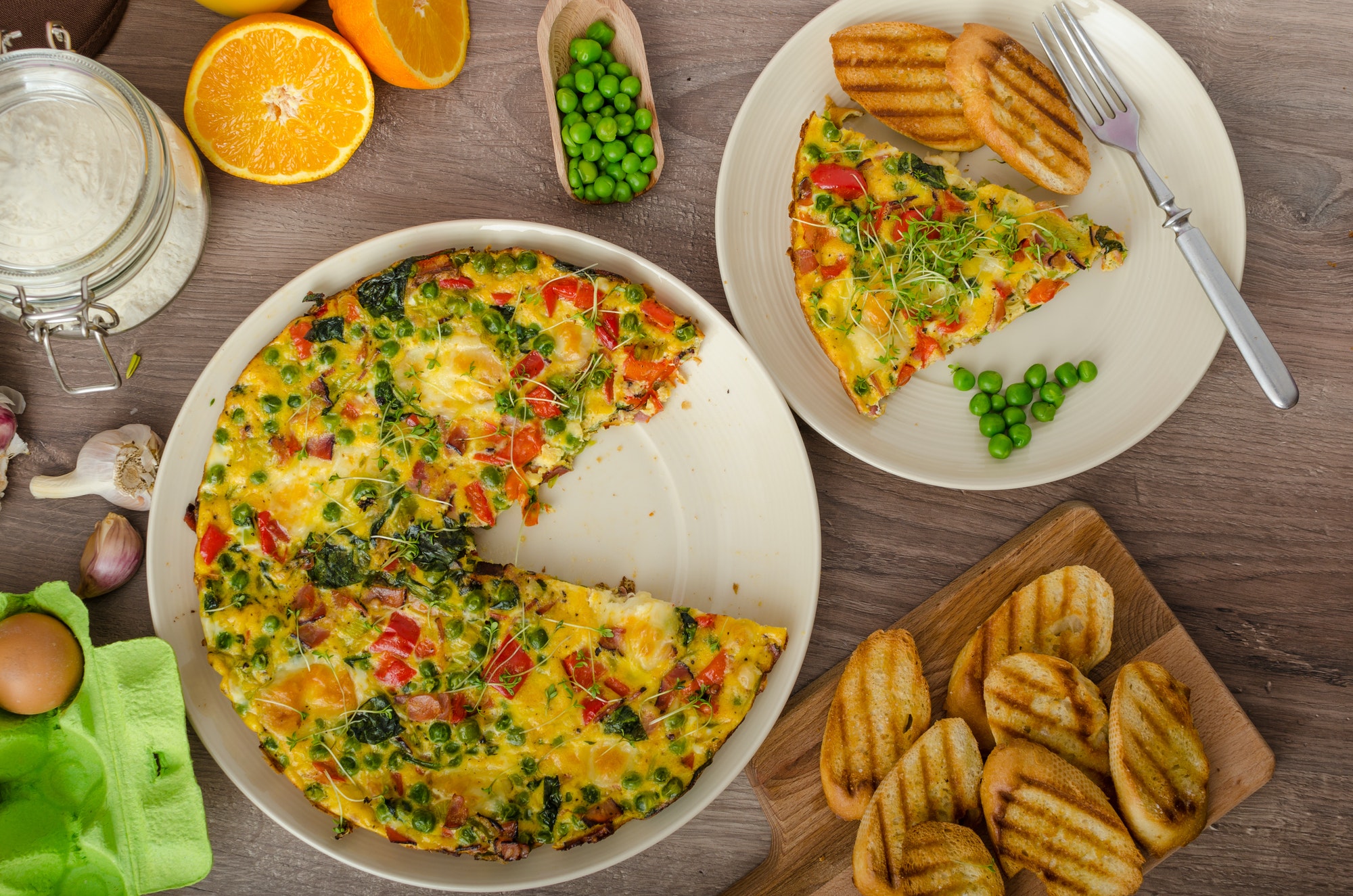
This veggie frittata is one of those recipes I come back to constantly because it practically makes itself from whatever I have in the fridge. Half a bell pepper, some leftover pasta from last night, a handful of spinach — it all goes in.
What makes this one stand out is the lemon zest. It sounds like a small detail, but it lifts the entire dish and keeps it from tasting heavy or one-note. Paired with fresh thyme and parsley, you get a frittata that tastes bright and herby rather than just eggy.
The method is classic Italian — start on the stovetop, finish in the oven. You get a beautifully set centre with golden edges and a melted cheese top that makes the whole thing feel indulgent even though it’s mostly vegetables and eggs.
Whether you serve it for breakfast, brunch, or a quick weeknight dinner with a simple green salad, this easy veggie frittata is ready in 30 minutes and never disappoints.
Easy Veggie Frittata with Lemon and Fresh Herbs
Ingredients
- ½ piece red bell pepper finely diced
- ½ medium yellow onion finely diced
- ½ cup leftover cooked pasta or cooked potatoes diced if using potatoes
- 1 cup fresh spinach roughly chopped
- 1 teaspoon fresh thyme or ½ teaspoon dry thyme
- 1 tablespoon fresh parsley finely chopped
- ⅓ cup shredded mozzarella or Gruyère cheese
- 5 large eggs
- 1 tablespoon lemon zest from 1 lemon
- 4 tablespoons extra-virgin olive oil divided
- ½ teaspoon fine sea salt plus more to taste
- ¼ teaspoon black pepper freshly ground
Instructions
- Preheat oven to 350°F / 175°C (180°C fan-forced). Position an oven rack in the upper third of the oven, one position below the top.
- Mix the eggs, lemon zest, thyme, and parsley in a medium bowl. Add salt and pepper and set aside.
- Place a 10-inch (25cm) oven-safe non-stick skillet on medium-high heat. Add 2 tablespoons of olive oil, then add the diced onion and bell pepper. Cook, stirring occasionally, for 3-4 minutes until softened. Add the spinach and stir until just wilted, about 1 minute. Season with a pinch of salt and pepper.
- Add the pasta and the other 2 tablespoons of olive oil. Mix everything around and make sure the pasta is coated in olive oil. Work it in if you’re using long pasta as I did.
- Next, add the eggs and, using a spatula, move the eggs around to get to the bottom of the pan. Lift the sides so the egg liquid can continue to reach the bottom.
- Soon you will see a crust forming on the sides of the pan. When the top of the frittata is no longer very wet, place the skillet in the oven on the upper-third rack and bake for 10 minutes, until the eggs are almost fully set but the centre still has a slight jiggle.
- After 10 minutes, remove the skillet from the oven. The frittata should be puffed slightly and set around the edges with only a small amount of moisture on top.
- Sprinkle the shredded cheese evenly over the top of the frittata. Return the skillet to the oven and bake for 5-7 minutes until the cheese is melted and lightly golden.
- Run a silicone spatula around the edges of the frittata to loosen it. Slide it onto a cutting board or serving plate. Slice into 4 wedges and serve with a simple mixed green salad dressed with a drizzle of olive oil, a squeeze of fresh lemon juice, and a pinch of salt.
Nutrition
What Makes This Veggie Frittata Special
Most frittata recipes play it safe with the same tired combination of whatever vegetables happen to be around. This one has a secret weapon: the zest of an entire lemon. That bright citrus note cuts through the richness of the eggs and olive oil in a way that makes every bite feel lighter and more interesting.
The technique matters too. By starting the frittata on the stovetop and moving the egg mixture around before transferring it to the oven, you get a custard-like interior that’s completely different from the rubbery texture of a frittata that’s been baked from start to finish. The cheese goes on at the very end, so it melts into a golden layer on top rather than sinking into the eggs and disappearing.
It’s also remarkably flexible. Leftover spaghetti, penne, diced potatoes, even cooked rice — whatever starch you have becomes the hearty backbone of the dish.
Equipment You’ll Need
- 10-inch oven-safe non-stick skillet — This is essential. The frittata goes from stovetop to oven, so a regular handle that isn’t oven-safe will be a problem. The non-stick surface is what allows you to slide the finished frittata cleanly onto a plate.
- Medium mixing bowl — For whisking the eggs with the lemon zest, herbs, salt, and pepper before adding them to the pan.
- Silicone spatula — You need to gently push cooked egg toward the centre and tilt the pan so raw egg flows underneath. A silicone spatula does this without scratching your non-stick coating.
- Microplane or fine grater — Essential for getting fine, even lemon zest without any bitter white pith. A coarse grater will give you chunky pieces that don’t distribute evenly.
- Oven mitts — The skillet handle will be extremely hot after 15-17 minutes in the oven. A folded tea towel is not sufficient — use proper oven mitts or a handle cover.
Tips for Best Results
- Don’t skip the egg-moving step. When you first pour the egg mixture into the pan, use your spatula to gently push the edges toward the centre and tilt the pan so uncooked egg flows underneath. This creates layers and prevents a dense, omelette-like texture.
- Use a properly heated pan. The olive oil should shimmer before you add the vegetables. If the pan isn’t hot enough, your onions and peppers will steam instead of sautéing, and you’ll end up with a watery frittata.
- Pat the spinach dry if it’s been washed. Excess water from spinach is the number one cause of a soggy frittata centre.
- Don’t overbake. Pull the frittata from the oven when the centre still has the slightest jiggle — residual heat will finish setting it. An overbaked frittata turns rubbery and dry.
- Let it rest for 2-3 minutes before slicing. This allows the eggs to finish setting and makes for cleaner slices.
Substitutions and Variations
- Starch swap: Replace the pasta with ½ cup of diced cooked potatoes, roasted sweet potato, cooked quinoa, or even day-old bread torn into small pieces for a strata-style frittata.
- Cheese options: Mozzarella gives you the classic melt. Feta crumbled on top adds a salty tang. Gruyère or fontina bring a nuttier, more complex flavour. Goat cheese works beautifully with the lemon zest.
- Greens: Swap spinach for roughly chopped kale (remove the stems first), Swiss chard, or rocket. Kale will need an extra minute of cooking to soften.
- Add protein: Fold in 60g of diced cooked ham, crumbled cooked sausage, or smoked salmon for a heartier version.
- Spice it up: Add ¼ teaspoon of red pepper flakes with the vegetables, or stir a teaspoon of harissa paste into the egg mixture for a North African twist.
- Dairy-free: Omit the cheese entirely — the lemon zest and fresh herbs provide enough flavour to carry the dish without it.
Storage and Reheating
- Fridge: Store leftover frittata slices in an airtight container in the refrigerator for up to 3 days.
- Freezer: Wrap individual slices tightly in cling film, then aluminium foil. Freeze for up to 2 months. Thaw overnight in the refrigerator before reheating.
- Reheating in the oven: Place slices on a baking sheet and warm at 300°F / 150°C for 8-10 minutes. This preserves the texture far better than the microwave.
- Reheating in a skillet: Warm a slice in a dry non-stick skillet over medium-low heat for 3-4 minutes, covering with a lid to heat it through evenly.
- Avoid the microwave if possible — it tends to make frittata rubbery. If you must, use 50% power in 30-second intervals.
What to Serve With This
This veggie frittata is best alongside something fresh and acidic to contrast the rich eggs and cheese.
- Simple green salad — Dressed with olive oil, a squeeze of the lemon you already zested, and flaky salt. This is the author’s recommendation and it’s spot on.
- Roasted cherry tomatoes — Toss halved cherry tomatoes with olive oil and roast at 400°F / 200°C for 15 minutes while the frittata cooks. The sweet, jammy tomatoes are a perfect match.
- Crusty bread — A thick slice of sourdough or ciabatta for mopping up any juices on the plate.
- Fruit salad — For a brunch spread, a bowl of seasonal fruit keeps things light.
- Soup pairing — For a more substantial dinner, serve alongside a simple tomato soup or minestrone.
Frequently Asked Questions
Can I make this veggie frittata without an oven-safe skillet?
Yes, but you’ll need to adjust the method. Cook the frittata entirely on the stovetop over medium-low heat with a lid on the pan. It will take about 10-12 minutes for the top to set. Then slide it onto a plate, place another plate on top, flip it, and slide it back into the pan to brown the other side for 2-3 minutes. It works, but the oven method is more foolproof.
Why did my frittata stick to the pan?
This almost always comes down to not using enough oil or using a skillet that has lost its non-stick coating. Make sure you use the full amount of olive oil called for, and ensure your non-stick pan is in good condition. Running the spatula around the edges immediately after removing it from the oven also helps release it while it’s still hot.
Can I use egg whites only?
You can, but the frittata will be drier and less rich. If you want to reduce the fat, use 3 whole eggs and 4 egg whites instead of 5 whole eggs. This keeps some richness from the yolks while lightening it up. The lemon zest and herbs will still carry the flavour.
How do I know when the frittata is done?
After 10 minutes in the oven, the edges should be set and slightly puffed, and the very centre should have just the slightest jiggle — like set custard, not liquid egg. If it’s still very wet on top, give it another 2-3 minutes. Once you add the cheese and return it to the oven, you’re just melting the cheese, not cooking the egg further.
Can I add meat to this frittata?
Absolutely. Diced cooked ham, crumbled Italian sausage, shredded rotisserie chicken, or even chopped bacon all work well. If using raw meat like sausage or bacon, cook it fully in the skillet first, remove it, cook your vegetables, then add the meat back in before pouring in the egg mixture.
What type of cheese works best?
Any good melting cheese works. Shredded mozzarella is mild and gives you a stretchy melt. Gruyère or fontina add a nuttier depth. Crumbled feta or goat cheese won’t melt into a smooth layer but add wonderful pockets of tangy flavour. For the strongest impact, mix two cheeses — mozzarella for melt and Parmesan for flavour.
The Italian Roots of the Frittata
The frittata is one of Italy’s most practical dishes, born from the simple need to use up whatever was on hand. The word comes from friggere, meaning “to fry,” and unlike its French cousin the omelette — which is folded around a filling — the Italian frittata cooks its ingredients directly into the egg mixture. Historically, it was a working-class staple, made with leftover pasta, stale bread, or whatever vegetables were in season. Every region of Italy has its own version: Naples is famous for the frittata di maccheroni, which uses leftover spaghetti exactly as this recipe does. The addition of lemon zest is a southern Italian touch, commonly found in coastal cooking where lemons grow abundantly. What started as humble cucina povera has become a beloved dish worldwide — proof that the best recipes are often the simplest ones.
If you try this veggie frittata, I’d love to hear how it turned out — leave a star rating and a comment below to let me know!


